Why Are My Shocks and Struts Worn Out in Fountaingrove? What Santa Rosa Drivers Need to Know About Suspension Ride Quality
If your car feels like it’s bouncing over every little bump, nose-diving forward when you hit the brakes, or swaying side to side when you take a curve, your shocks or struts are probably telling you something important. For drivers navigating the hills of Fountaingrove, the winding roads of Bennett Valley, or the steeper grades of Oakmont here in Santa Rosa, worn suspension components aren’t just a comfort issue — they’re a genuine safety concern. The good news is that once you know the signs, the fix is straightforward.
Shocks vs. Struts: What’s the Difference?
A lot of drivers use “shocks” and “struts” interchangeably, but they’re not the same thing. Shock absorbers are standalone dampening devices — they control how much your wheel bounces after hitting a bump. Struts are a structural part of the suspension that also includes a coil spring and provides support to the vehicle’s weight. Not every vehicle has all four — some have struts in front and shocks in rear, some have struts all around. Either way, both do the same fundamental job: keep your tires firmly on the road and your ride controlled.
When either one wears out, the car doesn’t just ride rough. Your tires wear unevenly, your braking distance increases, and your steering feels vague or wandering — none of which you want when you’re descending a Fountaingrove hill or merging onto Highway 101 after a long day.
Why Santa Rosa Terrain Accelerates Suspension Wear
Most suspension wear guidelines are written with flat suburban streets in mind. Santa Rosa isn’t that. The hills in Fountaingrove and Bennett Valley, the older road surfaces through Rincon Valley, and the pothole-prone stretches around Oakmont all put extra cyclic stress on shocks and struts. Every time your wheel drops into a dip or crests a rise, your suspension has to absorb and control that motion. Do that several hundred times a day over a few years, and the internal components of your shocks and struts simply wear down.
Drivers commuting south on 101 toward Rohnert Park, Petaluma, or down toward Marin County also rack up highway miles that compound this wear — especially if the road surface is rough or the commute involves a lot of lane changes and speed variation. That suspension is working the whole time, even when you don’t notice it.
The Warning Signs You Shouldn’t Ignore
Here’s what to pay attention to:
- Excessive bouncing after bumps. Press down on the hood or trunk of your parked car and release. It should settle after one or two bounces. If it keeps going, your shocks are likely worn.
- Nose-diving when braking. The front end dips sharply when you slow down — this is a classic sign of weak front struts.
- Body roll in corners. Your car leans noticeably to the outside when you take a turn or navigate an on-ramp curve.
- Uneven or cupped tire wear. This one sneaks up on people. Worn shocks allow the tire to bounce and scrub unevenly against the road, creating a scalloped pattern across the tread. If your tires look wavy rather than evenly worn, check the suspension first.
- Vibration or pulling at highway speed. If the car wanders or requires constant small steering corrections at 60–70 mph, the shocks may no longer be keeping the tires planted.
- Clunking or knocking sounds over bumps. Sometimes a worn strut mount or a loose shock absorber bushing will clunk. Don’t confuse this with ball joint noise — both deserve attention, but they’re different repairs.
- Visible fluid leaks on the shock body. If you look under the car and see oily residue running down the shock absorber, it’s leaking internally and losing its ability to dampen.
How Long Do Shocks and Struts Actually Last?
There’s no single universal answer — it depends on your vehicle, your driving conditions, and how you use the car. Most manufacturers suggest inspecting shocks and struts around 50,000 miles, with replacement commonly needed somewhere between 50,000 and 100,000 miles. But in Sonoma County, where you’ve got hilly terrain, seasonal potholes after wet winters, and the occasional gravel road out toward Sebastopol or the Russian River Valley, that wear can come earlier.
Here’s the thing: shocks and struts wear gradually. Unlike a brake rotor that suddenly starts squealing or a battery that dies overnight, suspension degradation is slow and easy to miss. You get so used to how the car rides that you stop noticing the change. That’s why periodic inspections matter more than waiting for a dramatic symptom.
At On-Site Auto Repair, we include a suspension check as part of our broader steering and suspension services — we’ll tell you honestly what we see without pushing unnecessary repairs.
What a Proper Shock and Strut Inspection Actually Involves
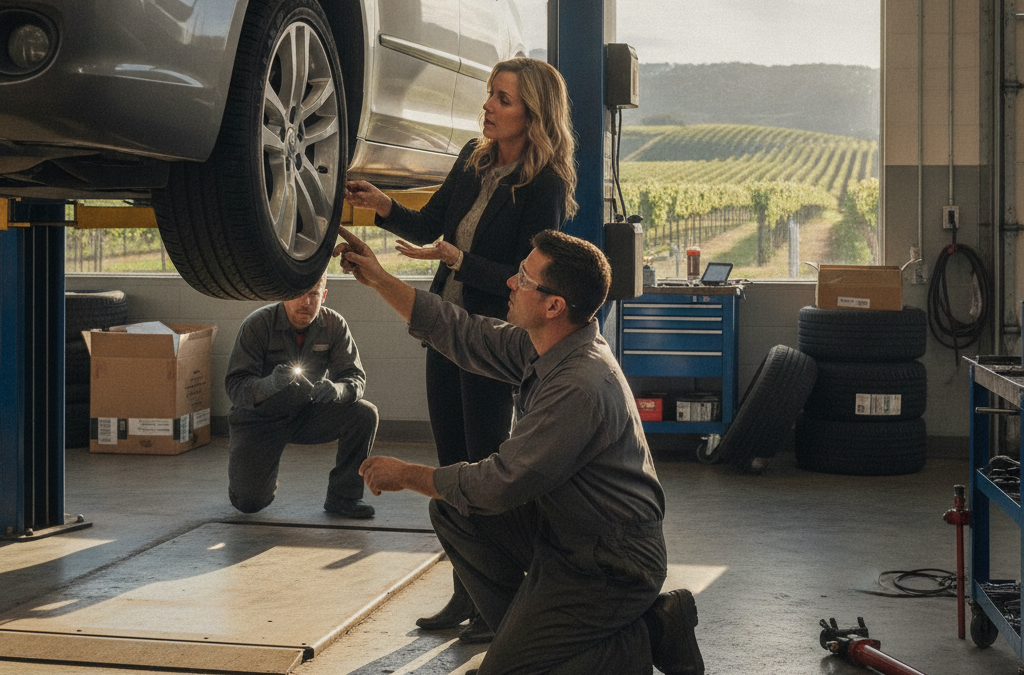
This is an area where the local competitor content we’ve reviewed is surprisingly thin. Most shops mention “suspension inspection” but don’t explain what that actually means for the customer. Here’s what a thorough inspection should include:
- A visual check of each shock or strut for leaks, cracks, or physical damage
- An inspection of strut mounts and upper bearings — these wear out separately from the strut itself and can cause noise even on a vehicle with newer struts
- A bounce test (the informal version) combined with a lift inspection to check for play or looseness in mounting hardware
- A check of the associated hardware: bump stops, dust boots, and coil spring condition if integrated into the strut
- A look at tire wear patterns, which can tell you a lot about what the suspension has been going through
If a shop just glances under the car for thirty seconds and says “you’re fine,” that’s not an inspection. Ask them what they actually checked.
Should You Replace All Four at Once?
Generally, yes — at least in pairs (both fronts or both rears together). If one side is worn enough to need replacement, the other side has had the same mileage and the same road conditions. Replacing only one strut can actually create a handling imbalance that feels worse than before.
Replacing all four at once makes sense when mileage and wear are consistent across the vehicle. Your mechanic should be able to show you what they’re seeing on each corner so you can make an informed call. We never push four-corner replacement just to pad a repair ticket — if only the fronts are due, we’ll tell you that.
What About Alignment After Strut Replacement?
Yes — if you’re replacing struts (particularly front struts), you almost always need a wheel alignment afterward. Struts are part of the geometry that determines how your wheels sit relative to the road. Replace them without realigning and your new struts will wear out faster, and so will your tires. Don’t skip this step to save a few dollars; it’s a false economy.
If you’ve also been dealing with tire wear issues or handling pull, combining strut replacement with an alignment at the same visit is the efficient move.
Preventive Maintenance Keeps Suspension Costs Down
The best way to manage suspension costs long-term is to catch problems early. Shocks and struts that are inspected on a regular schedule and replaced before they fully fail tend to cause less collateral damage — worn shocks that are ignored long enough can stress other suspension components like tie rods and control arm bushings. Our preventive maintenance services include suspension checks as part of the full-vehicle inspection, which is exactly the kind of proactive care that keeps repair bills manageable over time.
Frequently Asked Questions
How do I know if my struts or shocks are the real problem, not something else?
Several things can cause similar symptoms — ball joints, control arm bushings, tie rod ends, and even tire pressure issues can mimic shock or strut wear. That’s why a proper lift inspection matters. A knowledgeable tech can distinguish between these causes and give you a clear answer rather than just guessing at parts.
Is it safe to drive on worn shocks and struts in Santa Rosa?
You can drive on mildly worn shocks for a while without the car falling apart, but your stopping distance increases, your handling becomes less predictable in emergency maneuvers, and your tire wear accelerates. On Santa Rosa’s hillier streets and fast highway on-ramps, that’s a real risk. Don’t put it off indefinitely once you’ve noticed symptoms.
Do I need to replace the coil springs at the same time?
Not necessarily. Coil springs are checked separately. If they’re not cracked or sagging, they can typically be reused. Your mechanic should inspect them as part of the strut service and let you know their condition.
What does strut replacement typically cost?
Costs vary by vehicle make and model, labor time, and whether you need an alignment afterward. Premium vehicles like Lexus or German brands tend to run higher on parts. We recommend getting a written estimate upfront so there are no surprises. We don’t quote specific prices here, but we’ll give you an honest, no-pressure estimate when you contact us.
My car only has 45,000 miles. Can the shocks really be worn?
Mileage is a guide, not a guarantee. Aggressive driving, rough roads, heavy loads, or a vehicle that was already driven hard before you owned it can all shorten suspension life. If you’re noticing symptoms, get it inspected regardless of mileage.
Get an Honest Suspension Assessment in Santa Rosa
If your car doesn’t feel right — whether you’re navigating the curves in Fountaingrove, heading down the grade through Rincon Valley, or just commuting across town — don’t assume it’s something you have to live with. Suspension problems are fixable, and catching them early almost always costs less than waiting.
At On-Site Auto Repair, we’ve been working on shocks, struts, and suspension systems for all makes and models since 2011. We’ll inspect your suspension, tell you honestly what we find, and give you a clear picture of what needs attention now versus what can wait. No upselling, no mystery charges.
Contact us today to schedule your suspension inspection or request a free estimate. We serve drivers throughout Santa Rosa, Rohnert Park, Petaluma, Sebastopol, and all of Sonoma County.