Why Is My Car’s Fuel Injector Dirty or Failing in Petaluma? What Sonoma County Drivers Need to Know About Fuel Injection Problems
If your car has been idling rough, struggling to start on cool Sonoma County mornings, or delivering noticeably worse gas mileage on your Highway 101 commute, there’s a good chance your fuel injectors are trying to tell you something. Dirty or failing fuel injectors are one of the more common — and commonly overlooked — causes of engine performance problems in Petaluma and the surrounding area. The good news is that when caught early, fuel injector issues are usually straightforward to diagnose and fix without breaking the bank.
What Fuel Injectors Actually Do (and Why They Get Dirty)
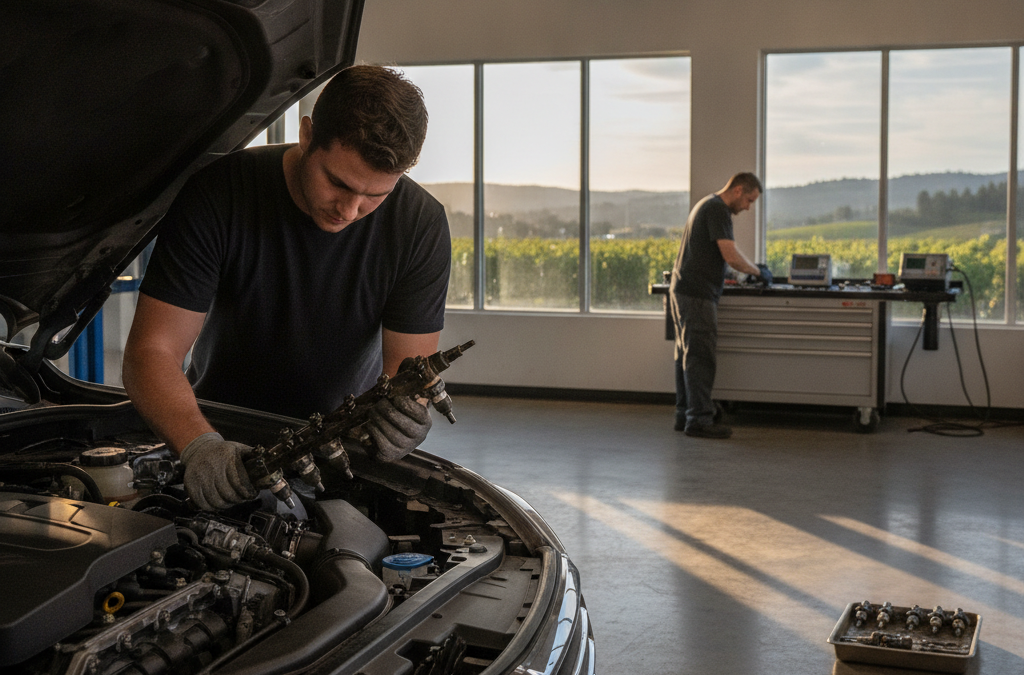
Your fuel injectors are small precision valves that spray a fine mist of gasoline directly into your engine’s combustion chamber or intake port at exactly the right moment and in exactly the right amount. When they’re working correctly, you get smooth acceleration, efficient combustion, and consistent power. When they’re not — whether because they’re clogged with carbon deposits, worn out, or leaking — your engine starts running less like a well-tuned machine and more like it’s working against itself.
Carbon buildup is the most common culprit. Over thousands of miles, fuel residue, engine heat, and combustion byproducts leave deposits on injector tips that restrict fuel flow and disrupt the spray pattern. This is especially common in direct-injection engines — a design used in many modern vehicles including popular Subarus, Volkswagens, and newer Ford and Chevy trucks — where the injector sprays fuel directly into the combustion chamber rather than upstream in the intake. Without intake manifold wash, these engines tend to build up deposits faster.
Short trips around Cotati or Rohnert Park don’t help either. Engines that never fully warm up leave more unburned residue behind, which accelerates deposit buildup over time.
Warning Signs Your Fuel Injectors Need Attention
Fuel injector problems tend to sneak up on you gradually rather than announcing themselves all at once. Here’s what to watch and listen for:
- Rough or uneven idle: If your car shudders or surges while sitting at a stoplight — say, on Lakeville Highway in Petaluma or waiting to merge onto 101 — that’s a classic sign of an injector that isn’t delivering consistent fuel.
- Hard starting: Especially on cold mornings. If you have to crank the engine longer than usual before it catches, restricted injectors may not be providing enough fuel to start combustion properly.
- Poor fuel economy: When injectors are partially clogged, your engine compensates by running rich — using more fuel than it needs. If you’re stopping at the pump more often, it’s worth investigating.
- Hesitation or stumbling under acceleration: If the car feels like it’s briefly cutting out or stumbling when you press the gas, a misfiring cylinder from a restricted injector is a likely cause.
- Check engine light with a misfire code: Codes like P0300 (random misfire) or P030X (cylinder-specific misfire) can absolutely be caused by a dirty or failing injector. An accurate diagnostic scan can help pinpoint whether it’s the injector, the ignition system, or something else entirely.
- Fuel smell: A leaking injector can cause raw fuel odor near the engine — don’t ignore this one.
Cleaning vs. Replacing: What’s the Right Call?
This is where a lot of drivers get steered wrong — either talked into an expensive injector replacement that wasn’t necessary, or sold a $20 bottle of gas-tank additive that doesn’t do much for severely clogged injectors.
Here’s an honest breakdown of your options:
Fuel Injection Cleaning Service
For mildly to moderately clogged injectors, a professional fuel injection cleaning service — where a concentrated cleaning solution is introduced directly into the fuel system under pressure — can restore flow and spray pattern significantly. This is a reasonable first step when symptoms are mild and the vehicle hasn’t been neglected for years. It’s not magic, but when done properly with the right equipment, it genuinely works.
Those pour-in-the-tank additives you see at auto parts stores? They have their place for mild maintenance, but they won’t clear a substantially clogged injector. Same goes for DIY kits — without proper equipment and pressure, you’re mostly hoping for the best.
Injector Replacement
If an injector is leaking, physically damaged, or so fouled that cleaning doesn’t restore proper function, replacement is the right move. Injectors are typically replaced in sets when multiple are affected, since they wear at similar rates. Your mechanic should be able to test each injector’s flow rate and spray pattern before recommending replacement — this is standard practice and something you should ask about if it’s not offered upfront.
At On-Site Auto Repair, we’re not going to recommend replacing parts you don’t need. If cleaning solves the problem, that’s what we’ll do. If it doesn’t, we’ll show you why replacement makes sense before we proceed.
What This Looks Like for Sonoma County Drivers Specifically
If you’re commuting from Petaluma or Sebastopol into Santa Rosa or down to the Bay Area via 101, your engine is spending a lot of time in stop-and-go traffic — exactly the conditions that accelerate injector fouling. Add in the hot, dry summers we get in Sonoma County, and engines are running warmer, which increases the rate at which fuel deposits bake onto injector tips.
We also see this frequently in higher-mileage vehicles — and Sonoma County has plenty of them. Working families in Cotati and south Petaluma often keep their cars well past 100,000 miles, which is completely reasonable if the vehicle is properly maintained. Fuel injection service is one of those items that’s easy to overlook on a 30/60/90K service schedule but pays off by keeping the engine running cleanly for another 50,000 miles.
Our preventive maintenance services include fuel system inspections so you don’t have to wait for symptoms to show up before addressing this kind of gradual wear.
What the Competitors Aren’t Telling You About Fuel Injectors
After looking at what’s covered across many local auto repair sites in Sonoma County, fuel injection is one of the most underexplained topics around. You’ll see mentions of “fuel system service” buried in service lists, but rarely an honest explanation of what the service actually involves, when it’s needed versus not needed, or how to tell if a shop is recommending it because your car genuinely needs it — or just because it’s a profitable add-on.
That’s worth addressing directly. Fuel injection service is sometimes oversold. If your car is running fine, gets good mileage, and passes emissions without issue, you may not need a cleaning at every service interval. But if you’re noticing any of the warning signs above, or your vehicle is a direct-injection engine that hasn’t had the intake valves cleaned in 60,000+ miles, it’s a conversation worth having with your mechanic — one where they should be able to explain their reasoning, not just hand you an invoice.
Frequently Asked Questions
How often should fuel injectors be cleaned?
There’s no universal answer, but many manufacturers and independent mechanics suggest considering a cleaning around every 60,000 to 75,000 miles, or sooner if you’re experiencing symptoms. Direct-injection engines may benefit from earlier attention due to faster deposit buildup.
Can dirty fuel injectors cause a check engine light?
Yes. If a dirty injector causes a cylinder to misfire, your vehicle’s computer will log a misfire code and illuminate the check engine light. A proper diagnostic scan will point toward the affected cylinder, and from there your mechanic can determine whether the injector is the root cause.
Is it safe to keep driving with a dirty or misfiring injector?
In the short term, yes — but it’s not a good idea to ignore it for long. A misfiring cylinder can damage your catalytic converter over time, and consistently running lean or rich puts additional stress on your engine. The longer you wait, the more expensive the downstream consequences can become.
Do fuel system additives from the gas station actually work?
Some top-tier gasoline brands include detergent additives that help keep injectors cleaner over time. Off-brand pour-in additives vary widely in quality. For routine maintenance, high-quality fuel and regular oil changes go a long way. For actual cleaning of fouled injectors, a professional service with proper equipment is significantly more effective.
Does On-Site Auto Repair service all makes and models for fuel injection problems?
Yes — we work on everything from Toyotas and Hondas to Fords, Chevys, Subarus, Volkswagens, Nissans, and plenty more. Whether you’re driving a 2009 Honda Civic with 140,000 miles or a newer direct-injection Ford F-150, we can diagnose and service your fuel system accurately.
Talk to a Mechanic Who’ll Give You a Straight Answer
If your car has been running rough, your mileage has dropped, or the check engine light just came on, don’t ignore it and hope it goes away. Fuel injector problems are diagnosable, fixable, and a lot less expensive to deal with early than after they’ve caused secondary damage.
On-Site Auto Repair has been working on vehicles throughout Sonoma County since 2011 — from daily drivers in Petaluma and Rohnert Park to older vehicles that just need a little more attention to keep running strong. We’ll tell you what your car actually needs, explain why, and give you a straight estimate before we touch anything.
Contact us today to schedule a diagnostic or ask about fuel injection service — no pressure, no runaround, just honest answers from a shop that treats your car like our own.