
Why Is My Car’s AC Blowing Warm Air in Sonoma? What Valley Drivers Need to Know About Air Conditioning Failures
If your car’s AC started blowing warm air in Sonoma — especially right as summer heat settles into the Valley — the short answer is: your system has lost the ability to cool air, and there’s usually a specific reason why. It could be something as simple as a clogged cabin air filter or as involved as a failing compressor. The good news is that most AC problems are diagnosable without guesswork, and the sooner you get it checked, the less expensive the fix tends to be.
Sonoma Valley summers are no joke. Whether you’re commuting from Boyes Hot Springs toward Santa Rosa on Highway 12, touring the wineries around Glen Ellen and Kenwood, or just doing everyday errands in the town of Sonoma, driving without a working AC in July or August isn’t just uncomfortable — it can be genuinely dangerous for kids, seniors, and pets riding along.
The Most Common Reasons Your Car’s AC Stops Cooling
Car air conditioning systems are more complicated than most people realize. A lot of things have to work together — the compressor, condenser, evaporator, expansion valve, refrigerant charge, and the electrical controls that tie it all together. When any one of those components fails or falls out of spec, you end up with warm air instead of cold. Here are the most common culprits:
1. Low Refrigerant (Usually From a Leak)
This is the number one cause of warm AC in vehicles of almost every age. Refrigerant — either R-134a in older vehicles or the newer R-1234yf in most cars built after 2017 or so — is the medium that actually carries heat out of your cabin. When there’s not enough of it in the system, the AC simply can’t do its job.
Here’s the thing people often misunderstand: refrigerant doesn’t just “run out” like fuel. If your system is low, it means there’s a leak somewhere. Just topping it off without finding the leak is a temporary fix at best — you’ll be back to warm air within weeks or months. A proper repair means finding the leak (often at a hose connection, the condenser, or the evaporator), fixing it, and then recharging the system to the correct specification.
2. A Failing or Seized AC Compressor
The compressor is the heart of the AC system — it pressurizes the refrigerant so the whole cycle can work. Compressors can fail gradually (you might notice the AC cycling on and off, or cooling only intermittently) or more suddenly. You might also hear a grinding or rattling noise from under the hood when the AC is switched on, which is a pretty reliable sign the compressor clutch or the compressor itself is on its way out.
Compressor replacement is one of the more involved AC repairs, but it’s far better to catch it early than to let a failing compressor contaminate the rest of the system with metal debris — which turns a compressor job into a full system flush and replacement.
3. A Blocked or Damaged Condenser
The condenser sits at the front of your vehicle (right behind the grille on most cars) and releases heat from the refrigerant into the outside air. If it gets clogged with bugs, road debris, or bent fins from a minor fender tap, airflow through it is reduced and cooling efficiency drops. On winery backroads in the Valley — especially around Kenwood and the Glen Ellen area — it’s not uncommon for condensers to take a hit from gravel or road grime.
4. A Clogged Cabin Air Filter
This one gets overlooked constantly. Your cabin air filter cleans the air coming into your interior — and if it’s completely clogged, airflow from your vents drops significantly. That means even if your AC is technically working, you barely feel it. After the wildfire seasons Sonoma Valley has seen in recent years, cabin air filters can load up with ash and particulate faster than the usual replacement interval suggests. If you haven’t replaced yours in the last 15,000 miles or so — or after a fire event — it’s worth checking.
5. Electrical or Control Issues
Sometimes the AC system itself is fine, but a blown fuse, a bad pressure switch, or a faulty blend door actuator is preventing it from operating correctly. These issues often show up as AC that works sometimes but not others, or a system where the fan blows but there’s no temperature change at all. Proper diagnosis matters here — you don’t want to replace an expensive compressor when the real problem is a $15 fuse.
What Sonoma Valley Drivers Should Know About AC Diagnosis
One thing we’ve noticed over the years: a lot of shops in the area will recharge your AC without actually diagnosing why it was low in the first place. You drive away cool for a few weeks, then you’re back to warm air and out the money you spent. That’s not how we handle AC repair at On-Site Auto Repair.
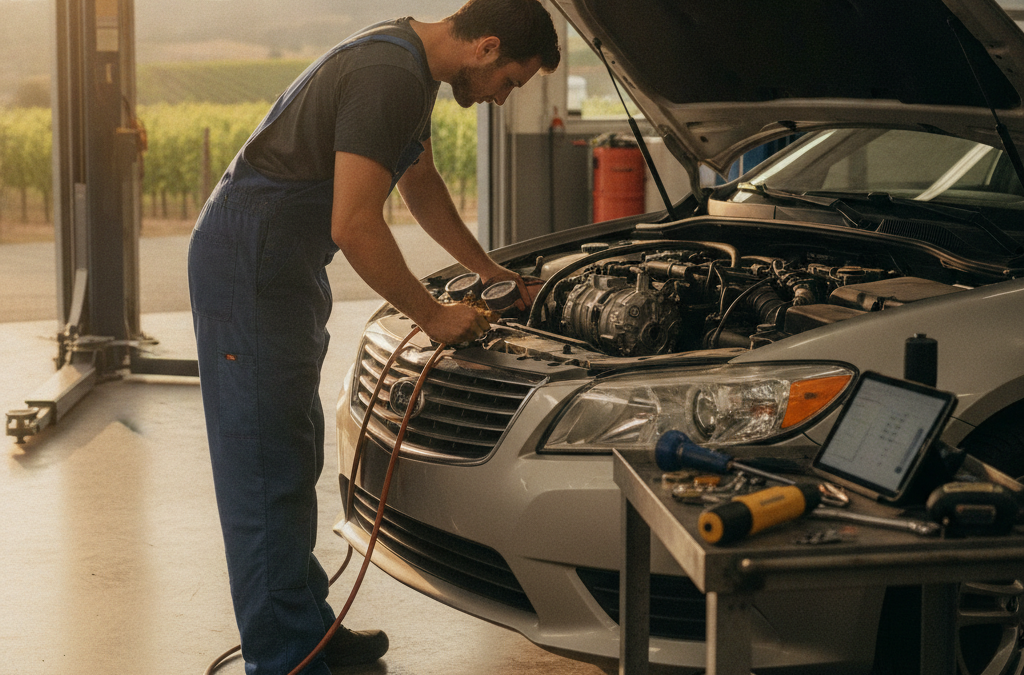
A real AC diagnosis involves checking system pressures on both the high and low sides, looking for refrigerant leaks with a UV dye or electronic detector, inspecting the compressor operation, and verifying that the electrical controls are functioning correctly. It takes a little more time upfront, but it means you get a real fix instead of a temporary patch. You can learn more about what we do on our AC and heating repair service page.
Does the Type of Refrigerant in Your Car Matter?
Yes — and this is something a lot of quick-lube shops and generic chain stores get wrong. Older vehicles (roughly pre-2015) typically use R-134a refrigerant. Newer vehicles — especially 2017 and later — use R-1234yf, which has a lower environmental impact but is more expensive and requires different handling equipment. Using the wrong refrigerant in your system can cause damage and void any warranty on the repair.
If someone quotes you an AC recharge without first asking what year and model your vehicle is, or without checking which refrigerant your system requires, that’s a red flag. Make sure whoever works on your AC actually has the right equipment for your specific vehicle.
How Much Does AC Repair Cost in Sonoma Valley?
This varies quite a bit depending on what’s actually wrong. A simple recharge after a confirmed and fixed minor leak is one of the more affordable AC repairs. A compressor replacement on a larger SUV or a European vehicle is a more involved job. What we’d caution against is automatically assuming the worst — or automatically assuming the best. Getting a proper diagnosis first is the only way to know what you’re actually dealing with, and it keeps you from paying for repairs you don’t need.
We always provide a clear estimate before any work begins. No surprises, no pressure to approve repairs you’re not ready for.
When Should You Stop Driving and Get It Looked At?
Honestly? As soon as you notice it’s not cooling the way it should. AC problems don’t get better on their own, and in the Sonoma Valley summer heat — where inland temperatures regularly climb into the 90s — a non-functional AC is more than an inconvenience. If you’re also hearing unusual noises from under the hood when the AC kicks on, smelling something musty or chemical from the vents, or noticing the system cycling on and off rapidly, those are signs to get it in sooner rather than later.
If you’re driving from Sonoma or Boyes Hot Springs to Santa Rosa for work, the last thing you need is to be stuck in that Highway 12 summer traffic with no working AC.
Frequently Asked Questions About Car AC Repair in Sonoma County
Can I just add refrigerant myself with a can from the auto parts store?
You can, but it’s not a great idea if you don’t know why the system was low in the first place. DIY recharge kits don’t find leaks, and overfilling a system with refrigerant can damage the compressor. If your AC was fully working last season and has slowly gotten warmer, a professional diagnosis is the right call.
My AC was fine last summer. Why is it suddenly blowing warm this year?
Refrigerant leaks are the most common answer. Even small leaks — at hose fittings or through a tiny condenser crack — can deplete the system over a winter of sitting. The AC seems fine until you flip it on in May or June and realize there’s not enough refrigerant left to cool effectively.
How often should the cabin air filter be replaced?
Most manufacturers suggest every 15,000 to 25,000 miles, but in Sonoma Valley — especially after fire seasons with heavy ash and smoke — it’s worth checking annually. A clogged filter won’t just hurt your AC effectiveness; it affects the overall air quality inside your vehicle.
My AC blows cold when I first start the car but warms up after 20 minutes. What does that mean?
This is a classic sign of either a refrigerant charge that’s slightly low or a compressor that’s starting to struggle under sustained load. It could also be an airflow issue with the condenser. It’s worth having it checked before the problem gets worse — intermittent cooling that turns into no cooling at all usually means something has progressed.
Do you work on AC for all vehicle types, including newer cars and trucks?
Yes. We service AC systems on all makes and models — Toyota, Honda, Ford, Chevy, Subaru, Nissan, Lexus, Hyundai, and everything in between. We handle both R-134a and R-1234yf systems and work on domestic and foreign vehicles alike. Check out our complete auto repair services for the full picture.
Get Your AC Working Before the Next Heat Wave
Whether you’re driving through Sonoma Valley daily, running errands between Glen Ellen and Santa Rosa, or heading into town from Kenwood for the weekend, a functioning AC isn’t a luxury in Sonoma County summers — it’s a basic safety feature. Don’t wait until you’re sweating through a traffic backup on Highway 12 to get it sorted out.
At On-Site Auto Repair, we’ve been diagnosing and fixing AC problems for Sonoma County drivers since 2011. We’ll tell you exactly what’s wrong, what it’ll take to fix it, and give you a straight estimate — no pressure, no upselling, no guesswork. Contact us today to schedule your AC inspection and let’s get you driving cool again.