Why Is My Car’s Wheel Bearing Humming or Grinding in Sonoma? What Wine Country Drivers Need to Know About Wheel Bearing Problems
That low, persistent hum coming from somewhere under your car — the one that gets louder as you speed up or shifts in pitch when you change lanes — is one of the most recognizable signs of a failing wheel bearing. If you live in or around Sonoma, Boyes Hot Springs, Glen Ellen, or Kenwood, and you’ve been noticing that sound on Arnold Drive, Highway 12, or the winding backroads through Sonoma Valley, don’t ignore it. A bad wheel bearing doesn’t fix itself, and what starts as a mild hum can turn into a grinding, then a wobble, and in serious cases, a wheel that stops turning properly altogether.
At On-Site Auto Repair, we’ve been diagnosing and fixing wheel bearing problems on vehicles of all makes and models across Sonoma County since 2011. Here’s what you actually need to know — without the runaround.
What Does a Wheel Bearing Actually Do?
Every wheel on your car rotates around a hub, and inside that hub sits a wheel bearing — a set of steel balls or rollers packed in grease and sealed inside a metal ring. The bearing allows the wheel to spin smoothly while supporting the weight of your vehicle. When it’s working properly, you don’t even know it’s there. When it starts to fail, you’ll definitely hear it.
Wheel bearings are built to last, but they’re not invincible. Road vibration, moisture intrusion, hitting a pothole hard, or just plain mileage eventually wears them down. And once a bearing starts to go, it tends to get worse faster — especially under the kind of driving conditions common in this part of Sonoma County.
Warning Signs of a Failing Wheel Bearing in Sonoma Valley
The symptoms of a bad wheel bearing can be easy to confuse with tire noise or even a brake problem. Here’s what to listen and feel for:
- A humming, growling, or roaring noise that increases with vehicle speed — not engine speed, but road speed. If it gets louder as you go faster on Highway 12 and quieter when you slow down, that’s a classic sign.
- The noise changes when you sway left or right. If you gently steer left and the hum gets louder, the bad bearing is likely on the right side — and vice versa. This is because weight shifts off the failing bearing when you turn toward it, and loads it up when you turn away.
- Vibration in the steering wheel or through the floorboard, especially at highway speeds.
- A grinding or rumbling sensation that you can feel underfoot, particularly when cornering through the curves around Glen Ellen or on the rolling roads toward Kenwood.
- Loose or wobbly steering feel in more advanced cases — this means significant wear and needs immediate attention.
- Uneven tire wear that can’t be explained by alignment alone.
The tricky part is that some of these symptoms can mimic worn tires, bad alignment, or even a CV joint issue. That’s why a proper hands-on inspection matters far more than just swapping parts and hoping for the best.
Why Sonoma Valley Roads Are Harder on Wheel Bearings
Drivers in and around Sonoma, Boyes Hot Springs, and the surrounding valley don’t just deal with flat highway miles. The roads here include tight curves, uneven pavement, and regular trips over railroad crossings and rough rural stretches. Wheel bearings take lateral stress during cornering, and the combination of winding roads, gravel driveways at wineries, and the occasional pothole on older stretches of Napa Road adds up over time.
Wine Country tourism season also brings a surge of rental cars and out-of-area vehicles on these roads — and tourists occasionally find themselves dealing with a breakdown noise they ignored since leaving the Bay Area. If you’re driving in from Marin County or Napa and you’ve been hearing that hum for a while, it’s worth getting checked before you head back home.
How a Wheel Bearing Is Diagnosed and Replaced
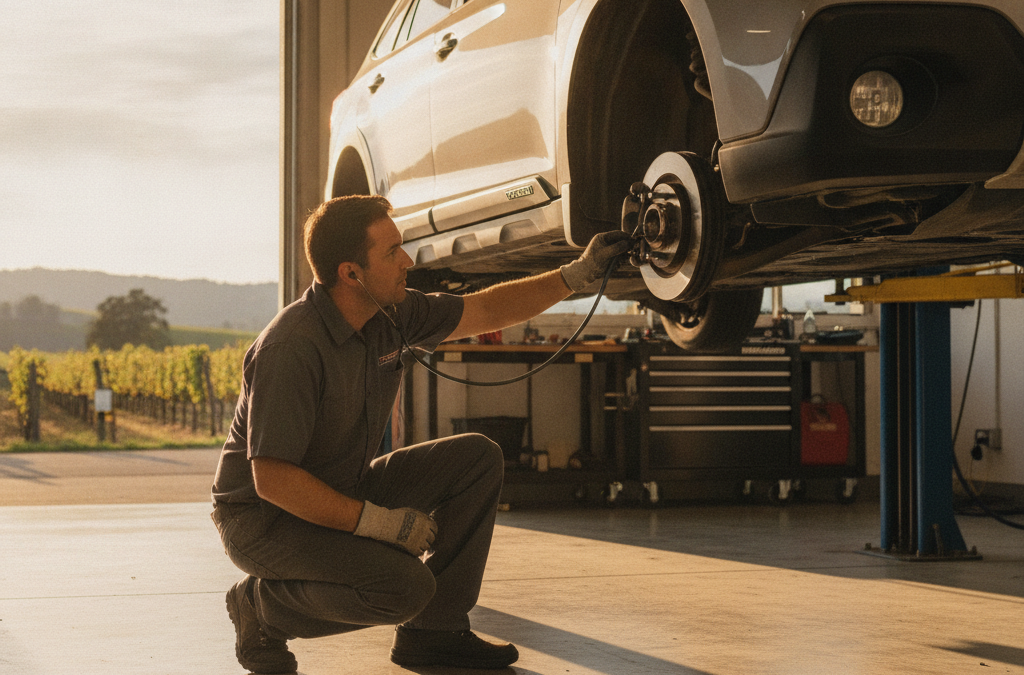
A proper wheel bearing diagnosis involves raising the vehicle and physically checking for play or roughness in each wheel hub. A good technician will spin each wheel by hand, feel for resistance or grinding, and check for any side-to-side wobble that indicates a worn bearing. Some vehicles use integrated hub assemblies — meaning the bearing and hub come as one unit — while others use press-fit bearings that require a hydraulic press to remove and install.
This isn’t a job for a basic tool kit or a quick driveway fix. The bearing needs to be properly seated and torqued to spec, and on many modern front-wheel-drive and all-wheel-drive vehicles, the job also involves removing the axle nut, the knuckle, and sometimes suspension components. Done right, a replacement bearing should last many years without issue. Done incorrectly, you could be dealing with the same noise within months.
At On-Site Auto Repair, we use quality parts appropriate for your vehicle — not the cheapest import bearing we can find. If we’re doing a wheel bearing job, we’re doing it right. Our steering and suspension services cover the full scope of what your wheels, hubs, and bearings need to stay safe and quiet.
Which Vehicles See Wheel Bearing Problems Most Often?
Wheel bearings can fail on any make or model, but some vehicles have known tendencies worth knowing about:
- Ford Focus and Ford Escape: Front wheel bearings are a relatively common wear item, especially after 80,000–100,000 miles.
- Chevrolet and GMC trucks and SUVs: Hub assemblies on these vehicles are durable but do wear, particularly if the vehicle sees a lot of towing or rough road use.
- Subaru Outback and Forester: With their all-wheel-drive systems, wheel bearing wear can show up earlier if the tires aren’t properly rotated and matched in diameter — a common issue on AWD Subarus.
- Honda CR-V and Accord: Generally reliable, but wheel bearings can develop noise after high mileage, especially on older models.
- Volkswagen and Audi: European press-fit bearings are more labor-intensive to replace and require precise installation — not a job for a shop without the right equipment.
Regardless of what you drive, the same rule applies: if you hear that hum, get it checked sooner rather than later.
Can You Drive on a Bad Wheel Bearing?
Technically, yes — for a short time. Practically, it depends on how far along the failure is. Early-stage bearing noise is a warning. Late-stage bearing failure — where you can feel vibration, the noise has become a grinding roar, or the wheel has noticeable play — is a safety issue. In a worst-case scenario, a severely failed bearing can cause a wheel to lock up or separate from the hub. That’s not a risk worth taking on Highway 12 or any road in Sonoma Valley.
If you’re not sure how bad it is, the safest move is to get it inspected. We offer free estimates, and we’ll tell you honestly whether it needs immediate attention or whether you have a little time. Reach out to us here and we’ll get you scheduled.
Frequently Asked Questions About Wheel Bearing Problems in Sonoma County
How much does it cost to replace a wheel bearing?
The cost varies depending on your vehicle and which bearing needs replacement. Front wheel bearings on many vehicles use integrated hub assemblies, which tend to be more expensive than rear press-fit bearings. Labor time also varies. We provide honest, upfront estimates — give us a call and we can give you a better idea once we know your vehicle.
Can a bad wheel bearing cause my car to pull to one side?
It can contribute to a pulling sensation, particularly when the bearing is significantly worn. However, pulling while driving is more commonly caused by alignment or tire issues. The best approach is to have both checked at the same time.
Is a humming noise always a wheel bearing?
Not always. Tire tread wear patterns, particularly cupping or feathering, can cause very similar humming sounds. A rotating tire noise usually stays constant during turns, while a wheel bearing noise typically shifts in pitch when you sway left or right. A proper lift inspection will tell us which one it is.
How long does a wheel bearing replacement take?
For most vehicles, a single wheel bearing replacement takes one to two hours. If the job requires significant disassembly — which is common on AWD or 4WD vehicles — it may take a bit longer. We’ll give you an accurate time estimate before we start.
Should I replace wheel bearings in pairs?
Not necessarily — this is different from brake pads, where matching pairs make more sense. If only one bearing is showing wear or noise, there’s no strong reason to replace the other side proactively. We’ll check the condition of both and recommend only what’s actually needed.