Why Is My Car’s Engine Overheating in Rohnert Park? What Sonoma County Drivers Need to Know About Cooling System Failures
If your temperature gauge is creeping toward the red while you’re sitting in Rohnert Park traffic on Redwood Drive — or pushing up Highway 101 on a hot July afternoon — your car is trying to tell you something important. Engine overheating isn’t just an inconvenience. It’s one of the fastest ways to turn a manageable repair into a blown head gasket or a seized engine. The good news is that most overheating problems have clear warning signs, and catching them early keeps the repair cost from getting out of hand.
At On-Site Auto Repair, we’ve been diagnosing and fixing cooling system issues for Sonoma County drivers since 2011 — everything from small coolant leaks on older Hondas to full radiator replacements on work trucks. Here’s what you need to know if your engine is running hot.
What Actually Causes an Engine to Overheat?
Overheating doesn’t usually happen out of nowhere. It’s almost always the end result of something that’s been building up for a while. The most common causes we see include:
- Low or contaminated coolant — Coolant (antifreeze) is what pulls heat away from your engine. If it’s low due to a slow leak, or if it’s old and broken down, it can’t do its job. This is the most frequent culprit we see in the shop.
- A failing water pump — The water pump circulates coolant through your engine and radiator. When the impeller wears out or the pump starts to leak, coolant circulation drops off, and the engine temperature climbs. We covered water pump failure in depth in a previous post, but it’s worth mentioning here because it’s often misdiagnosed as a thermostat problem.
- A stuck or failed thermostat — The thermostat regulates how much coolant flows to the radiator. If it sticks closed, your engine has nowhere to dump heat. You’ll typically see the temperature gauge spike quickly after the engine warms up.
- A clogged or damaged radiator — Over time, radiators accumulate deposits and debris. A clogged radiator can’t dissipate heat efficiently, especially when you’re idling in stop-and-go traffic around Cotati or sitting at a Rohnert Park shopping center.
- A blown head gasket — This is what you’re trying to avoid. A head gasket failure can cause or result from overheating. If you’re seeing white smoke from your exhaust, bubbling in the coolant reservoir, or oil that looks like a milky coffee drink, stop driving and call us immediately.
- A broken or loose cooling fan — At highway speeds, airflow through the radiator keeps things cool. But at low speeds and idle, your electric or mechanical cooling fan does that job. A bad fan motor or a blown fuse can cause overheating specifically in slow traffic — which is exactly when Rohnert Park commuters tend to notice it.
Warning Signs Before the Gauge Goes Red
Most overheating events don’t come without warning. Here’s what to pay attention to before things get serious:
- Temperature gauge sitting higher than usual, even if it hasn’t reached the red zone yet
- A sweet smell coming from under the hood — that’s coolant burning off, and it usually means you have a leak somewhere
- Steam or white smoke rising from under the hood
- Your heater suddenly blowing cold air (can indicate low coolant level in the system)
- A puddle of bright green, orange, or pink liquid under your parked car — coolant is usually brightly colored for exactly this reason
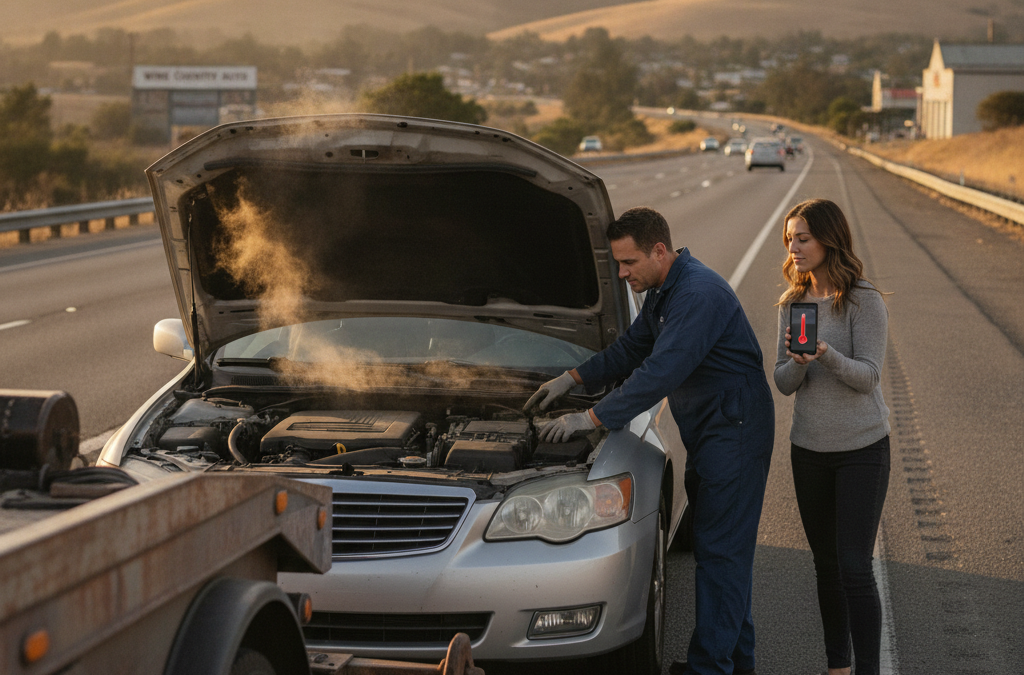
If your gauge hits the red zone, the right move is to pull over safely, turn the engine off, and let it cool for at least 20–30 minutes before you open the hood. Never open a hot radiator cap — the pressurized coolant inside can cause serious burns.
Why Rohnert Park and Sonoma County Conditions Make Overheating More Likely
Our North Bay summers are genuinely tough on cooling systems. Rohnert Park and the surrounding area along the Highway 101 corridor can see extended stretches of 90°F+ heat from June through September. Add in bumper-to-bumper traffic on 101 during evening commutes toward Petaluma or slow going through Windsor on a Friday afternoon, and you have conditions that stress even a healthy cooling system.
Coolant also degrades over time — it becomes acidic and loses its ability to prevent corrosion inside the engine and radiator. Most manufacturers recommend a coolant flush every 30,000 to 50,000 miles or every two to five years, depending on the type of coolant your vehicle uses. If you’ve never had it done, or if you can’t remember the last time it was done, that’s a good place to start.
Vehicles with high mileage — something we see a lot of in working-class areas like Cotati and southwest Santa Rosa — are especially vulnerable. Hoses get brittle, radiator caps lose their ability to hold pressure, and old coolant simply breaks down. These aren’t expensive fixes on their own, but left alone, they set the stage for a much bigger problem.
What to Do If Your Engine Overheats on the Road
If you’re driving and notice the temperature gauge spiking, here’s the short version of what to do:
- Turn off the AC immediately — It adds load to the engine and makes heat buildup worse.
- Turn the heat on full blast — Counterintuitive, yes, but your heater core acts as a secondary radiator and can pull some heat away from the engine. It buys you a little time.
- Pull over as soon as it’s safe — Don’t push it. Every minute you drive an overheating engine is another minute closer to a very expensive repair.
- Turn the engine off and wait — Don’t open the hood immediately. Give it at least 20–30 minutes before you check anything.
- Call for help — If you’re not sure what you’re looking at, don’t guess. Contact On-Site Auto Repair and we’ll help you figure out the next step.
What a Proper Cooling System Inspection Actually Covers
One thing we see often in the industry is shops that do a quick visual check and call it a cooling system inspection. A thorough inspection should include a lot more than that. When we look at a cooling system, we check:
- Coolant level and condition (color, pH, freeze point)
- Radiator cap pressure rating and seal condition
- All hoses for cracks, softness, bulging, or end collapse
- Thermostat function
- Water pump for leaks and bearing play
- Cooling fan operation (both electric fans and mechanical clutch fans)
- Radiator for external blockage or internal restriction
- Signs of head gasket compromise — combustion gases in coolant, oil contamination
That kind of thorough look is what helps us catch a problem early and give you an honest recommendation — not upsell you on repairs you don’t need. Learn more about our cooling system services and what’s included.
Can You Add Water to a Hot Radiator in an Emergency?
This comes up more than you’d think. The honest answer is: only if the engine has fully cooled down first. Adding cold water to a hot engine can cause thermal shock and crack the engine block or head. If you’re stranded and the engine is fully cooled, plain water works in a pinch — but get the system properly flushed and refilled with the correct coolant as soon as possible. Running on straight water, especially in Sonoma County winters when temperatures dip, can cause freeze damage.
What Competitor Shops Often Miss: Brand-Specific Coolant Requirements
Here’s something we don’t see discussed enough in local auto repair content — not every vehicle uses the same type of coolant, and mixing the wrong types can cause serious internal corrosion. Toyota vehicles typically use Toyota Super Long Life Coolant (pink/red). Many GM vehicles use Dex-Cool (orange). Honda uses a blue or green OEM formulation. European vehicles like VW and Mercedes often have specific requirements that differ from what you’d find in a standard flush kit.
Using the wrong coolant doesn’t just void manufacturer recommendations — it can cause silicate dropout that clogs passages in your radiator and water pump, leading to the exact overheating problem you were trying to prevent. If your shop doesn’t ask what year, make, and model your vehicle is before doing a coolant flush, that’s a problem. We always use the correct fluid for your specific vehicle, whether it’s a Subaru Outback, a Ford F-150, or a Lexus ES.
Speaking of Subarus — if you drive one and your engine temperature has been acting up, it’s worth having the head gasket inspected as part of any cooling system diagnosis. Certain Subaru four-cylinder engines from the mid-2000s onward have a known history with this issue, and overheating accelerates the problem significantly. You can read more about Subaru-specific maintenance at our Subaru repair page.
Frequently Asked Questions About Engine Overheating in Sonoma County
How much does it cost to fix an overheating engine?
It really depends on the cause. A thermostat replacement is typically one of the more affordable cooling system repairs. A water pump, radiator, or cooling fan runs higher. A head gasket is a major repair and significantly more expensive — which is exactly why catching overheating early matters so much. We always give you a free estimate and explain what we found before any work begins.
Is it safe to drive a short distance if the engine is running a little hot?
We’d advise against it. Even a short drive with an overheating engine can cause damage that wouldn’t have happened if you’d pulled over. The risk isn’t worth it — especially when towing costs are far less than an engine repair.
How often should I get my coolant flushed?
Most vehicles need a coolant flush every 30,000 to 50,000 miles or every two to five years. Some newer vehicles with extended-life coolant can go longer, but we still recommend checking the condition and level annually — especially before Sonoma County summers hit.
My car only overheats in traffic, not on the highway. What does that mean?
That pattern usually points to a cooling fan issue. At highway speeds, airflow keeps the radiator cool. At idle or low speeds, the fan takes over. If the fan isn’t working properly, you’ll only see the problem when the car isn’t moving fast enough to generate natural airflow.
Can low engine oil cause overheating?
Yes, indirectly. Oil helps carry heat away from internal engine components. If your oil is very low or badly degraded, the engine runs hotter than it should — and that extra heat can push an already-stressed cooling system over the edge. It’s another reason regular oil changes matter more than people think.
Don’t Let a Cooling System Problem Become an Engine Problem
An overheating engine is one of those situations where acting fast genuinely saves you money. What starts as a small coolant leak or a tired thermostat can escalate quickly — especially during a Rohnert Park summer commute or a long drive through Sebastopol to the coast. The vehicles we see with the worst heat-related damage are almost always ones where the driver noticed something early and pushed through it.
At On-Site Auto Repair, we’ve been helping Sonoma County drivers avoid exactly that outcome since 2011. We’ll give you a straight diagnosis, a clear explanation of what we found, and an honest estimate — no pressure, no unnecessary repairs. If you’re noticing anything unusual with your temperature gauge, don’t wait. Reach out to us today and let’s take a look before a small problem becomes a big one.