Why Is My Car’s Serpentine Belt Squealing or Cracking in Rohnert Park? What Sonoma County Drivers Need to Know About Belt and Accessory Drive Problems
If you’re hearing a high-pitched squeal from under your hood — especially on cold mornings or when you first fire up the engine — there’s a good chance your serpentine belt is trying to tell you something. For drivers in Rohnert Park and the surrounding Sonoma County area, this is one of those warning signs that’s easy to dismiss but genuinely shouldn’t wait. A failing serpentine belt doesn’t just make noise. When it finally goes, it takes your power steering, your alternator, your water pump, and your AC compressor with it — all at once. That can mean pulling over on the Highway 101 corridor with a dead engine and no warning.
The good news is that serpentine belt problems are almost always catch-before-they-break situations. You just need to know what to look for — and act on it.
What Is a Serpentine Belt and What Does It Do?
The serpentine belt is a single, continuous rubber belt that snakes around multiple pulleys in your engine bay. It drives several critical accessories simultaneously — your alternator (which charges the battery), your power steering pump, your AC compressor, and on many vehicles, your water pump. Think of it as the one belt doing the work of what used to take three or four separate belts.
Because it’s doing so much, when it fails, multiple systems fail at the same time. You might notice your steering gets heavy, your battery warning light comes on, your temperature gauge starts climbing, and your AC dies — all within seconds of the belt snapping. It’s a worst-case scenario you can almost always avoid with a simple inspection.
Warning Signs Your Serpentine Belt Is Wearing Out
Here’s what to watch and listen for:
- Squealing or chirping noise — especially on startup or when turning on the AC. This is often the belt slipping on a glazed or worn pulley surface.
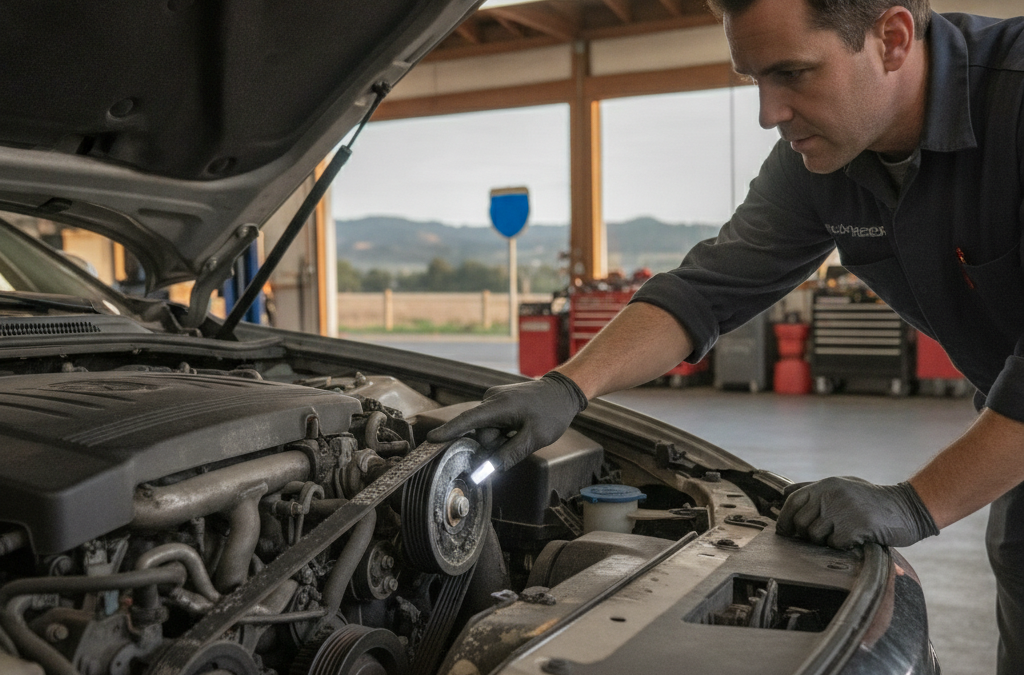
- Visible cracking or fraying — if you pop the hood and look at the belt, you should see a smooth, ribbed surface. Cracks along the ribs, chunks missing, or frayed edges mean the rubber is breaking down.
- Glazing or shiny appearance — a belt that looks shiny instead of matte has been slipping and overheating.
- Flickering dash lights or battery warning — if the belt is slipping, the alternator isn’t spinning consistently, which causes voltage fluctuations.
- Power steering feels heavy suddenly — on vehicles with a belt-driven power steering pump, a slipping or broken belt means you lose assist immediately.
- Overheating — some vehicles route the serpentine belt through the water pump. If the belt fails on those, coolant stops circulating fast.
If you’re seeing or hearing any of these, don’t wait. It’s genuinely not worth the risk of being stranded, especially in the middle of a Highway 101 commute from Rohnert Park toward Petaluma or Santa Rosa.
What Actually Causes Serpentine Belts to Fail?
Rubber degrades over time — that’s just chemistry. But a few things accelerate the process, and Sonoma County drivers face some of them regularly.
Age and mileage are the primary factors. Most belts are designed to last somewhere between 60,000 and 100,000 miles, but that varies a lot by vehicle make and driving conditions. A Toyota Camry with mostly highway miles and a belt changed at 90,000 is very different from a Ford F-150 used for short-trip driving around Cotati every day.
Heat cycles matter enormously. Sonoma County’s hot, dry summers — and the temperature swings between cool coastal mornings and 95-degree afternoons — are genuinely hard on rubber components. A belt that sits in a hot engine bay day after day, season after season, ages faster than one in a milder climate.
Oil or coolant contamination will destroy a belt fast. If there’s an oil leak dripping onto your belt, it soaks into the rubber and causes it to swell, crack, and slip. This is one reason fixing one problem early (an oil leak, for example) can prevent a cascade of other issues down the road.
A worn tensioner or idler pulley is often the overlooked culprit. These are the components that keep the belt at the right tension and guide it along its path. If the tensioner spring is weak or an idler pulley bearing is failing, the belt can’t maintain proper contact — and that causes squealing, slipping, and accelerated wear. Replacing a belt without checking the tensioner and pulleys is a shortcut that can leave you right back where you started in six months.
Why the Tensioner and Pulleys Matter as Much as the Belt
This is where a lot of shops cut corners — and it’s one of the gaps we see when looking at how competitors explain this service. Most shop websites will tell you they replace serpentine belts. Far fewer talk about what actually needs to happen around that belt replacement to make it last.
When we service a serpentine belt at On-Site Auto Repair, we don’t just swap the belt. We inspect the belt tensioner for proper spring tension and wear, check each idler pulley by hand for roughness or wobble in the bearing, look for any signs of oil or coolant contamination that could be shortening belt life, and check the alignment of the pulleys themselves. If a pulley is even slightly out of alignment, it’ll chew through a new belt quickly.
On many vehicles — especially higher-mileage Hondas, Subarus, Toyotas, and domestic trucks — the smart move is to replace the tensioner and idler pulleys at the same time as the belt, since they’re similar in age and you’re already right there. It usually adds modest cost but can save you a significant repair bill later when a pulley bearing seizes and damages a brand-new belt. We’ll always explain the options honestly and let you make the call — no pressure.
How Long Does Serpentine Belt Replacement Take?
On most vehicles, a straightforward belt replacement takes an hour or less. If we’re also replacing the tensioner and idler pulleys, add a little time. Some vehicles — particularly certain European makes and a few trucks with tight engine bays — can take longer due to access. We’ll give you an honest time estimate upfront, and we’ll call you if anything unexpected comes up during the job. No surprises on your invoice.
If you’re in Rohnert Park, Windsor, or anywhere along the 101 corridor and need same-day service, give us a call and we’ll do our best to fit you in. A belt that’s already squealing loudly or showing visible cracking is genuinely urgent — it can fail with little additional warning.
What Happens If You Ignore It?
Serpentine belts rarely give you much runway once they start to go. A belt that’s chirping one week can snap the next. When it does:
- Your power steering disappears — steering becomes very heavy, which is dangerous at highway speeds
- Your alternator stops charging — within minutes, the battery can’t sustain the engine and it stalls
- Your water pump stops (on affected vehicles) — overheating follows quickly
- Your AC shuts down immediately
The repair cost of replacing a belt proactively is a fraction of what you’d pay after a belt failure causes secondary damage — like an overheated engine, a seized power steering pump, or a dead battery from sustained under-voltage. Preventive maintenance on items like this is genuinely one of the highest-return investments you can make in your vehicle.
Which Vehicles Are Most Prone to Serpentine Belt Problems?
Honestly, every vehicle with an internal combustion engine has a serpentine belt (or a similar drive belt system), so this applies across the board. That said, a few patterns worth knowing:
- Subaru — known for tight engine bays where belt and pulley access can be more involved
- Honda and Acura — generally reliable, but belt tensioners on older 4-cylinder models have been known to wear out
- Domestic trucks (Ford F-Series, Chevy/GMC trucks, Ram) — high-mileage work trucks often go longer than they should between belt inspections
- Older Lexus and Toyota vehicles — extremely reliable belts overall, but don’t skip the inspection just because the car seems fine
Electric vehicles like Tesla and Rivian don’t use a traditional serpentine belt, since they don’t have an engine-driven accessory system. But every conventional gas or hybrid vehicle does, and it deserves a look during your next service visit.
Frequently Asked Questions: Serpentine Belts in Sonoma County
How do I know if it’s the serpentine belt squealing or something else?
Belt squeal tends to be loudest on cold startups and may fade as the engine warms up. It often gets louder when you turn on the AC or crank the wheel. If the noise is more of a grinding or rhythmic clunking, that points more toward a pulley bearing. Either way, bring it in — both are worth diagnosing before they leave you stranded.
Can I drive with a cracked serpentine belt?
Technically you can — until you can’t. A belt with minor surface cracking might last another few weeks or a few miles. One that’s deeply cracked, missing chunks, or fraying at the edges can snap any time. We’d strongly recommend not driving more than necessary until it’s been replaced.
How much does serpentine belt replacement cost?
We don’t publish flat prices because costs vary by vehicle make, model, and what related components need attention. We always provide a free estimate before any work begins. There’s no obligation, and we’ll explain exactly what we found and why we’re recommending what we are.
Should I replace my belt tensioner at the same time?
In most cases, yes — especially if your vehicle has over 80,000 miles and you’ve never had the tensioner replaced. It’s the same access, similar labor cost, and a failed tensioner will damage a new belt fast. We’ll check the tensioner and pulleys during the inspection and give you our honest read on whether they need attention.
Does On-Site Auto Repair service all makes and models?
Yes. We work on everything from Hondas and Toyotas to Ford trucks, Subarus, Jeeps, Volkswagens, Mercedes, Kias, and more. If it has a combustion engine and a serpentine belt, we can service it. Check out our complete auto repair services for the full list.
Get Your Serpentine Belt Inspected Before It Becomes an Emergency
Whether you’re in Rohnert Park, Cotati, Petaluma, Windsor, or anywhere else in Sonoma County, On-Site Auto Repair has been helping local drivers stay ahead of breakdowns since 2011. We believe in straight answers, honest estimates, and repairs done right the first time — no upselling, no unnecessary services, no surprises. We treat your car the way we’d want someone to treat ours.
If your belt is squealing, your engine is making a noise you can’t explain, or it’s just been a while since anyone looked under the hood, we’re here to help. Contact us today to schedule a free inspection or get an estimate — it takes a few minutes and could save you a very bad day on the side of the road.