Why Is My Car’s CV Axle Clicking or Vibrating in Petaluma? What Sonoma County Drivers Need to Know About CV Joint Problems
If you hear a rhythmic clicking or popping noise when you make a turn — especially at lower speeds in a parking lot or while pulling out of your driveway — there’s a good chance your CV joint is starting to fail. It’s one of the most consistently misunderstood drivetrain noises drivers bring to us, and unfortunately it’s also one of the more common ones we see on vehicles coming in from Petaluma, Rohnert Park, and throughout Sonoma County. The good news: caught early, a CV joint repair is usually straightforward and affordable. Ignored too long, you’re looking at a much bigger job — or worse, getting stranded.
What Is a CV Axle, and Why Does It Matter?
CV stands for constant velocity. Your CV axles are the shafts that transfer power from your transmission or differential out to the wheels. On front-wheel-drive vehicles — which covers a huge percentage of the cars and crossovers on the road today — the CV axles do double duty: they have to spin at high speed and flex side to side as your front wheels steer. That’s a lot to ask of any mechanical part.
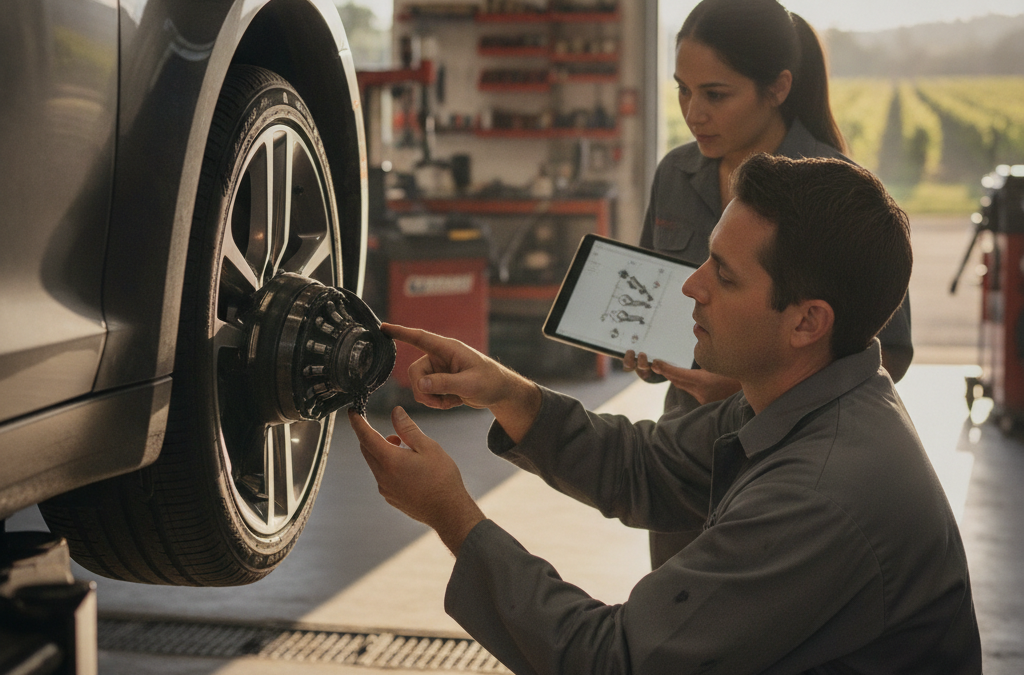
Each CV axle has two CV joints: one at the wheel end (called the outer joint) and one closer to the transmission (the inner joint). Each joint is packed with grease and protected by a rubber boot. When that boot cracks, tears, or collapses — which happens with age, heat cycling, road debris, or just miles — the grease escapes and dirt gets in. Once a CV joint runs dry and dirty, it wears fast. The clicking sound you hear is the joint struggling to articulate cleanly under load.
AWD and 4WD vehicles also have rear CV axles, so this isn’t just a front-wheel-drive problem. If you’re driving a Subaru Outback, a Ford Explorer, or a Toyota RAV4 — all common vehicles we service from Petaluma to Santa Rosa — your rear axles can develop the same issues.
What Does a Failing CV Joint Actually Sound Like?
Here’s what to listen for, and what each symptom typically points to:
- Clicking or popping when turning: Classic outer CV joint failure. Usually worse when turning sharply at slow speeds — like backing out of a driveway, making a U-turn, or navigating a parking structure.
- Vibration or shuddering during acceleration: Often points to a failing inner CV joint. You might feel it through the steering wheel or the floorboard when you accelerate from a stop.
- Clunking when shifting into drive or reverse: This one can overlap with other drivetrain issues, but a worn inner joint can produce a noticeable thunk when you go from park to drive.
- Grease splattered inside your wheel well: If you look at the inside of your wheel and see black grease thrown around, that’s a torn CV boot. The joint itself may still be okay — but it won’t be for long without intervention.
None of these symptoms go away on their own. They get worse, and eventually a severely worn CV joint can separate entirely — which means you lose drive to that wheel and potentially lose control of the vehicle. That’s not a scenario you want to find yourself in on Highway 101 during a morning commute to the Bay Area.
Why CV Joint Problems Are More Common Than You Might Think in Sonoma County
A few things stack up against CV axles around here. Petaluma drivers who do daily Highway 101 runs accumulate miles fast — and high mileage is the single biggest predictor of CV joint wear. We also see a lot of older vehicles in service, especially in working-class parts of the county where people are keeping cars on the road well past 150,000 miles. At that mileage, CV boots have often already cracked once or been replaced, and the joints underneath may be on borrowed time.
Rough roads don’t help either. Some of the back roads running through Cotati, Sebastopol, and out toward the coast are harder on drivetrain components than people realize. Potholes and uneven pavement put extra stress on the joint’s range of motion, accelerating wear on already-tired grease seals and boots.
If you’re running a small fleet of delivery vehicles or work vans in the Petaluma or Rohnert Park area, CV axle wear is something worth adding to your preventive inspection schedule — especially on high-mileage vehicles that are making frequent turns in tight spaces.
Boot Replacement vs. Full CV Axle Replacement — What’s the Right Call?
This is a question we get a lot, and the honest answer depends on how far things have progressed.
If the boot is torn but the joint itself hasn’t been running dry for long — no clicking, no roughness when you spin the axle by hand — a boot replacement with fresh grease can be a reasonable option. It’s less labor-intensive and less expensive than replacing the whole axle.
But if there’s already clicking, grinding, or visible wear inside the joint, a boot replacement alone won’t fix the underlying damage. At that point, replacing the entire axle shaft is the better long-term move. Remanufactured CV axles are widely available for most makes and models, and on many vehicles the job can be done in a couple of hours. We’ll always tell you exactly what we find and what we recommend — no pressure to do more than what’s actually needed.
For a more complete look at what’s involved in keeping your drivetrain and undercarriage healthy, our steering and suspension service page covers related components we inspect as part of a thorough drivetrain check.
Brand-Specific Notes on CV Axle Wear
Some vehicles are more prone to CV axle issues than others, based on design and mileage patterns we see locally:
- Honda and Acura: Generally solid, but high-mileage Civics and CR-Vs (well over 100K) will often need at least one axle. Outer boots tend to crack with age even on well-maintained examples.
- Subaru: With AWD on all models, Subarus have CV axles on all four corners. The Outback and Forester are popular in Sonoma County, and we see inner joint wear fairly often on high-mileage examples — especially if the transmission fluid hasn’t been kept up.
- Toyota and Lexus: Very durable overall, but the Camry, Corolla, and RAV4 are all front-wheel or all-wheel-drive platforms where outer CV joint failure eventually shows up past 120K–150K miles.
- Ford and Chevy trucks/SUVs: If you’re in 4WD often — or even if you’re not — the front axle shafts on trucks can develop worn outer joints over time, especially if the front differential seals have leaked grease into the axle area.
- Volkswagen and Audi: German platforms tend to have excellent engineering but can be more labor-intensive to work on. CV axle access varies by model. Worth getting an inspection if you’re hearing anything unusual and the odometer is above 80K.
Whatever you’re driving, we work on it. If you’re not sure whether what you’re hearing is a CV joint, a wheel bearing, or something else entirely, a proper inspection will sort it out quickly. Our auto diagnostic service includes a thorough undercarriage and drivetrain check when needed.
What Competitors Often Miss on This Topic
We looked at how local shops cover CV joint issues online, and most either mention it in passing on a generic services page or don’t cover it at all. What’s missing is practical guidance on what the noise actually sounds like, when a boot replacement is enough vs. when you need the full axle, and which vehicles in the local fleet are most vulnerable. If you’ve been searching for this information and coming up empty, that’s why — and it’s part of why we write these articles. You deserve clear answers, not a vague list of services.
Frequently Asked Questions About CV Axle Problems in Sonoma County
How long can I drive with a clicking CV joint?
Not long — and the timeline is unpredictable. Some joints click for months before failing; others go quickly once the wear begins. Avoid letting it go past the point of clicking, because a fully failed joint can leave you stranded or cause a loss of vehicle control. Get it inspected sooner rather than later.
Will a bad CV joint affect my alignment or tire wear?
Not directly — but if the axle is causing vibration, it can mask alignment issues or put uneven stress on other front-end components. It’s worth checking alignment and tire wear at the same time if the axle is being replaced.
Is a CV axle the same as a drive shaft?
Not exactly. On rear-wheel-drive vehicles, a long driveshaft runs from the transmission to the rear differential, and it typically uses U-joints rather than CV joints. On front-wheel-drive and most AWD vehicles, shorter CV axles connect the transmission directly to each wheel. Some AWD vehicles use both.
My car has high mileage but no clicking yet — should I have the CV boots inspected?
Yes, absolutely. A cracked or leaking boot is much cheaper to address than a worn-out joint. If your vehicle is over 80,000–100,000 miles, it’s worth having the boots looked at during any routine service visit.
Do you service CV axles on all makes and models?
Yes. We work on everything from Toyotas and Hondas to Subarus, VWs, Fords, GM trucks, and more. If you’re in Petaluma, Rohnert Park, Sebastopol, Cotati, or anywhere else in Sonoma County, we can get you in and take a look.
Ready to Get That Clicking Noise Checked Out?
If something sounds off when you turn — or if you’ve noticed vibration during acceleration and aren’t sure what’s causing it — don’t wait until the joint fails completely. Bring your vehicle to On-Site Auto Repair in Santa Rosa, and we’ll give you a straight answer about what’s going on and what it’ll take to fix it. No upselling, no guesswork, no unnecessary repairs. Just honest work from a shop that’s been taking care of Sonoma County drivers since 2011.
Contact us today to schedule an inspection or get a free estimate. We serve drivers from Petaluma and Rohnert Park all the way up to Healdsburg and everywhere in between.