Why Is My Car’s Starter Motor Failing in Petaluma? What Sonoma County Drivers Need to Know About No-Start Problems
If you turn the key — or push the start button — and get a single loud click, a weak groaning sound, or complete silence, your starter motor is one of the most likely causes. For drivers in Petaluma and across Sonoma County, a failing starter can leave you stranded at home, in a parking lot, or on the way to catch the SMART train. The good news is that starter problems usually give you warning signs before they fail completely. Knowing what to listen for can save you from being stuck somewhere inconvenient.
What Does a Starter Motor Actually Do?
The starter motor is a small but powerful electric motor that physically cranks your engine when you try to start the car. It draws power from the battery, engages a small gear called the pinion, and spins the engine’s flywheel fast enough to get combustion going. Once the engine starts, the starter disengages automatically.
Most starters last somewhere between 100,000 and 150,000 miles — sometimes longer on well-maintained vehicles. But heat, high mileage, and electrical wear can shorten that lifespan significantly. In Sonoma County, where summer temperatures climb and many drivers are putting serious highway miles on their vehicles commuting to the Bay Area via Highway 101, starter wear is more common than people realize.
The Most Common Signs of a Failing Starter
Here’s what to pay attention to before your starter quits entirely:
- A single loud click when you turn the key. This is the most classic starter symptom. The solenoid — a small relay that activates the starter — is engaging, but the motor itself isn’t turning. Don’t confuse this with a dead battery, which usually produces rapid clicking sounds.
- Slow, labored cranking. If your engine is turning over but sounds sluggish — like it’s struggling to get going — the starter motor may be drawing too much current or wearing out internally.
- Intermittent starting problems. Sometimes it starts fine, sometimes it doesn’t. Intermittent issues are classic signs of a starter that’s on its way out. A worn brush or bad connection inside the motor can make it work one minute and fail the next.
- Grinding noise when starting. If the starter’s pinion gear isn’t fully engaging with the flywheel, you’ll hear a nasty grinding metal sound. Don’t ignore this — it can damage the flywheel, which is a much more expensive repair.
- The engine cranks fine but won’t fire. This is NOT a starter issue — this points toward fuel, ignition, or a sensor problem. It’s an important distinction that a proper diagnostic will catch.
Starter Problems vs. Dead Battery vs. Bad Alternator — How to Tell the Difference
This is where a lot of drivers get confused, and honestly, where some shops take shortcuts. A no-start problem could be your starter, your battery, your alternator, a bad ignition switch, a neutral safety switch, or a blown fuse. They don’t all feel exactly the same, but they can be close enough to confuse even experienced drivers.
Here’s a rough breakdown:
- Dead battery: Rapid clicking when you turn the key, or nothing at all with very dim dash lights. Headlights will be dim or dead. A jump start typically gets you running.
- Bad alternator: Your car starts but dies shortly after, or warning lights come on while driving. The battery keeps draining because it’s not being recharged. (We covered this in detail in our post about alternator failure.)
- Failing starter: A jump start usually does NOT fix a bad starter. You may have full battery voltage and still get that single click or no response at all. The lights and dash may work perfectly — the starter just won’t engage.
If you’re not sure what you’re dealing with, that’s exactly when a proper auto diagnostic matters. Guessing and replacing parts one at a time wastes money and time — especially if you’re trying to get back on the road quickly.
Why Sonoma County Conditions Can Accelerate Starter Wear
A few things about daily life in this part of California are especially hard on starters and starting systems:
Heat. Starters mounted close to the exhaust system take a beating during Sonoma County’s hot, dry summers. Heat causes the internal windings to wear faster and can cause the motor to draw excessive current. After a long drive on a hot day, you may notice the car is harder to start when the engine is fully heat-soaked — this is called heat soak, and it’s a classic symptom of a starter that’s beginning to fail.
High-mileage vehicles. In working-class neighborhoods across the county, many families are keeping their vehicles well past 150,000 miles — which is completely reasonable given how reliable modern cars have become. But starters don’t last forever, and high-mileage vehicles deserve honest, proactive inspection rather than just waiting for something to break.
Stop-and-go driving. Drivers commuting from Petaluma, Rohnert Park, or Windsor into the Bay Area are hard on their entire drivetrain. Every start cycle puts load on the starter. Multiple cold starts per day — especially short trips where the engine barely warms up — add up over time.
What the Repair Actually Involves (and What It Costs)
Starter replacement is a straightforward repair on most vehicles, but the labor time varies quite a bit depending on the make and model. On some cars — a Toyota Camry or Honda Accord, for example — it’s relatively accessible. On others, particularly some German vehicles, Subarus, or trucks with tight engine bays, it can take significantly more time to reach.
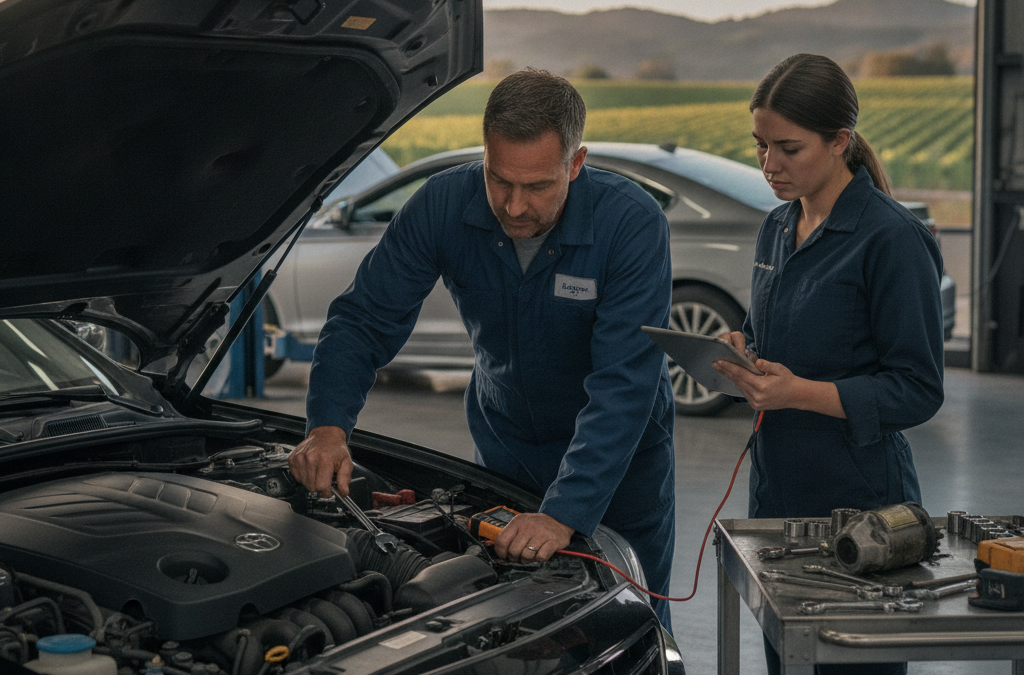
Before any repair, a good shop will test the starter, battery, and charging system together — not in isolation. You want to know you’re replacing the right part. We don’t sell you a starter if your battery is actually the problem, and we don’t clear the no-start and send you home without confirming what caused it. That’s just how we operate.
As a general reference point, starter replacements typically include both the part and labor. Costs vary by vehicle make and model, and we always provide a clear estimate before any work begins. No surprises.
Can You Drive with a Failing Starter?
Technically, once the engine is running, a bad starter doesn’t affect how the vehicle drives. But if the starter fails completely, you won’t be able to restart the car after turning it off. That means once you park — for gas, groceries, or a winery visit in Sonoma Valley — you may be stuck. It’s not a “drive it until it dies” situation you want to be in, especially if you’re relying on the vehicle for work or family transportation.
The sooner you get it checked, the more control you have over the timing of the repair. Complete auto repair doesn’t have to be reactive — catching this before you’re stranded is always the better outcome.
What Competitor Shops in Sonoma County Often Miss on This Topic
Most local shop websites cover starting system problems only in passing — usually buried in a general “electrical” or “battery” page without distinguishing between battery failure, alternator failure, and starter failure. That leaves drivers doing internet searches at midnight trying to figure out why their car won’t start in the morning, without clear answers.
A quality diagnosis doesn’t just check the battery voltage and call it done. It includes load-testing the battery, checking the charging output of the alternator, and testing starter draw with an amp clamp. If your shop isn’t doing all three before recommending a repair, you could be replacing the wrong part. We do this every time — it’s not extra, it’s just how a starting system should be diagnosed.
Frequently Asked Questions
Can a bad starter drain my battery?
Not usually while the car is off. But a starter that’s drawing too much current when cranking can stress the battery significantly. Over time, repeated hard starts can contribute to battery wear — which is why both should be tested together.
My car started fine yesterday. Why won’t it start today?
Intermittent starting problems are common with failing starters. Heat, vibration, and worn internal contacts can make the motor work sometimes and fail others. If it happened once, there’s a good chance it will happen again — get it looked at before you’re stuck somewhere.
Will a jump start work if my starter is bad?
Usually not. A jump start adds voltage to a low battery, but if the starter motor itself isn’t working, additional voltage won’t fix it. If jumping the car doesn’t help, that’s actually a useful clue pointing toward the starter rather than the battery.
How long does a starter replacement take?
On most common vehicles — Toyotas, Hondas, Fords, Chevys — it’s typically a same-day repair. More complex engine layouts can take longer. We’ll give you an honest time estimate upfront.
Do I need to replace the battery at the same time as the starter?
Not automatically, but we’ll test your battery during the same visit. If the battery is borderline — especially on a vehicle that’s had hard starts for a while — it may make sense to replace both at once and save a return trip.
Get Your Starting System Checked Before You’re Stranded
If your car is giving you hesitation, clicks, or slow cranking, don’t wait until it won’t start at all. We serve drivers throughout Petaluma, Rohnert Park, Windsor, Sonoma, and all of Sonoma County — and we’re honest about what you actually need. No upselling, no guessing, no surprises on the bill.
Contact On Site Auto Repair today to schedule a free estimate or starting system diagnostic. We treat your car the same way we’d treat our own — because that’s the only way we know how to work.