
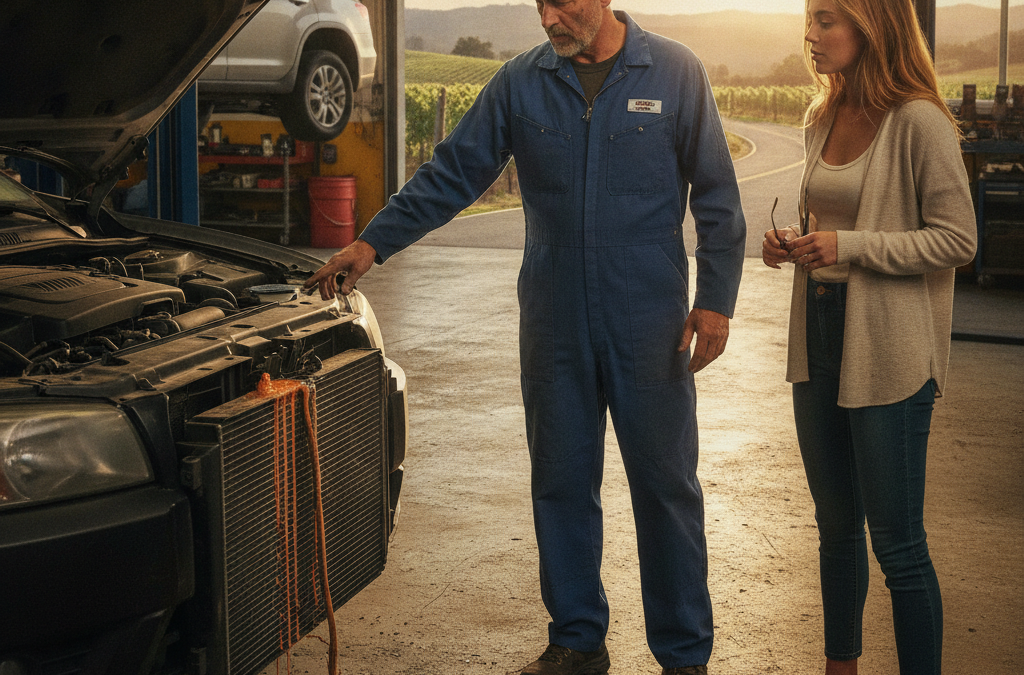
Why Is My Car’s Radiator Leaking or Clogged in Santa Rosa? What Sonoma County Drivers Need to Know About Radiator Problems
If you’ve ever noticed a small puddle of bright green or orange fluid under your car, or watched your temperature gauge creep toward the red during a summer drive through Wine Country, your radiator may be trying to tell you something. A leaking or clogged radiator is one of the most common — and most overlooked — cooling system problems in Sonoma County. And in Santa Rosa, where summer temperatures routinely push into the 90s and drivers are putting serious miles on Highway 101, a failing radiator can go from minor annoyance to expensive engine damage faster than you’d expect.
The good news? Radiator problems are almost always caught and fixed before they become a crisis — as long as you know what to look and listen for.
What Does a Radiator Actually Do?
Your radiator sits at the front of your engine bay and does one job: it keeps your engine from cooking itself. Coolant circulates through your engine, absorbs heat, flows into the radiator, gets cooled by airflow through the fins, and then loops back through again. It’s a continuous cycle that runs every time your engine is on.
When that cycle is interrupted — by a leak, a clog, or a cracked tank — heat builds up fast. Engines aren’t designed to run hot. Even a few minutes of significant overheating can warp cylinder heads, blow gaskets, or cause damage that runs into thousands of dollars. Catching a radiator problem early is one of the smartest things you can do for your car’s long-term health.
Warning Signs Your Radiator Is Leaking or Failing
These are the most common signs that something’s wrong with your radiator — and none of them should be ignored:
- Coolant puddle under the car. Bright green, orange, pink, or blue fluid on your driveway or parking spot is a classic sign of a coolant leak. It usually has a slightly sweet smell. Don’t confuse it with water dripping from your AC drain — that’s normal. Colored fluid is not.
- Temperature gauge climbing higher than normal. If your gauge is creeping toward the red — especially during stop-and-go traffic or long highway stretches — your cooling system isn’t keeping up. Pull over safely before it reaches the danger zone.
- White smoke or steam from under the hood. If you see steam rising from the engine bay, your coolant is boiling somewhere it shouldn’t be. This is a stop-immediately situation.
- Low coolant reservoir level. If you’re topping off your coolant more often than you used to, there’s a leak somewhere — even if you can’t see it on the ground. Slow leaks often evaporate before they hit the pavement.
- Discolored or sludgy coolant. Coolant should be bright and clear. If it looks brown, oily, or has debris floating in it, your radiator may be corroded internally or contaminated with engine oil — a sign of bigger trouble.
- Gurgling or bubbling sounds. Unusual noises from your cooling system, especially when the engine is warming up, can indicate air pockets caused by a leak or a failing head gasket.
What Actually Causes Radiator Problems in Sonoma County?
Radiators don’t usually fail overnight. Most problems develop slowly, driven by a handful of factors that are especially common here in the North Bay.
Age and corrosion are the leading culprits. Coolant breaks down over time, becoming acidic and eating away at the inside of your radiator. Most manufacturers recommend a coolant flush every 30,000 miles or every two to five years — whichever comes first. Many drivers in Santa Rosa go much longer than that, especially if the car is running fine otherwise.
Summer heat accelerates wear on every part of your cooling system. When temperatures climb in July and August and you’re sitting in traffic on Santa Rosa Avenue or making a trip out to the Sonoma Valley, your radiator is working overtime. That sustained heat stress shortens the lifespan of hoses, clamps, and the radiator core itself.
Wildfire ash and debris can clog the radiator’s external fins, reducing airflow and efficiency. After a fire season, it’s worth having your radiator inspected — especially if you park outside. This is a maintenance angle that most shops in the area don’t talk about enough, but it’s real.
Road debris and impact damage are more common than you’d think. If you’ve hit a rock or debris on a backroad near Sebastopol or Windsor, it’s possible you took a small hit to the front of your radiator without even knowing it. These hairline cracks often don’t show up until the engine gets hot and pressure builds.
Learn more about our complete cooling system services for Santa Rosa and Sonoma County drivers.
Radiator Leak vs. Clog: What’s the Difference?
These two problems feel similar from the driver’s seat — both cause overheating — but they have different root causes and different fixes.
A radiator leak means coolant is escaping somewhere: a cracked plastic tank, a corroded seam, a damaged hose connection, or a pinhole in the core. Small leaks can sometimes be temporarily addressed with a stop-leak product from the parts store, but these are band-aids at best. They can clog passages and make the eventual proper repair more expensive. The right fix is a pressure test to find the exact source, followed by a proper repair or radiator replacement.
A clogged radiator means coolant is flowing too slowly or not at all through the internal passages. This is usually caused by years of scale buildup, old deteriorated coolant, or contamination. The radiator might look fine from the outside but be nearly blocked internally. A coolant flush helps prevent this. If the clog is severe, the radiator may need to be replaced or rodded out.
Can You Drive With a Leaking Radiator?
Honestly? Not for long, and not safely. A slow leak might give you a day or two before things get critical, but once your coolant level drops enough that your engine loses its heat protection, damage happens quickly. We’ve seen engines in Rohnert Park and Petaluma come in with blown head gaskets and warped heads that could have been avoided entirely if the driver had addressed a known leak a week earlier.
If your temperature gauge is rising or you can smell coolant burning, pull over, turn off the engine, and let it cool completely before doing anything else. Do not remove the radiator cap when the engine is hot — the pressurized steam can cause serious burns. Once it’s cooled down, check the coolant level and call us.
What Does Radiator Repair or Replacement Actually Cost?
Costs vary depending on your make and model, and whether the radiator needs a simple repair or a full replacement. A coolant flush — which is the best preventive measure — is typically one of the more affordable services on the maintenance calendar. Radiator replacement ranges more widely depending on whether you drive a basic commuter sedan or a larger truck or SUV with a more complex cooling system.
What we’ll always do at On-Site Auto Repair is give you a clear, honest estimate before any work begins. No surprises, no pressure. If we find that a flush and new hoses will solve the problem, we’ll tell you that — we’re not going to recommend a full radiator replacement when it isn’t needed.
How Often Should You Flush Your Coolant in Santa Rosa?
Most manufacturers recommend a coolant flush every 30,000 miles or every two to three years for conventional green coolant, and every 50,000 to 100,000 miles for extended-life coolants (the orange or pink types used in many newer vehicles). If you’ve been driving the same car for five years and can’t remember the last time your coolant was changed, it’s probably overdue.
For drivers in Windsor, Sebastopol, or anywhere else in the North Bay who spend time on rural roads or put significant miles on their vehicles during tourist season, sticking to that schedule pays off. A $100 flush today is far cheaper than a $3,000 head gasket job later.
Frequently Asked Questions About Radiator Problems in Sonoma County
How do I know if my radiator is leaking or if it’s something else?
The easiest first check is your coolant reservoir — if the level is consistently dropping, you have a leak somewhere in the system. A shop can do a pressure test to pinpoint the exact location. Not all leaks drip on the ground; some burn off on hot engine surfaces before they hit the pavement.
My car is overheating, but I don’t see any leaks. Why?
Overheating without visible leaks usually points to an internal blockage (clogged radiator), a failing water pump, a stuck thermostat, or a head gasket issue allowing combustion gases into the coolant. A proper diagnostic is the only way to know for sure — guessing and replacing parts without testing wastes money.
Is it safe to add water to my radiator in an emergency?
Plain water in a pinch is better than letting your engine overheat, but it’s a temporary measure only. Water alone doesn’t have the corrosion inhibitors or freeze protection that coolant provides. Get the system properly refilled with the right coolant as soon as possible.
Do newer cars have radiator problems too?
Yes. Plastic tank radiators — common on most vehicles built since the 1990s — are actually more prone to cracking with age than the older all-metal designs. The plastic becomes brittle over time, especially with repeated heat cycling. Toyota, Honda, Subaru, Ford, and Chevy trucks alike — we see radiator issues across all makes and model years.
How long does a radiator replacement take?
For most vehicles, a straightforward radiator replacement takes two to four hours in the shop. More complex setups — like some European vehicles or trucks with large auxiliary coolers — can take longer. We’ll always give you a realistic timeline upfront so you can plan your day.
Don’t Wait Until You’re Stranded on the Side of the Road
Radiator problems are one of those things where acting early makes a real difference — both for your wallet and for how long your engine lasts. Whether you’ve noticed a small puddle in your driveway, your temperature gauge is acting up on your commute, or you just can’t remember the last time your coolant was serviced, it’s worth getting it checked out.
At On-Site Auto Repair in Santa Rosa, we’ve been helping Sonoma County drivers stay on the road since 2011. We work on all makes and models — from Toyotas and Hondas to Subarus, Fords, and everything in between — and we’ll always tell you exactly what we found and what it’ll take to fix it, with no pressure and no upselling.
Contact us today to schedule a cooling system inspection or request a free estimate. We’d rather help you catch a small problem now than see you on the side of Petaluma Hill Road with steam pouring out of your hood.