Why Is My Car’s Clutch Slipping or Hard to Press in Santa Rosa? What Manual Transmission Drivers Need to Know
If your clutch pedal suddenly feels like it’s fighting back — or your engine revs are climbing but your car isn’t actually accelerating the way it should — you’re probably dealing with a clutch problem. For manual transmission drivers in Santa Rosa and the surrounding Sonoma County area, these symptoms are worth taking seriously. A slipping clutch doesn’t fix itself, and a stiff pedal can leave you stranded at a stoplight faster than you’d think.
The good news is that most clutch problems give you plenty of warning before they fail completely. Once you know what to look for, you can usually catch it early enough to avoid a much bigger repair bill.
What Does a Slipping Clutch Actually Feel Like?
Clutch slip happens when the friction disc inside your clutch assembly wears down and can no longer maintain a solid grip between the engine and the transmission. When it starts to go, you’ll notice that pressing the accelerator makes your engine rev up — but the car doesn’t speed up the way it should. It can feel like the vehicle is hesitating, or like you’re in a gear that’s slightly too high for the speed you’re at.
A few specific things to watch for:
- RPMs jump during acceleration but the car doesn’t pull forward with them — especially noticeable when merging onto Highway 101 or climbing the hills around Fountaingrove or Bennett Valley
- A burning smell after heavy traffic or hill starts — that’s clutch material overheating from excessive slippage
- Difficulty getting into gear smoothly — grinding or resistance when shifting, even when you’re fully pressing the pedal
- The engagement point feeling higher than usual — if the clutch used to catch low in the pedal travel and now catches near the top, the disc is wearing thin
If you’re doing a lot of stop-and-go driving in Roseland or commuting through Rohnert Park on surface streets, a worn clutch will show its age faster. Hill starts are especially rough on a slipping clutch — and Santa Rosa has no shortage of those.
Why Is My Clutch Pedal So Stiff or Hard to Push?
A clutch pedal that suddenly feels heavy or stiff is a different problem — and it’s often a hydraulic one. Most modern vehicles use a hydraulic clutch system, which means there’s a master cylinder and slave cylinder working together to operate the clutch. When one of those components starts to fail, or when the hydraulic fluid gets old and contaminated, you’ll feel it directly in how hard it is to press the pedal.
Other causes of a stiff pedal include:
- A failing clutch master cylinder — often accompanied by a spongy or inconsistent pedal feel
- A worn or binding clutch cable — on older vehicles with cable-operated clutches, the cable itself can fray or corrode, especially in wet conditions or on vehicles that have been sitting
- A seized pilot bearing or worn pressure plate — these can create resistance and make the whole system feel tight
- Low or contaminated hydraulic fluid — similar to brake fluid, clutch hydraulic fluid absorbs moisture over time and breaks down
If your pedal is stiff and you’re also noticing fluid on the floor on the driver’s side, or a soft and spongy feel when pressing, a hydraulic leak is likely. That needs attention right away — you can lose the ability to disengage the clutch entirely if the system runs dry. Manual transmission and clutch service covers the full system, from the hydraulics to the friction components themselves.
How Long Should a Clutch Last in Sonoma County?
A clutch is technically a wear item — like brake pads, it’s designed to be replaced eventually. Under normal driving conditions, a clutch can last anywhere from 60,000 to well over 100,000 miles depending on the vehicle, the driver, and how the vehicle is used.
That said, a few local driving conditions can accelerate clutch wear significantly:
- Hilly terrain — If you live in Fountaingrove, Bennett Valley, or anywhere with regular hill starts, your clutch works harder every single day. Riders who “ride the clutch” on inclines wear friction material much faster.
- Stop-and-go commuting — Whether you’re crawling down Mendocino Avenue at 5 PM or sitting in traffic on the 101 heading south toward Petaluma, repeated partial engagement wears the clutch faster than highway driving.
- Towing or hauling heavy loads — Trucks and vans used for work purposes, common in the trades-heavy neighborhoods of southwest Santa Rosa, put extra stress on the clutch during every take-off.
- Aggressive or inexperienced shifting — Newer drivers who are still learning, or drivers who downshift hard regularly, will see shorter clutch life.
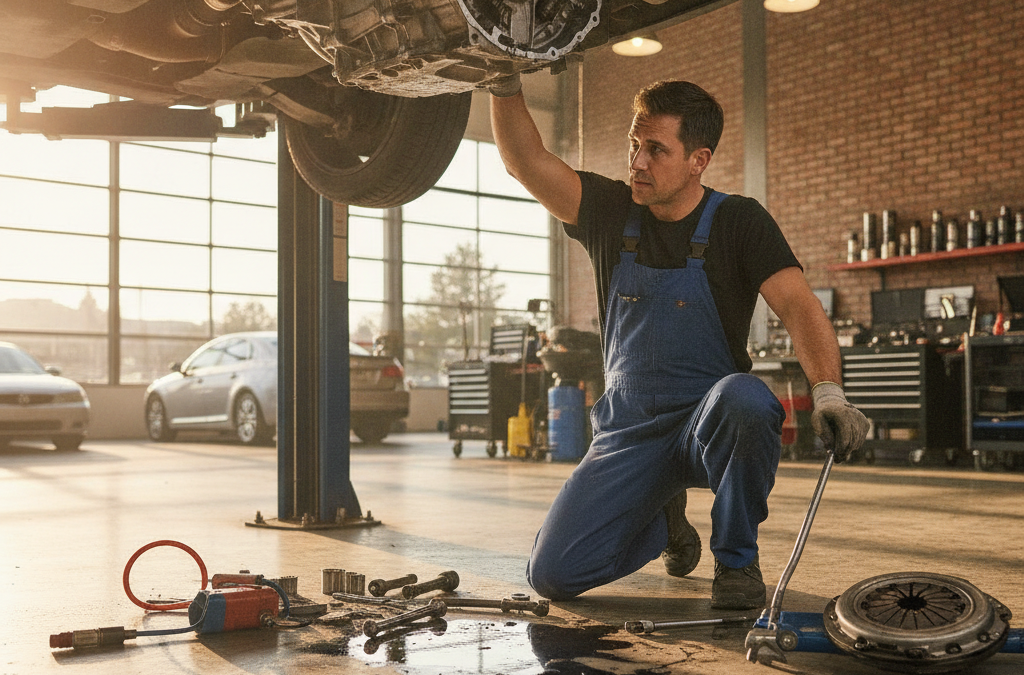
When we inspect a clutch, we’re looking at the friction disc thickness, the condition of the pressure plate and flywheel, the hydraulic components, and the release bearing. Often if the disc is worn, the flywheel has taken some heat damage and needs to be resurfaced or replaced at the same time — which is why it pays to inspect everything while the transmission is already out.
Manual Transmission Clutch Service: What the Competitors Aren’t Telling You
Here’s something that tends to get glossed over at a lot of shops: the clutch job isn’t just about the clutch disc. When a technician pulls a transmission to replace a clutch, the labor to access everything is already done. If you only replace the friction disc and skip the pressure plate, release bearing, and flywheel inspection — you may be back in six months with a new problem in the same area.
A complete clutch job should typically include:
- Clutch disc replacement
- Pressure plate inspection and replacement if needed
- Flywheel resurfacing or replacement
- Release (throw-out) bearing replacement
- Inspection of the pilot bearing
- Clutch master and slave cylinder check
Cutting corners here is a false economy. Ask your shop whether they include the full clutch kit or just the disc. At On Site Auto Repair, we walk you through exactly what we found, what we recommend, and why — no pressure, no surprises.
Clutch Problems by Make and Model: What We See Locally
Some vehicles are more prone to clutch issues than others, and in Sonoma County we work on a wide variety of them. Subaru manual transmissions (common with older WRXs and Foresters driven in Sebastopol and out toward the Russian River Valley) can develop slave cylinder leaks over time. Honda Civics and Fits with high mileage often need clutch jobs around 80,000–100,000 miles. Ford Rangers and older F-150s used for work frequently show accelerated wear from towing. Volkswagen and Mazda manuals tend to have good clutch longevity but can be expensive to service if you take them to the wrong shop.
We service clutches across all makes and models, domestic and import — and we’re familiar with the quirks of each.
Frequently Asked Questions About Clutch Problems in Santa Rosa
Can I keep driving if my clutch is slipping?
For a short time, maybe — but not for long. A slipping clutch will continue to wear faster the more you drive it, and eventually it will slip so badly the car won’t move at all. It’s better to get it checked while it’s still drivable than to get stranded.
Is a stiff clutch pedal dangerous?
It can be. If a hydraulic failure is causing the stiffness, you could lose the ability to disengage the clutch entirely, which makes the vehicle very difficult to operate safely. If your pedal suddenly feels dramatically harder than usual, get it inspected right away.
How much does a clutch replacement cost?
Clutch replacement costs vary quite a bit depending on the vehicle make, model, and what components need to be replaced alongside the disc. Labor is the biggest factor since the transmission has to come out. We provide honest estimates upfront — contact us for a free assessment specific to your vehicle.
Does On Site Auto Repair service manual transmissions?
Yes. We service both automatic and manual transmissions, including clutch systems, on all makes and models. We’ve been doing this since 2011 and we treat your car the same way we’d want our own taken care of.
My clutch is fine at the moment, but my car is getting up there in miles. Should I have it inspected?
If you’re over 60,000 miles on a manual transmission vehicle, especially if you do a lot of hill driving or stop-and-go commuting around Santa Rosa or Rohnert Park, it’s worth having the clutch system checked during your next service visit. Catching wear early gives you time to plan the repair instead of reacting to a breakdown.
Ready to Get Your Clutch Checked in Santa Rosa?
Whether your clutch is already slipping, your pedal feels off, or you just want to know where things stand on a high-mileage manual transmission vehicle, we’re here to help. On Site Auto Repair has been serving Santa Rosa and Sonoma County drivers since 2011 — no upselling, no unnecessary repairs, just honest work and straight answers.
Contact us to schedule a free estimate or clutch inspection. We work on all makes and models, and we’ll tell you exactly what we find before we do anything.