Why Are My Shocks and Struts Worn Out Already? What Healdsburg and Sonoma County Drivers Need to Know
If your car has started feeling like it’s bouncing down the highway instead of gliding, or if you’ve noticed it swaying a little too much when you change lanes on Highway 101, there’s a good chance your shocks or struts are past their prime. This is one of the most overlooked maintenance items we see at On Site Auto Repair in Santa Rosa — and it’s especially common among drivers who regularly travel Sonoma County’s winding backroads, hilly neighborhoods, and rural wine country routes. The good news is the warning signs are usually obvious once you know what to feel for, and catching it early saves you from more expensive repairs down the road.
Shocks vs. Struts — What’s the Difference, and Does It Matter?
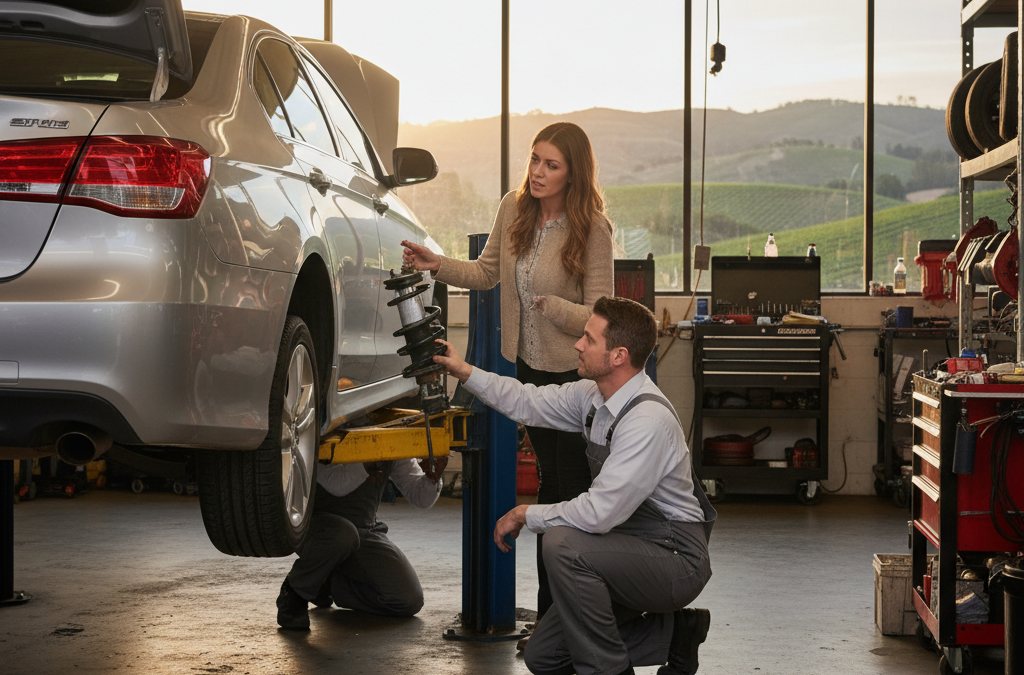
A lot of people use these terms interchangeably, and that’s understandable — they do similar jobs. Both are part of your suspension system and work to dampen the up-and-down movement of your wheels so your tires stay in contact with the road. But they’re built differently. A shock absorber is a standalone component; a strut is a structural part of the suspension that also includes a coil spring. Many front-wheel-drive vehicles use struts up front, while trucks and SUVs are more likely to run separate shocks.
What matters for you as a driver is this: when either one wears out, your vehicle becomes harder to control, your tires wear unevenly, and your braking distances increase. That last point is important — worn shocks and struts can add several extra feet to how long it takes you to stop. On a busy stretch of Old Redwood Highway or coming downhill out of Fountaingrove, that extra distance matters.
Warning Signs Your Shocks or Struts Need Attention
You don’t need a lift and a flashlight to suspect suspension trouble. Your car will usually tell you. Here’s what to watch — and feel — for:
- Excessive bouncing after a dip or bump. If your car keeps rocking after you hit a pothole or railroad crossing, that’s a classic shock/strut symptom. A healthy car should settle within one or two cycles.
- Nose-diving when you brake. Does the front of your car dip forward aggressively when you slow down? That’s your struts struggling to manage weight transfer.
- Body roll in turns. If your car leans noticeably when you corner — especially on curvy routes through the Russian River Valley or Sonoma Valley — your suspension is losing its ability to keep the vehicle stable.
- Cupped or scalloped tire wear. This one trips people up because they assume it’s a tire problem. Uneven wear that looks wavy or cupped around the tread is often caused by a bouncing wheel — which means worn shocks.
- Clunking or knocking sounds over bumps. This usually means a component is loose or a mount has worn through. Don’t ignore it — things that clunk can become things that break.
- Vibrating steering wheel. If your steering wheel shimmies at highway speed or over rough pavement, worn struts can be part of the equation alongside alignment and tire balance issues.
Why Sonoma County Roads Are Especially Hard on Suspension
Most suspension manufacturers quote a general service interval of around 50,000 miles, but that number assumes average road conditions. In Sonoma County, average doesn’t quite cover it.
If you live in or regularly drive through areas like Bennett Valley, Oakmont, or Fountaingrove, you’re dealing with steep grades and sharp turns on a daily basis. Every time you crest a hill and come back down, your suspension is working hard. Drivers commuting from Healdsburg or Cloverdale down Highway 101 toward Santa Rosa put a lot of miles on their vehicles in a short period of time — and highway miles still accumulate wear, especially with the uneven pavement sections common on that corridor.
Then there are the winery backroads. If you’re regularly running out to the Russian River Valley or heading through the hills toward Sebastopol or Sonoma, you know those roads can have their share of crumbling edges, frost heaves, and the occasional unmarked dip. That kind of irregular terrain adds up. We regularly see vehicles from Windsor and Healdsburg come in with suspension wear well below the 50K threshold simply because of how and where they’re driven.
Learn more about our steering and suspension services for Sonoma County vehicles.
What the Competitors Aren’t Telling You: The Alignment Connection
Here’s something that doesn’t get enough attention in most local shop content — and it’s a genuine gap we’ve noticed: replacing shocks and struts without checking your alignment is a mistake. Worn suspension components allow your wheels to shift out of proper geometry over time. Once you install fresh struts, that misalignment doesn’t fix itself. If you drive away without an alignment check, you’ll start wearing through your new components and your tires unevenly almost immediately.
At On Site Auto Repair, we always recommend — and perform — a wheel alignment check after any suspension work. It’s not an upsell. It’s just the right way to do the job. Your tires are one of the biggest investments on your vehicle, and a $100 alignment can protect a $600 tire set for years to come.
The same logic applies if you’ve recently hit something significant — a deep pothole, a curb at speed, or one of those unmarked speed bumps that seem to multiply in Sonoma County parking lots every winter. Even if nothing feels dramatically wrong afterward, it’s worth having the alignment checked. Subtle misalignment is almost impossible to detect without a proper rack, and it quietly destroys tires and steering components over months.
How Long Does Shock and Strut Replacement Take — and What Should You Expect?
A full set of four shocks or struts (or a combination of both, depending on your vehicle) is typically a half-day job for most cars and trucks. Some vehicles — particularly certain German models or trucks with complex suspension geometry — can take longer. If you’re only replacing a pair (front or rear), you might be in and out in two to three hours.
We’ll always give you a clear, honest estimate before any work begins. We’ll tell you what needs to be replaced now, what can wait, and what’s still in good shape — so you’re not walking out with a bill full of surprises. That’s how we’ve worked since we opened, and it’s not going to change.
If you drive a Subaru, Toyota 4Runner, Ford F-150, or any lifted or modified vehicle, let us know ahead of time — parts lead times and labor complexity can vary, and we’d rather set accurate expectations upfront.
See how suspension checks fit into our preventive maintenance approach.
A Quick Self-Test You Can Do Right Now
Not sure if your suspension needs attention? Try the bounce test. Find a safe, empty spot, put your weight on the front corner of your car (lean on it firmly), then let go. Count how many times it bounces before settling. Once or twice is normal. Three or more times, and you’ve got a shock or strut that’s losing its damping ability. Do the same at the rear. It’s not a substitute for a professional inspection, but it gives you a useful data point before you call.
Frequently Asked Questions
How often should shocks and struts be replaced in Sonoma County?
The standard guidance is every 50,000 miles, but if you’re regularly driving hilly terrain in areas like Fountaingrove or Bennett Valley, or putting frequent miles on rural roads to Healdsburg or Cloverdale, you may see wear closer to 40,000 miles. An inspection at that point is a smart call.
Can I drive with worn shocks or struts?
Technically yes, but it’s not recommended. Worn shocks increase stopping distances, reduce stability in emergency maneuvers, and cause uneven tire wear. The longer you wait, the more it costs in tires and secondary damage to other suspension components.
Do I need to replace shocks and struts in pairs?
Yes — always replace in axle pairs (both fronts or both rears). Replacing just one creates an imbalance in handling and wear. If one side is worn enough to replace, the other side is almost always close behind.
Will new shocks and struts improve my braking?
Yes, noticeably. Fresh shocks and struts keep your tires planted more firmly on the road, which improves the contact patch your brakes have to work with. It’s one of the most underappreciated safety upgrades you can make to a high-mileage vehicle.
Does On Site Auto Repair handle suspension work on trucks and SUVs?
Absolutely. We work on all makes and models — from compact Hondas and Subarus to full-size trucks like the Ford F-150, Ram 1500, and Chevy Silverado. If you drive a larger vehicle or a lifted rig, just give us a heads-up when you call so we can make sure we have everything ready.
Serving Healdsburg, Santa Rosa, and All of Sonoma County
Whether you’re commuting from Healdsburg to Santa Rosa every morning, running wine country deliveries between Cloverdale and Sonoma, or just trying to keep a family hauler in good shape in Windsor or Sebastopol — your suspension is worth paying attention to. It affects how your car rides, how it handles, how it stops, and how long your tires last.
At On Site Auto Repair, we’ve been diagnosing and fixing suspension problems for drivers across Sonoma County since 2011. We’ll tell you honestly what needs attention and what doesn’t. No pressure, no padding the bill, no overselling parts you don’t need.
If you’ve noticed any of the warning signs above, or if it’s simply been a while since anyone looked under your car, reach out to us today for a free estimate. We’re easy to get to from anywhere in the county, and we’ll take good care of your vehicle — same as we would our own.