
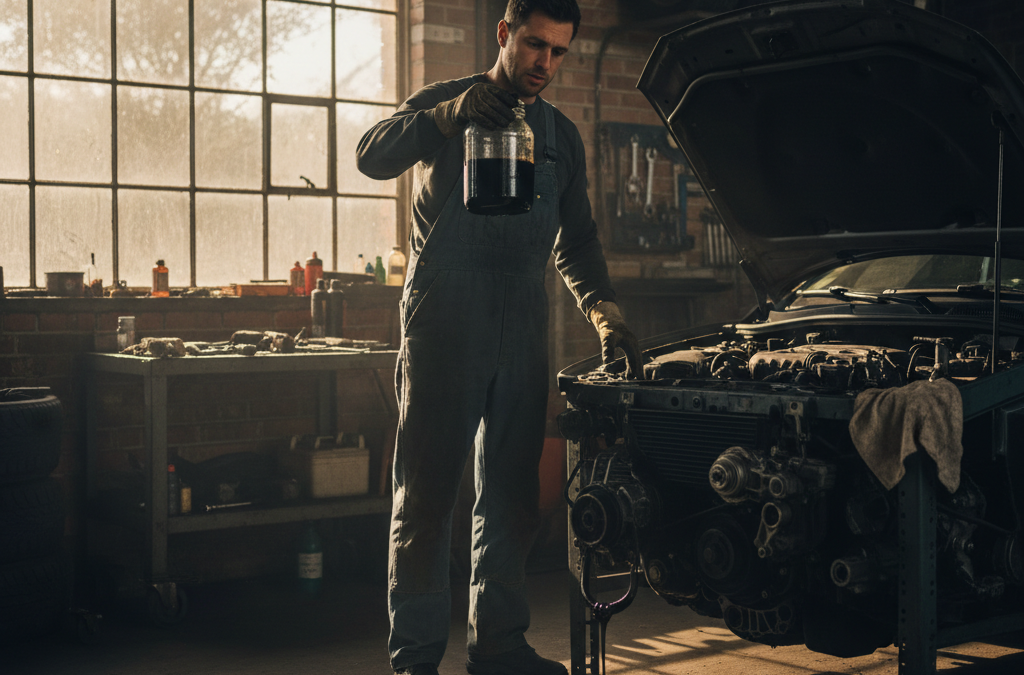
Why Is My Oil Looking Dark and Gritty in Rohnert Park? What Your Engine Oil Is Actually Telling You
If you’ve ever pulled your dipstick and noticed the oil looks almost black, feels gritty between your fingers, or — worse — looks like a chocolate milkshake, your engine is trying to tell you something. Dark oil by itself isn’t always an emergency, but gritty, foamy, or milky oil is a different story entirely. For drivers in Rohnert Park and throughout Sonoma County, understanding what your oil actually looks like — and what it means — can be the difference between a routine service visit and a very expensive engine repair.
What Does Normal Engine Oil Look Like?
Fresh engine oil is amber-colored, almost like honey, and it coats the dipstick in a clean, smooth film. As it does its job — lubricating metal surfaces, absorbing heat, and collecting combustion byproducts — it naturally darkens. That’s expected. A dark oil color on its own doesn’t automatically mean it’s overdue for a change; some synthetic oils and certain engines run oil darker than others within normal service intervals.
What you’re looking for is texture and consistency. Rub a small amount between your thumb and forefinger. It should feel slick and smooth. If it feels gritty or rough, that’s a sign of metal particles or dirt contamination — and that’s not normal at any mileage.
What Gritty Oil Actually Means
Grit in your engine oil usually points to one of a few problems. The most common? The oil simply hasn’t been changed often enough, and the filter is saturated. Once the filter hits capacity, contaminants — metal shavings, carbon deposits, combustion residue — start circulating freely through your engine. Every time that gritty oil passes through a bearing or a valve, it’s doing microscopic damage.
In some cases, gritty oil signals something more serious: excessive internal engine wear. If metal is actively flaking off your engine components, you’ll feel it in the oil before you hear it in the engine. This is especially worth watching on higher-mileage vehicles — older Subarus, high-mile Hondas, or any vehicle that’s been pushed hard on long Highway 101 commutes from Rohnert Park or Cotati down into Marin County.
If you’re seeing grit, don’t just change the oil and forget it. Have a technician check it and, if warranted, run an oil analysis or inspect for wear patterns. Catching internal engine wear early is the difference between an inexpensive fix and a full engine replacement.
Milky or Foamy Oil Is a Red Flag — Don’t Ignore It
If your oil looks light brown, creamy, or foamy — almost like a latte — coolant has gotten into the oil. This is one of the most serious warning signs your engine can give you, and it needs same-day attention. Coolant contamination typically means a blown head gasket, a cracked engine block, or a failed intake manifold gasket. Once coolant mixes with oil, the oil loses its ability to lubricate, and engine damage accelerates fast.
Subaru owners in Sonoma County, take note: the older EJ-series engines found in 2000s-era Foresters, Outbacks, and Impreza WRXs have a documented history of head gasket failure. If you own one of these and haven’t had the head gaskets inspected, checking the oil condition is a quick first indicator. Milky residue under the oil cap is a classic sign.
Other vehicles prone to this problem include older Chevrolet and GMC trucks with the 5.3L or 6.0L V8 (intake manifold gasket failures), and several Chrysler/Dodge engines from the mid-2000s. If you drive any of these, it’s worth keeping an eye on your oil.
What About Oil That Burns Off Too Quickly?
If you’re regularly adding oil between changes — more than about a quart every 1,000 miles — your engine is burning it. You might notice blue-tinged exhaust smoke, especially on startup. This typically points to worn piston rings or valve stem seals, and it can happen in high-mileage vehicles or in engines that ran low on oil for extended periods.
Burning oil isn’t always a death sentence for the engine, but it does need to be monitored carefully and addressed. Running low on oil — even briefly — dramatically increases internal wear.
How Local Driving Conditions in Rohnert Park and Sonoma County Affect Your Oil
Oil life isn’t just about mileage — it’s also about how and where you drive. Rohnert Park commuters who spend time idling in Highway 101 traffic, making frequent short trips around Cotati or down toward Petaluma, or driving in stop-and-go conditions are actually harder on their oil than someone logging the same miles on an open highway. Short trips don’t let the engine fully warm up, which means fuel and moisture can contaminate the oil more easily.
During Sonoma County’s fire seasons, ash and fine particulate matter in the air can also accelerate air filter and oil filter saturation. If you were driving regularly during a heavy smoke event — the kind we’ve seen affecting Santa Rosa and surrounding communities — it’s worth checking your filters sooner than your usual interval.
Hot summer temperatures also push oil harder. When it’s consistently in the 90s and your engine is working overtime on a longer drive, oil breaks down faster. Full synthetic oil handles heat significantly better than conventional, which is one reason we often recommend it for Sonoma County drivers — especially if you’re running an older vehicle that sees varied conditions.
How Often Should You Actually Change Your Oil?
The old rule of thumb — every 3,000 miles — is outdated for most modern vehicles. If you’re running full synthetic oil (which most vehicles 2010 and newer recommend), many manufacturers specify 5,000 to 10,000 miles between changes, depending on driving conditions. Some Toyota and Honda models can go even longer under ideal conditions.
That said, the “severe service” category matters. If you’re towing, making lots of short trips, idling frequently, or driving in dusty conditions — all of which apply to plenty of Sonoma County drivers — your real-world interval is shorter than what the owner’s manual lists for normal use. When in doubt, check your oil condition yourself between services. It only takes 30 seconds and a paper towel.
If you’re unsure what interval is right for your specific vehicle and how you drive it, that’s exactly the kind of question we’re happy to answer honestly — without upselling you on services you don’t need. Our preventive maintenance services are built around what your car actually needs, not what generates the most revenue.
What to Do If Your Oil Looks Off
- Dark but smooth: Likely just due for a change. Schedule a service within the next few hundred miles.
- Gritty or rough texture: Change the oil immediately and have a technician assess for internal wear.
- Milky or foamy: Stop driving and have the vehicle inspected right away — this is a same-day situation.
- Oil level dropping between changes: Track how fast it drops and bring it in to check for burning or leaks.
- Smells like fuel: Fuel dilution of the oil can happen with certain driving patterns or injection issues — worth having checked.
If your vehicle has thrown a check engine light alongside any of these oil symptoms, don’t wait. Our auto diagnostic services can read what the engine is actually logging and connect the dots before small problems become big ones.
Frequently Asked Questions
Is dark oil always a sign I need an oil change?
Not necessarily. Oil darkens naturally as it does its job, and this is normal — especially with synthetic oil. What matters more is the texture (smooth vs. gritty), the level, and how long it’s been since your last change. Check both color and feel.
My oil looks fine but I haven’t changed it in 8,000 miles. Should I still change it?
Yes. Even if the oil looks okay, its additive package — the chemistry that protects your engine — degrades over time regardless of appearance. Follow your manufacturer’s recommended interval, and factor in your actual driving conditions.
Can I drive with milky oil for a few days until I get to a shop?
No — please don’t. Coolant-contaminated oil loses its lubricating properties quickly. Continuing to drive can cause severe and permanent engine damage within a short distance. Have it towed or inspected immediately.
Do I need to use the oil brand my dealer recommends?
No. What matters is the viscosity (like 5W-30) and the specification (like API SP or ILSAC GF-6) matching your owner’s manual. Using a quality full synthetic oil from any reputable brand that meets your spec is fine — and you don’t need to go to a dealership to get it done right.
How do I know if my engine is burning oil vs. leaking it?
If you’re losing oil but don’t see puddles under your car, it’s likely burning. Look for blue-gray smoke from your exhaust, especially when you first start the engine or when you lift off the throttle going downhill. A technician can do a leak-down or compression test to confirm.
We’ll Tell You Straight — No Upselling
At On Site Auto Repair in Santa Rosa, we’ve been working on vehicles since 2011, and we treat your car the same way we’d treat our own. If your oil is fine and you’ve got miles to go before your next change, we’ll tell you that. If something looks wrong, we’ll explain exactly what we’re seeing and give you a straight answer on what it’ll take to fix it — no pressure, no inflated repair lists.
Whether you’re in Rohnert Park, coming up from Petaluma, or anywhere else in Sonoma County, reach out and let us take a look. A quick oil inspection costs you nothing, and it could save your engine.
Contact us today to schedule a free estimate or ask us a question — we’re here to help you keep your vehicle running the way it should.