
Why Is My Car’s Engine Oil Leaking in Santa Rosa? What Sonoma County Drivers Need to Know About Oil Leaks
If you’ve noticed a dark, slippery puddle under your car in the driveway — or you’re burning through oil faster than you used to — you’re dealing with an oil leak. And yes, it matters. An oil leak in Santa Rosa isn’t just a nuisance or a cosmetic problem. It’s your engine quietly asking for help. Left alone, a small drip can turn into low oil pressure, accelerated engine wear, or in the worst cases, a seized engine that costs far more to replace than the original repair ever would have. The good news is that most oil leaks, caught early, are very fixable — and far less expensive than what happens when you ignore them.
What Does an Oil Leak Actually Look Like?
Oil leaks show up in a few different ways. The most obvious is a dark brown or black puddle under your parked car — usually toward the front or middle of the vehicle. But not all leaks make it to the ground. Some burn off on the exhaust manifold and create a faint burning smell when the engine is hot, which is easy to confuse with other issues. Others seep slowly onto the underside of the engine and just look like general grime.
Here’s what to watch for:
- A dark puddle on your driveway or parking spot — especially if it’s oily and not watery (coolant is usually green, orange, or pink; oil is brown to black)
- The oil level on your dipstick dropping between oil changes — if you’re adding a quart every few weeks, something is leaking or burning
- A burning smell coming from the engine when the car is warmed up — oil dripping onto hot engine components will smoke
- Blue or gray smoke from the exhaust — this usually points to oil burning internally, though it can overlap with external leak symptoms
- A greasy, crusty buildup around the engine — look for it around the valve covers, oil pan, or where gaskets meet
If you see any of these signs, don’t just top off the oil and hope for the best. That’s a short-term fix that’s masking a real problem.
The Most Common Sources of Engine Oil Leaks
Oil leaks aren’t random — they come from specific places. A good mechanic will trace the leak to its actual source rather than guess. Here are the most common culprits we see on vehicles brought in from Santa Rosa, Rohnert Park, Sebastopol, and throughout Sonoma County:
Valve Cover Gasket
This is probably the most common oil leak on older vehicles. The valve cover sits on top of the engine and is sealed with a rubber gasket. Over time — especially with the temperature swings we get in Sonoma County, hot dry summers followed by cooler wet winters — that rubber hardens, shrinks, and cracks. Oil then seeps out along the top of the engine and often drips onto the exhaust, creating that burning smell. On many four-cylinder engines, a valve cover gasket replacement is a relatively straightforward repair.
Oil Pan Gasket
The oil pan sits at the bottom of the engine and holds all the oil when the engine is off. The gasket that seals it to the engine block can wear out or get damaged — sometimes from road debris or improper installation during a past oil change. This is one of the leaks most likely to create that telltale puddle in your driveway.
Rear Main Seal
The rear main seal sits between your engine and transmission, sealing the crankshaft where it exits the engine. When this seal fails, you get a significant oil leak that drips from the back of the engine. It’s a more involved repair because of where it’s located, but it’s not something to put off — especially if you drive longer commutes on Highway 101 toward the Bay Area, where low oil pressure at highway speeds can cause serious engine damage fast.
Front Crankshaft Seal
Similar to the rear main seal but at the front of the engine. This one often goes unnoticed longer because the leak drips inside the timing cover area and can contaminate your timing belt — which is a much bigger problem if it causes the belt to slip or fail.
Oil Filter or Drain Plug
Sometimes the simplest answer is the right one. A loose or cross-threaded drain plug, or an oil filter that wasn’t tightened properly, can cause a real leak. If you’ve recently had an oil change somewhere else and now notice oil dripping, that’s worth checking right away.
Why Santa Rosa’s Climate Accelerates Oil Leaks
Gaskets and seals are made of rubber and synthetic materials that don’t last forever — and Sonoma County’s climate works against them. The dry summer heat bakes rubber components, causing them to harden and lose their ability to flex and seal properly. Then the cooler, wetter months cause contraction. That repeated cycle of expansion and contraction over years takes a toll, especially on higher-mileage vehicles. Drivers in neighborhoods like Oakmont and Fountaingrove, where hilly terrain means engines work harder and run hotter, sometimes see gasket wear accelerate a little faster than average.
Vehicles in Roseland and other parts of southwest Santa Rosa that are kept on the older side of the mileage spectrum are also more prone to leaks — not because they’re maintained poorly, but simply because seals and gaskets have more years on them. A higher-mileage Honda, Toyota, or Subaru can absolutely run well past 200,000 miles, but it needs leaks addressed when they show up rather than deferred.
Can You Drive with an Oil Leak? Honestly, Here’s the Answer
It depends on how bad it is. A very minor seep — barely a drop a day — might be something you monitor closely while scheduling a repair. But anything beyond that, especially if your oil level is dropping noticeably between changes, is a serious risk. Engines don’t survive long when oil pressure drops. If your oil pressure warning light comes on, pull over safely and call for help — don’t drive on it.
As a general rule: if you can see a puddle or you’re adding oil more than once between oil changes, treat it as something to diagnose and fix now, not later. The repair almost always costs far less than the engine damage that follows if you wait. Our complete auto repair services include full engine leak diagnosis — we’ll tell you exactly what’s leaking, where it’s coming from, and what it’ll take to fix it.
What the Diagnosis Actually Involves — And Why It Matters
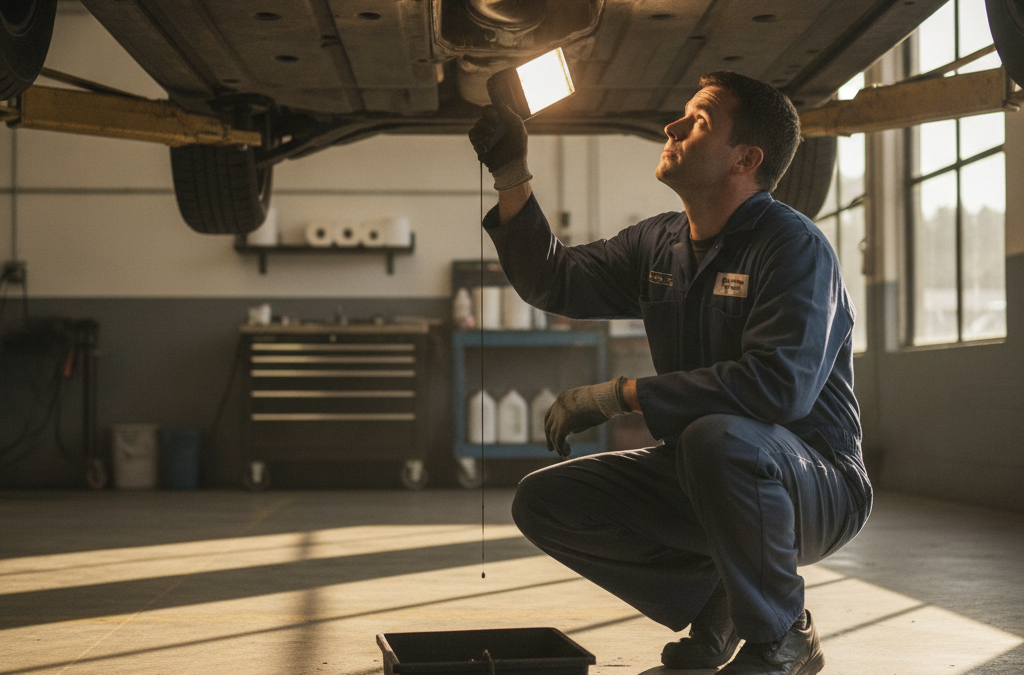
One thing that surprises a lot of people is how tricky oil leak diagnosis can be. Oil doesn’t always drip from the exact spot where it’s leaking — it flows and travels along engine surfaces before it drips. That means the puddle under your car might be six inches away from the actual source of the leak. Proper diagnosis usually involves cleaning the engine, sometimes using a UV dye added to the oil, and then running the vehicle and inspecting carefully with a light to trace the leak to its origin.
Skipping that step leads to misdiagnosis — replacing a valve cover gasket when the real problem is an oil pressure sensor, for example. At On-Site Auto Repair, we don’t guess. We trace it to the source before recommending any repair.
Oil Leaks by Vehicle Brand: What We See Most Often in Sonoma County
Some vehicles are more prone to certain leaks than others. Here’s a quick honest breakdown based on what we see regularly:
- Subaru (especially older EJ-series engines): Infamous for valve cover gaskets and rear main seals. If you own an older Outback or Forester, this is worth keeping an eye on.
- Toyota and Lexus: Generally very reliable, but higher-mileage 4Runners, Tacomas, and Camrys do develop valve cover gasket and oil pan gasket leaks eventually.
- Honda and Acura: V6 models in particular can develop valve cover gasket leaks. The Accord and Odyssey are common culprits.
- Ford and Chevy trucks: Rear main seals and oil pan gaskets are frequent issues on high-mileage trucks, especially ones used for towing or hauling.
- German vehicles (VW, Audi, BMW, Mercedes): These tend to develop oil leaks at higher frequency than Japanese brands as they age. Valve cover gaskets, cam seals, and oil cooler gaskets are common on these platforms.
If you drive a Subaru and have been watching for signs of leaks, you can also learn more about Subaru-specific repair and maintenance for Sonoma County owners.
What a Fair Oil Leak Repair Quote Looks Like
We’ll be straightforward with you: repair costs vary widely depending on where the leak is coming from and what vehicle you drive. A valve cover gasket on a simple four-cylinder engine is one of the more affordable gasket jobs. A rear main seal on a V8 truck involves more labor and costs more. We don’t have a one-size-fits-all number to give you here, and any shop that quotes you a flat price without seeing the vehicle is guessing.
What we can tell you is that we provide free estimates, we explain exactly what we found and why a repair is needed, and we don’t add on services you don’t need. If we find something else while we’re in there, we’ll show you and let you decide — not pressure you into unplanned repairs.
Frequently Asked Questions About Oil Leaks in Sonoma County
How do I know if the puddle under my car is oil or something else?
Oil is typically dark brown to black, slippery, and smells like, well, motor oil. Coolant is usually greenish, orange, or pink and has a slightly sweet smell. Transmission fluid is reddish. Water from the AC condenser is clear and odorless. If you’re not sure, put a piece of white cardboard under the car overnight and check the color and consistency in the morning.
Can I use an oil stop-leak additive from the auto parts store?
These products can temporarily slow a minor seep, but they don’t fix the underlying problem and can sometimes cause issues with seals elsewhere in the engine. We don’t recommend them as a long-term solution. Use them only to buy yourself a day or two to get to a shop — not as a permanent repair.
My oil leak is small — can I just keep an eye on it and add oil as needed?
In the very short term, you can monitor it carefully. But this approach carries real risk: oil leaks don’t usually stay small forever, and if your oil level drops when you’re not watching, you could damage your engine without warning. It’s better to have it diagnosed and fixed.
How often should I check my oil level between changes?
Once a month is a good habit for most drivers. If you know you have a minor leak or you drive a higher-mileage vehicle, check it every two weeks or every couple of fill-ups at the gas station. Two minutes with the dipstick can save you thousands of dollars.
Does On-Site Auto Repair work on all makes and models for oil leaks?
Yes. We work on domestic and foreign vehicles — Toyota, Honda, Ford, Chevy, Subaru, Volkswagen, Mercedes, Nissan, Hyundai, Kia, and many others. If it has an engine and it’s leaking oil, we can diagnose and repair it.
Don’t Let an Oil Leak Turn Into an Engine Repair
The pattern we see over and over is this: a driver notices a drip, figures it’s not urgent, keeps topping off the oil, and then one day the engine warning light comes on — or worse, the engine starts knocking. At that point, what could have been a few hundred dollars in gasket work becomes a much larger conversation about engine repair or replacement.
If you’re seeing oil spots in your driveway, getting a burning smell from under the hood, or watching your oil level drop faster than it used to, bring your vehicle in. We’ll find the leak, give you a straight answer about what it’ll take to fix it, and get you back on the road. Contact On-Site Auto Repair to schedule a free estimate — we serve Santa Rosa, Windsor, Petaluma, Sebastopol, Rohnert Park, and drivers throughout Sonoma County.