Why Does My Car Smell Burning When I Drive in Sonoma County? What Different Smells Actually Mean
If you’ve noticed a burning smell coming from your car while driving around Santa Rosa or on the highway, don’t assume it’s nothing — and don’t assume it’s everything either. A burning odor can mean something as minor as a plastic bag melted on your exhaust or as serious as an oil leak dripping onto a hot engine block. The key is knowing which smell you’re dealing with, because they really do point to different systems and different levels of urgency. Let’s walk through the most common ones.
Burning Smell After Hard Braking — Especially on Sonoma County Hills
This is one of the most common smells we hear about from drivers in Santa Rosa, and it’s especially common if you live in or regularly drive through hilly neighborhoods like Fountaingrove, Bennett Valley, or Oakmont. If you’ve been riding your brakes down a long grade or doing a lot of stop-and-go in traffic, you might notice a sharp, acrid burning smell — almost like scorched metal or overheated friction material.
That’s your brake pads overheating. It’s called brake fade, and while it can happen to any vehicle, it’s more common when brakes are already worn thin, when brake fluid is old and moisture-contaminated, or when a driver is consistently using the brakes to control speed on steep descents instead of downshifting.
One important note: if this smell happens even during normal, flat driving — not just after a long hill — that’s a different story. A stuck caliper can cause one brake to drag constantly, which generates heat even when you’re not braking at all. That’s a situation that needs attention soon, not eventually. Brake service is one of the most safety-critical things you can stay on top of, especially if you’re doing regular Highway 101 commutes from Windsor or Petaluma.
That Sharp, Oily Burning Smell — Probably an Oil Leak
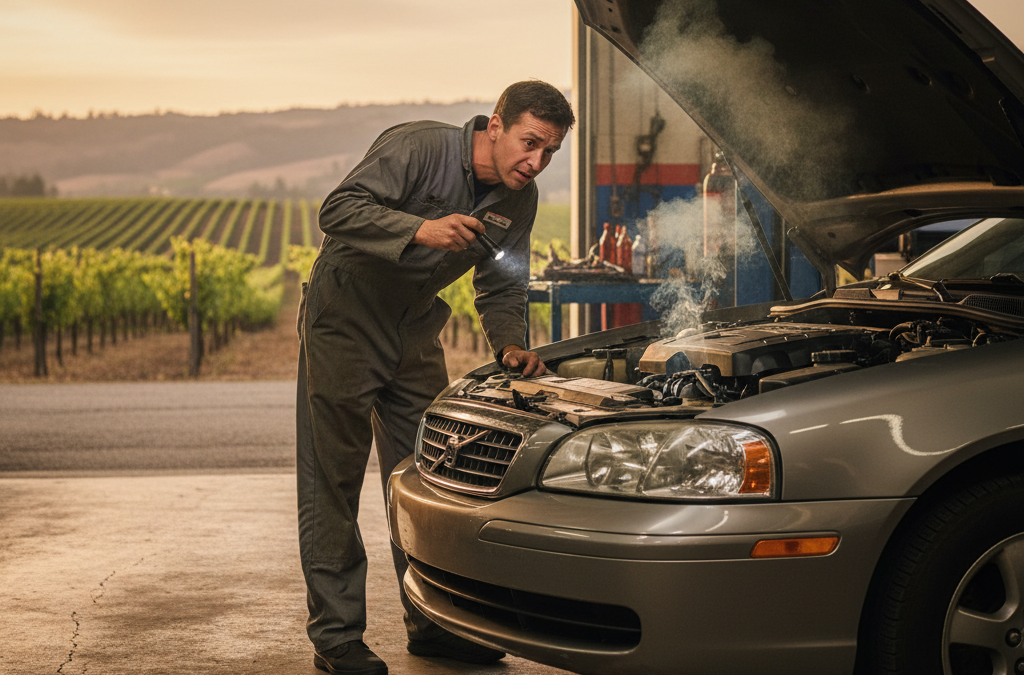
An oil leak that drips onto a hot exhaust manifold, engine block, or other hot surface will burn off and create a very distinctive smell. It’s acrid, slightly smoky, and often stronger right after you park and the engine starts cooling down. You might also notice a thin wisp of smoke rising from under the hood.
Oil leaks are common on higher-mileage vehicles, and if you’re driving a Subaru, older Ford, or a German vehicle like a BMW or Volkswagen, valve cover gasket leaks are a fairly typical culprit. The smell itself isn’t immediately dangerous, but an oil leak left alone can lead to bigger problems — low oil levels, engine damage, or in a worst-case scenario, a fire if oil contacts extremely hot components.
If you’re noticing this smell regularly, it’s worth having someone take a look. A quick visual inspection under the hood can often pinpoint where the leak is coming from before it becomes a more expensive repair.
Sweet or Syrupy Smell — That’s Coolant, Not a Good Sign
Coolant (antifreeze) has a distinctly sweet smell — almost like maple syrup or fruit candy. If you’re picking up that scent from inside the cabin or from under the hood after driving, it usually means coolant is leaking somewhere and hitting a hot surface, or in some cases, it’s being burned inside the engine itself.
A coolant smell inside the car — especially combined with fogging windows or a slick film on the inside of the windshield — is a sign your heater core may be leaking. Outside the cabin, it could be a hose, a leaking radiator, or a failing water pump seal. Either way, coolant loss leads to overheating, and overheating leads to serious engine damage. This one shouldn’t wait. With Sonoma County summers getting genuinely hot, the last thing you want is to be dealing with an overheating engine on the 101 in July.
Burning Rubber Smell — Check More Than Just the Tires
The obvious assumption when you smell burning rubber is that it’s your tires. And sometimes it is — if you’ve been doing a lot of sharp turns, or if a tire is rubbing against something (a misaligned wheel, a loose fender liner, or worn suspension components can all cause this). But burning rubber can also come from a rubber hose or belt that’s slipped off its track and is contacting a hot or spinning part of the engine.
Drive belts and serpentine belts are made of rubber compounds, and when they start slipping or glazing — usually because the tensioner is worn — they can emit a rubber burning smell. If that belt fails completely, you could lose power steering, your alternator, or your water pump, depending on what it drives. If the smell is new and you can’t trace it to anything obvious, a diagnostic inspection is the right move.
Electrical or Burning Plastic Smell — Take This One Seriously
A burning plastic or electrical smell — think melted wire insulation or a hot circuit board — is the one that warrants the most caution. Electrical fires in vehicles can develop quickly and with little warning. Common causes include a short circuit, a failing component like an alternator or blower motor drawing too much current, or even a rodent that’s chewed through wiring (more common than you’d think in rural parts of Sonoma County, Sebastopol, and Healdsburg).
If you smell something electrical and it’s coming from inside the cabin — especially near the dashboard or from the vents — pull over when it’s safe to do so and don’t dismiss it. Turn off the car, check for visible smoke, and call for help if anything looks wrong. This isn’t a drive-home-and-deal-with-it-tomorrow situation.
For anything that might be electrical in nature, a proper auto diagnostic inspection can help identify whether there’s a fault code related to a failing component before it becomes a real problem.
Wildfire Smoke and Your Car’s Ventilation System
This one is specific to Sonoma County and the broader North Bay. During fire season, the smoke and ash that gets pulled through your car’s ventilation system can leave behind residue in your cabin air filter and HVAC ducts. If you notice a persistent smoky or musty smell when you run your heat or AC — even after fire season is over — it’s worth replacing the cabin air filter and having your AC system inspected. This is something that comes up every fall for a lot of drivers in Rohnert Park, Santa Rosa, and the areas closest to recent burn zones.
Frequently Asked Questions
Is a burning smell from my car always an emergency?
Not always, but it’s always worth identifying quickly. Overheated brakes after a long downhill drive will usually resolve on their own once you stop and let them cool. But electrical smells, coolant smells inside the cabin, and persistent oil smells should be checked out soon — don’t just wait and see.
Can I drive my car if it smells like burning oil?
Short distances, maybe — but check your oil level first. If it’s low, top it off before driving. An active oil leak that’s contacting hot engine parts is a fire risk if the leak is large enough. Get it inspected as soon as you can.
Why does my car smell like burning only when the heater is on?
If it happens at the start of cold weather, it could just be dust burning off the heater core after months of sitting unused. If it persists or smells sweet (like coolant) or electrical, those are different issues worth looking into — especially a sweet smell, which often indicates a heater core leak.
My car smells like burning after I park it in Oakmont or Fountaingrove — why does the smell seem worse there?
Hilly neighborhoods mean your brakes work harder than average. If the smell is concentrated right after parking following a downhill drive, it’s most likely brake heat. But if you’re also noticing the smell on flat roads or at low speeds, a stuck caliper or dragging brake is worth ruling out.
How much does it cost to diagnose a burning smell?
At On Site Auto Repair, we don’t charge you just to look at the car and tell you what’s going on. We’d rather give you an honest answer upfront than send you home guessing. Costs vary depending on what’s actually causing the issue, but we’ll always explain what we found and what it’ll take to fix it before any work begins.
Get It Checked Before a Small Problem Becomes a Big One
Burning smells are your car’s way of flagging something that’s out of the ordinary. Some are minor. Some are urgent. But none of them should be ignored for long — especially if you’re relying on your vehicle for daily commutes, hauling kids around Santa Rosa, or making runs to Petaluma and Windsor for work.
We’ve been diagnosing and repairing vehicles across Sonoma County since 2011, and we treat every car we work on like it belongs to someone we know — because it usually does. If something smells off, reach out and let us take a look. We’ll give you a straight answer and a fair estimate, no runaround.