
Why Is My Car’s Battery Draining Overnight in Rohnert Park? What a Parasitic Draw Actually Means
You wake up in Rohnert Park, head out to your car, turn the key — and nothing. Or maybe just a sad clicking sound. You jump it, it starts fine, and by the next morning it’s dead again. If this is happening to you, the battery itself might not even be the real problem. What you’re likely dealing with is something called a parasitic draw — an electrical component in your car that keeps pulling power from the battery even after you’ve shut everything off and walked away for the night.
This is one of those issues that’s easy to misdiagnose and expensive to get wrong. A lot of drivers end up replacing a perfectly good battery — twice, sometimes — before anyone figures out there’s actually a hidden electrical fault to blame. Here’s what’s really going on, how a proper diagnosis works, and what you should do if this is happening to your vehicle.
What Is a Parasitic Draw, and Why Does It Happen?
Every modern car has systems that stay partially active even when the vehicle is off — your clock, your alarm system, your key fob receiver. These tiny draws are completely normal and shouldn’t drain a healthy battery overnight. The problem is when something extra stays on that shouldn’t be.
A parasitic draw happens when a module, relay, circuit, or accessory fails to power down properly after you shut the car off. It keeps pulling electrical current from the battery the same way a phone charger left plugged into the wall keeps drawing a small amount of power. The difference is, your car battery has a limited capacity — and if that drain is large enough, it’ll be flat by morning.
Common culprits include:
- A stuck relay that keeps a module running when it should be off
- A faulty body control module (BCM) that doesn’t go into sleep mode
- An aftermarket accessory — a stereo, dash cam, or remote start — that was wired incorrectly
- A glove box, trunk, or under-hood light that stays on when the compartment is closed
- A malfunctioning alternator diode that allows current to flow backward
- A failing power seat or sunroof module that stays active
It can happen on virtually any make or model — Toyota, Honda, Ford, Chevy, Subaru, Kia, Volkswagen, and plenty of others. Newer vehicles with more sophisticated electronics are actually more prone to this kind of fault because there are simply more modules that can misbehave.
How a Real Parasitic Draw Diagnosis Actually Works
This is where a lot of shops — including some in the Rohnert Park and Cotati area — fall short. Diagnosing a parasitic draw correctly isn’t just plugging in a scan tool and reading a code. It takes time, patience, and the right procedure.
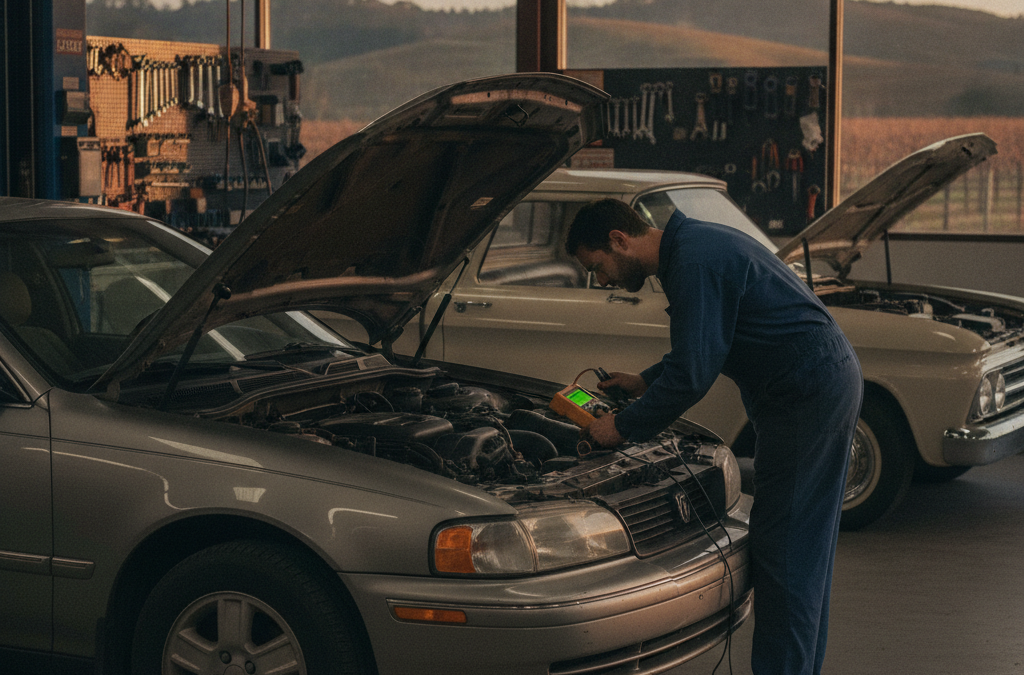
The proper method involves connecting a digital multimeter in series with the battery to measure how much current is flowing while the vehicle is in its fully-asleep state. That process alone can take 30 to 45 minutes, because modern vehicles often take that long to finish all their post-ignition tasks and go fully dormant. Rush that step and you’ll get a false reading.
Once you’ve confirmed there’s an abnormal draw — generally anything above about 50 milliamps for most passenger cars — you start pulling fuses one by one to identify which circuit is responsible. When the current drops, you’ve found your circuit. From there you trace back to the specific component.
The key word here is specific. A proper diagnosis tells you exactly what’s causing the drain. Replacing a battery without doing this work is like putting a new bucket under a dripping ceiling without fixing the leak. You’ll be back in the same situation within weeks.
At On Site Auto Repair, our auto diagnostic services include proper electrical testing — not just code reading — so we can actually track down what’s pulling from your battery instead of guessing.
Could It Just Be a Weak Battery or Aging Alternator?
Yes, absolutely — and that’s exactly why a real diagnosis matters before you spend money on parts.
A battery that’s more than four or five years old may simply not hold a charge well anymore, especially after Sonoma County’s hot, dry summers. Heat is the number one enemy of car batteries, and if your car sat outside during last summer’s heat waves, your battery may have aged faster than you’d expect. In that case, replacing the battery is the fix — but you should still have it load-tested first to confirm.
An alternator with a failing diode can also mimic a parasitic draw by allowing current to drain backward through the charging circuit at night. A simple alternator output test will catch this.
The bottom line: until you test both the battery and the charging system and measure the actual overnight draw, you’re just guessing — and parts guessing gets expensive fast.
Signs You’re Dealing With a Parasitic Draw (and Not Just a Dead Battery)
Not sure which problem you have? Here are some patterns to look for:
- Dead battery after sitting 24–48 hours — classic sign of a draw, especially if the car starts fine after a jump
- Battery dies faster when you add accessories — if the problem started after a new stereo or dash cam was installed, that accessory may be wired to a always-on circuit
- Battery warning light or flickering dash lights — can indicate an alternator diode issue
- You’ve already replaced the battery once and it’s happening again — this is the clearest sign that the battery wasn’t the root cause
- Car starts fine every morning but dies after a long weekend away — normal-range draw that’s just too high for the battery to sustain over several days
Drivers who commute on Highway 101 from Rohnert Park toward San Francisco or Petaluma and back every day sometimes don’t notice the problem right away — the daily driving keeps the battery topped off. It often shows up on weekends or after a trip when the car sits longer than usual.
What This Repair Typically Involves
Once the faulty circuit is identified, the repair depends on what’s causing the draw. Sometimes it’s a simple relay replacement — inexpensive and quick. Other times it’s a module that needs reprogramming or replacement, which can be more involved. If an aftermarket accessory was wired incorrectly, rewiring it to a switched circuit (one that only powers on with the ignition) usually solves the problem.
Whatever the fix, it should be paired with a fresh battery load test and an alternator check to make sure the whole charging system is healthy before you leave the shop. At On Site Auto Repair, we always give you a clear explanation of what we found and what it costs to fix it — no surprise add-ons, no pressure to approve work you didn’t ask for.
If your vehicle also needs broader electrical or engine attention, our team handles complete auto repair across all makes and models, so you don’t have to bounce between shops.
Frequently Asked Questions
How long does it take to diagnose a parasitic draw?
A thorough parasitic draw test takes at least an hour — sometimes longer, depending on how many circuits are involved and how long the vehicle takes to go into sleep mode. Anyone who tells you they diagnosed it in ten minutes with a code reader didn’t actually do the full test.
Is a parasitic draw dangerous to drive with?
The draw itself usually isn’t a safety hazard while you’re driving, but a battery that’s been repeatedly drained and jump-started can fail unexpectedly — including while you’re on the road. It’s worth getting it sorted sooner rather than later.
Can I test for a parasitic draw myself?
You can get a rough idea with a multimeter if you’re comfortable working around electrical systems, but the process requires patience, the right settings, and knowledge of what normal draw looks like for your specific vehicle. For most people, having a shop do it right the first time is the smarter call.
Does cold weather make parasitic draws worse?
Cold temperatures reduce battery capacity, so a draw that barely affects your battery in September might leave you stranded on a cold January morning in Rohnert Park or Petaluma. Winter often exposes electrical problems that were lurking all summer.
My car has a newer battery — could it still be a parasitic draw?
Yes. A brand-new battery will still drain overnight if there’s a significant draw. In fact, if your new battery is dying quickly, that’s one of the clearest signs that the battery was never the real problem to begin with.
Don’t Keep Jump-Starting the Same Problem
If you’re waking up to a dead battery more than once, the answer isn’t another jump or another battery replacement — it’s a proper electrical diagnosis. On Site Auto Repair has been serving drivers in Santa Rosa, Rohnert Park, Cotati, and across Sonoma County since 2011. We take the time to find the actual cause instead of guessing at parts, and we’ll explain exactly what we found before we do any work.
Give us a call at (707) 326-8655, email us at help@on-siteautorepair.com, or visit our contact page to schedule a diagnostic appointment. Stop replacing the same battery twice — let’s find what’s actually draining it.