Why Is My Car’s Radiator Failing in Windsor? What Sonoma County Drivers Need to Know About Cooling System Repairs
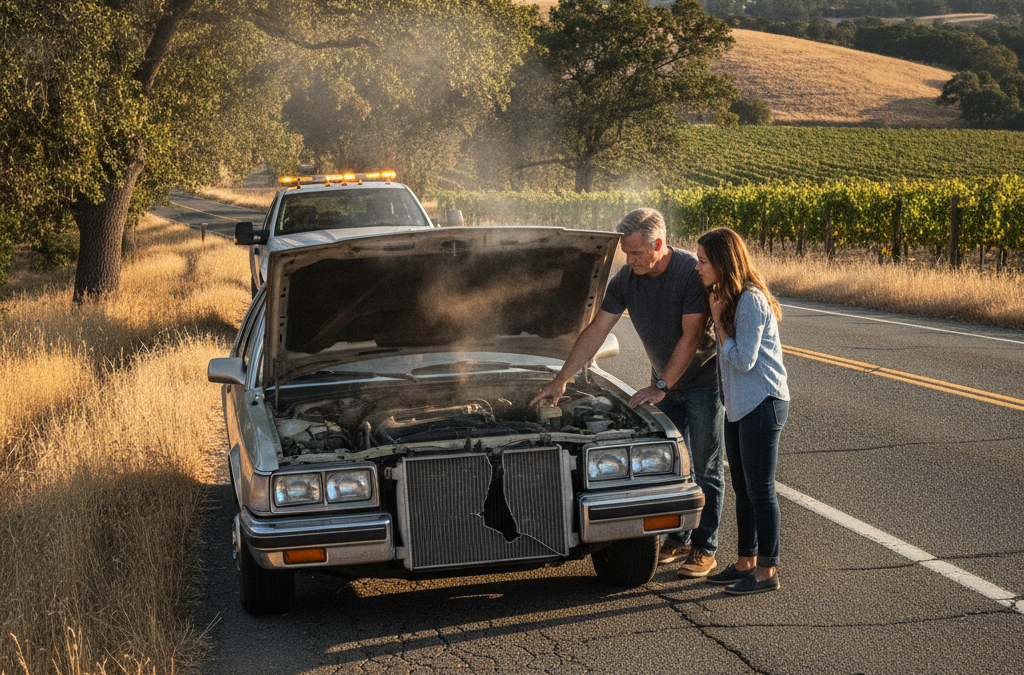
If your temperature gauge is creeping toward the red, you’re noticing a sweet smell coming from under the hood, or you’re finding a puddle of greenish or orange liquid where your car was parked — your radiator may be on its way out. For drivers in Windsor, Santa Rosa, and across Sonoma County, this isn’t a problem you want to ignore. A failing radiator can lead to engine overheating, and an overheated engine can mean cracked cylinder heads, blown head gaskets, or worse. Catching the problem early saves you from a bill that’s five to ten times bigger than a simple radiator repair.
What Does a Radiator Actually Do?
Your radiator sits at the front of the engine bay and acts as your engine’s heat exchanger. Hot coolant flows out of the engine, travels through the radiator’s thin metal tubes, gives off heat through the fins as air passes over them, and then cycles back into the engine cooled down and ready to absorb more heat. It’s a continuous loop — and when any part of it breaks down, your engine temperature climbs fast.
The radiator works in partnership with your water pump, thermostat, coolant reservoir, radiator cap, and cooling fans. A problem in any one of these can look like a radiator issue at first. That’s why a proper cooling system diagnosis matters — you want to know exactly which component is failing before parts start getting swapped out.
Warning Signs Your Radiator Is Starting to Fail
Most radiators don’t just blow out suddenly. They give you signals first. Here’s what to watch for:
- Rising temperature gauge: If the needle climbs higher than normal during your commute or while idling in traffic, that’s your first clue. Don’t wait to see if it comes back down on its own.
- Coolant leaks: A puddle under the front of your car — especially a bright green, orange, pink, or blue liquid — means coolant is escaping somewhere it shouldn’t. Leaks often start small, then get worse quickly.
- Sweet smell from the engine bay: Coolant has a distinctly sweet odor. If you smell it while driving or after you park, you’ve got a leak somewhere in the system.
- Visible rust, corrosion, or discoloration: Older radiators — especially on vehicles with 80,000 or more miles — can develop rust spots, white mineral deposits, or discolored areas where the metal has been compromised.
- Sludge in the coolant reservoir: If your coolant looks brown, oily, or gunky instead of bright and translucent, it’s been contaminated. This can happen when coolant breaks down over time or when oil finds its way into the cooling system.
- Coolant disappearing without a visible leak: If you’re topping off the reservoir regularly but can’t find a puddle, you may have an internal leak — meaning coolant is being burned inside the engine. That’s a serious sign of a head gasket or radiator issue.
Why Sonoma County Summers Are Especially Hard on Radiators
If you’re driving regularly in Windsor, through Healdsburg wine country, or down Highway 101 from Santa Rosa toward Rohnert Park, your cooling system is working harder than it might in a milder climate. North Bay summers can push ambient temperatures well into the 90s — and sitting in traffic on 101 in that heat is genuinely tough on any cooling system that isn’t 100% healthy.
Add in the fact that many Sonoma County drivers are putting serious miles on their vehicles — long daily commutes to the Bay Area will accelerate wear on hoses, clamps, and radiator cores — and you’ve got a recipe for cooling problems showing up sooner than you might expect. Vehicles with 60,000 to 100,000 miles that have never had a coolant flush are especially vulnerable heading into summer.
The terrain matters too. If you’re regularly driving into the hills east of Windsor or through the rural backroads near Healdsburg, your engine works harder going uphill and generates more heat — especially if you’re towing, hauling gear, or driving a larger SUV or truck.
What a Cooling System Inspection Actually Looks Like
When you bring your vehicle in to have the cooling system inspected, a thorough technician will check more than just the radiator. A proper inspection includes:
- Pressure-testing the cooling system to find leaks that aren’t always visible externally
- Checking coolant condition — its color, pH level, and freeze/boil protection range
- Inspecting hoses for cracks, softness, or bulging (silicone hoses last longer; original rubber hoses on older vehicles degrade)
- Testing the radiator cap — it’s a pressure-holding component, not just a lid, and a weak cap causes the system to boil over at lower temps
- Checking the water pump for bearing noise or weeping from the seal
- Verifying the thermostat is opening and closing properly
- Confirming cooling fans are operating at the right speeds for both low-speed and high-speed cooling
If any of these components are compromised, replacing the radiator alone won’t solve your overheating problem. That’s why a complete diagnosis — not just a visual once-over — makes a real difference.
Radiator Repair vs. Replacement: What’s the Right Call?
This is a question we get a lot, and the honest answer is: it depends on the vehicle, the age of the radiator, and the nature of the leak or damage.
Small cracks or pinhole leaks in aluminum radiators sometimes respond well to repair, but it’s often not a long-term fix. If the radiator core is structurally compromised, corroded, or heavily clogged with debris and scale, replacement is usually the smarter investment — especially if the vehicle is a daily driver that you depend on. A new radiator for most common vehicles (Toyota, Honda, Subaru, Ford, Chevy) is often a straightforward job with reasonable parts costs, and it gives you peace of mind for the next several years.
On higher-mileage vehicles or models with known cooling system vulnerabilities — Subaru owners, for example, know their vehicles have a history of head gasket and cooling system issues — we’ll always give you an honest assessment of whether the repair makes financial sense relative to the vehicle’s overall condition. No upselling, no pressure. Just a clear picture of what’s going on and what your options are.
How Often Should You Flush Your Coolant?
Most manufacturers recommend a coolant flush somewhere between 30,000 and 50,000 miles, or every 2 to 5 years — though some modern vehicles with long-life coolant can go longer. The honest answer is that many Sonoma County drivers are driving on coolant that’s well past its service life without knowing it.
Old coolant breaks down chemically. It loses its corrosion inhibitors, becomes more acidic, and starts eating away at the metal components inside your cooling system — including the radiator itself. A coolant flush isn’t just about preventing overheating; it’s about protecting every part of the system for the long haul.
If you’ve never had it done — or if you’re not sure when it was last done — it’s worth getting the system checked, especially before summer hits or before any long road trips through Wine Country.
What About Brand-Specific Cooling System Concerns?
Different makes handle cooling system wear differently, and it’s worth knowing your vehicle’s track record:
- Subaru: Known for head gasket issues on older four-cylinder engines that often show up as coolant loss without an obvious external leak. If you drive an older Outback, Forester, or Legacy, pay close attention to coolant level and any white exhaust smoke.
- Toyota and Honda: Generally reliable cooling systems, but hoses and water pumps do wear on higher-mileage vehicles. Timing belt replacement on older models is a good opportunity to service the water pump at the same time.
- Ford and Chevy trucks: Larger engines generate more heat, and trucks that are used for towing or hauling will stress the cooling system more than passenger cars. Radiator and transmission cooler condition both deserve attention.
- German vehicles (VW, Mercedes, BMW): Plastic components in the cooling system — expansion tanks, thermostat housings — are common failure points as these vehicles age. Staying ahead of these parts is cheaper than dealing with a breakdown.
Frequently Asked Questions: Radiator and Cooling System Repair in Sonoma County
How do I know if it’s the radiator or the water pump that’s failing?
A water pump failure often shows up as a whining or grinding noise from the front of the engine, or a weeping leak near the pump itself. Radiator failures tend to show up as external leaks at the core, tanks, or hose connections. A pressure test and visual inspection can usually tell them apart, but sometimes both need attention at the same time.
Can I drive my car if the temperature gauge is a little high?
We’d strongly recommend against it. Driving even a few miles with an overheating engine can warp cylinder heads or blow a head gasket — repairs that cost several times more than whatever cooling system issue started the problem. If the gauge is climbing, pull over safely, turn off the engine, and call for help.
Is a coolant flush worth it if my car isn’t overheating?
Yes. Coolant flushes are preventive maintenance, not just emergency repairs. Fresh coolant protects the radiator, water pump, and hoses from corrosion. It’s one of the lower-cost services that genuinely extends the life of your cooling system.
Do you service all makes and models in Windsor and the surrounding area?
Yes — we work on everything from Toyotas and Hondas to Ford trucks, Subarus, Kias, Volkswagens, and many others. If you’re not sure whether we handle your specific vehicle, just give us a call and we’ll let you know upfront.
How long does a radiator replacement typically take?
On most common vehicles, a radiator replacement can be completed in a few hours. More complex setups — or vehicles where other components need attention at the same time — may take a full day. We’ll give you an honest time estimate when you bring the vehicle in.
Get Your Cooling System Checked Before Summer Gets Here
If you’re in Windsor, Santa Rosa, or anywhere in Sonoma County and you’ve noticed any of the warning signs above — or if you simply can’t remember the last time your coolant was checked — don’t wait for a breakdown on the side of the highway to find out there’s a problem. The preventive maintenance approach is almost always cheaper, faster, and less stressful than dealing with an overheated engine.
At On Site Auto Repair, we’ve been serving Sonoma County drivers since 2011. We give you a straight answer about what your vehicle needs, we don’t push repairs you don’t need, and we treat every car that comes through our door like it belongs to someone we know — because it usually does.
Contact us today to schedule a cooling system inspection or get a free estimate. We’re here to help you stay on the road safely — no drama, no runaround.