
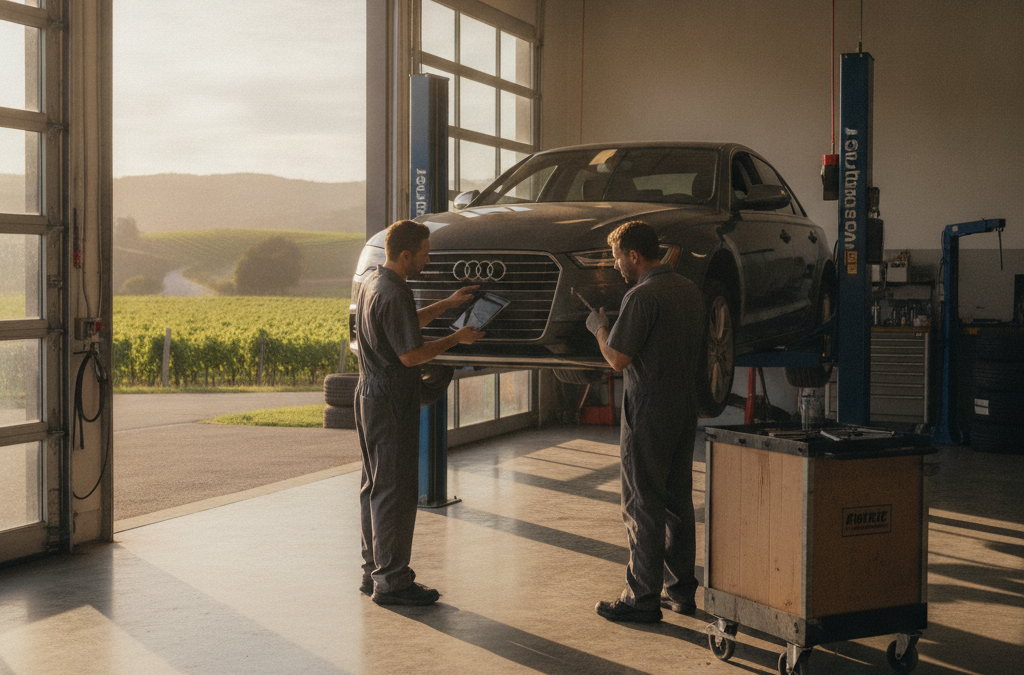
Why Is My Transmission Slipping or Hesitating in Sonoma? What Automatic Transmission Problems Actually Feel Like
If you’re driving through Sonoma Valley — maybe heading through Boyes Hot Springs toward the plaza, or winding up toward Kenwood — and your car suddenly revs high without actually picking up speed, that’s a transmission slip. It’s one of those symptoms that’s hard to describe but immediately recognizable when it happens. Your engine sounds like it’s working hard, but the car just… doesn’t go anywhere. Or your automatic shifts feel jerky and unpredictable, like the car can’t decide which gear it wants to be in.
That feeling is your transmission asking for help. And the sooner you listen, the better — because automatic transmission problems that get ignored tend to get significantly more expensive in a hurry.
What Transmission Slipping Actually Feels Like
A lot of people describe transmission problems in slightly different ways, which makes sense — there are a few distinct things that can go wrong, and they don’t all feel identical. Here are the most common experiences drivers describe when they bring their cars to us:
- Revving without accelerating: You press the gas, the engine RPMs climb, but the car doesn’t respond proportionally. It feels like the connection between the engine and the wheels just… let go for a second.
- Hesitation when shifting from park to drive: You put it in gear and there’s a delay before it actually engages — sometimes a noticeable clunk.
- Hard or jerky shifts: Instead of smooth transitions between gears, every upshift or downshift feels abrupt, like the transmission is slamming into place.
- Unexpected gear changes: The transmission shifts up or down at the wrong time, especially noticeable when you’re trying to hold speed on a flat stretch of Arnold Drive.
- Burning smell: Overheated transmission fluid has a very distinct sharp, burnt smell — different from brake smell or oil burning. If you notice it, don’t ignore it.
Any one of these on its own is worth paying attention to. More than one at the same time means you need to get it looked at soon.
Why Sonoma Valley Driving Is Harder on Transmissions Than You Might Think
Drivers around Sonoma, Glen Ellen, and Kenwood deal with a mix of conditions that can stress an automatic transmission more than flat-road driving. You’ve got stop-and-go traffic near the Sonoma Square on weekends — especially during harvest season when Wine Country tourism is at its peak — combined with the grade changes as you head up into the Sonoma Valley foothills.
Towing is another factor. If you occasionally haul a trailer to a property in the Sonoma hills, or you’ve been using your truck or SUV for vineyard work, that extra load puts real heat into the transmission. Heat is the number one enemy of automatic transmission fluid — and when the fluid breaks down, the internal components start to wear faster than they should.
That same summer heat that makes Sonoma Valley wine country so productive also means higher ambient temperatures under your hood. A transmission that’s running a little rough in the spring can really show its problems once temperatures climb into the 90s.
The Fluid Is Usually the First Thing to Check
A lot of transmission slipping — especially in the earlier stages — comes down to fluid condition and level. Automatic transmission fluid (ATF) does multiple jobs at once: it lubricates moving parts, transfers hydraulic pressure so gears can shift, and carries heat away from the internals. When it’s low, dirty, or degraded, all three of those functions suffer.
Many manufacturers now label their transmissions as having “lifetime fluid” — meaning they suggest you never need to change it. In practice, most mechanics who’ve worked on real-world vehicles for any length of time will tell you that’s optimistic. If you’re at 60,000 or 80,000 miles and you’ve never had your transmission fluid serviced, it’s likely past due regardless of what the sticker says.
A transmission fluid service — drain and refill, or a full flush depending on the vehicle — is one of the most cost-effective things you can do to extend your transmission’s life. It’s not glamorous, but it matters. You can learn more about what’s involved with transmission repair and service at On Site Auto Repair.
When It’s More Than Just Fluid: What Else Can Cause Slipping
If the fluid looks okay and the level is fine, the slipping is coming from somewhere else. Some of the more common culprits include:
- Worn clutch packs: Inside an automatic transmission, there are clutch packs that engage and disengage to shift gears. They wear over time, especially if the fluid hasn’t been serviced regularly.
- Solenoid issues: Shift solenoids are electrically controlled valves that direct fluid pressure to the right clutch packs at the right time. When a solenoid fails, you get late shifts, skipped gears, or erratic behavior. This will often trigger a check engine light.
- Torque converter problems: The torque converter connects your engine to your transmission. When it starts to fail, you may feel shuddering at highway speed or a loss of power during acceleration.
- Valve body wear: The valve body routes hydraulic pressure throughout the transmission. Wear or debris buildup here can cause hesitation and rough shifts that feel almost random.
Most of these issues are diagnosable with the right scan tools and a road test. Some of them are relatively straightforward to address. Others are more involved. The important thing is knowing which one you’re dealing with before you start spending money.
Repair or Replace? Here’s How to Think About It
This is the question that causes the most stress for vehicle owners, and honestly, it depends on a few things: the age and mileage of the vehicle, the extent of the damage, and what the vehicle is worth to you.
If a solenoid replacement or a fluid service resolves the issue, you’re usually looking at a manageable repair. If the internal clutch packs are worn or the torque converter has failed, the cost goes up — but a rebuilt or remanufactured transmission is often still worth it on a reliable vehicle with reasonable mileage. Buying a replacement vehicle at today’s prices is rarely the cheaper option.
We’ll always give you an honest assessment of what we find and what the options are — including what we’d realistically do if it were our own vehicle. No pressure, no upselling, just a straight answer. Drivers coming down from Petaluma or up from Rohnert Park on Highway 101 are often dealing with higher-mileage vehicles that have been doing long commutes for years. We understand what that kind of driving does to a transmission, and we’ll give you a quote that reflects what the job actually requires.
Brand-Specific Notes Worth Knowing
Some vehicles are more prone to transmission issues than others. A few things we see regularly:
- Honda and Acura: Some older V6 models have a history of automatic transmission failure, especially if fluid changes were skipped. If you’re driving a higher-mileage Honda, proactive fluid service is worth prioritizing.
- Ford and GM trucks: Generally robust transmissions, but they’re often used for towing and hauling — which adds thermal stress. An external transmission cooler can make a real difference if you’re regularly towing.
- Subaru CVT models: Continuously variable transmissions (CVTs) have their own fluid requirements and service intervals. They behave differently than traditional automatics — a CVT “slip” can feel unusual and is sometimes mistaken for an engine problem.
- Nissan CVT: Nissan’s CVT has had well-documented reliability issues in certain model years. If you’re driving a Nissan with a CVT that’s showing hesitation or shuddering, don’t wait on it.
Whatever you’re driving, the brand-specific quirks matter. We work on all makes and models and know the common failure patterns for most of them.
Frequently Asked Questions
How do I know if my transmission is slipping or if it’s an engine problem?
A good test: notice whether your engine RPMs rise normally when you accelerate. If the RPMs climb but your speed doesn’t follow, that’s a transmission slip. If both the RPMs and your speed feel sluggish, it’s more likely an engine or fuel delivery issue. When in doubt, a diagnostic scan will usually point toward the right system.
Can low transmission fluid cause slipping?
Yes — and it’s one of the first things to check. Low fluid reduces hydraulic pressure inside the transmission, which prevents the clutch packs from engaging fully. The fix might be as simple as a fluid top-off and service, especially if you catch it early.
Is it safe to keep driving with a slipping transmission?
Short answer: no. Driving on a slipping transmission accelerates internal wear and can turn a repairable problem into a full replacement situation. If you’re noticing it, get it checked as soon as you can — especially before a longer drive down to Marin County or over to Napa.
How often should I have my automatic transmission serviced?
Most vehicles do well with a transmission fluid service every 30,000 to 60,000 miles under normal driving conditions. If you tow, drive in stop-and-go traffic frequently, or put a lot of miles on Highway 101 commuting to the Bay Area, erring toward the shorter interval makes sense. Check your owner’s manual and ask your mechanic what they’ve seen on vehicles like yours.
Does On Site Auto Repair handle transmission diagnostics?
Yes — we run a full diagnostic before recommending any transmission repair, so you know exactly what you’re dealing with before any work begins. We service transmissions on all makes and models, including domestic trucks, Japanese imports, and European vehicles. Contact us to schedule a free estimate.
If your transmission has been feeling off lately — hesitating, slipping, shifting roughly — the best thing you can do is get it checked before it gets worse. We’re based in Santa Rosa and serve drivers throughout Sonoma County, including Sonoma, Glen Ellen, Boyes Hot Springs, Kenwood, and beyond. Give us a call at (707) 326-8655 or reach out through our contact page. We’ll take a look, tell you exactly what’s going on, and give you an honest quote with no pressure.