
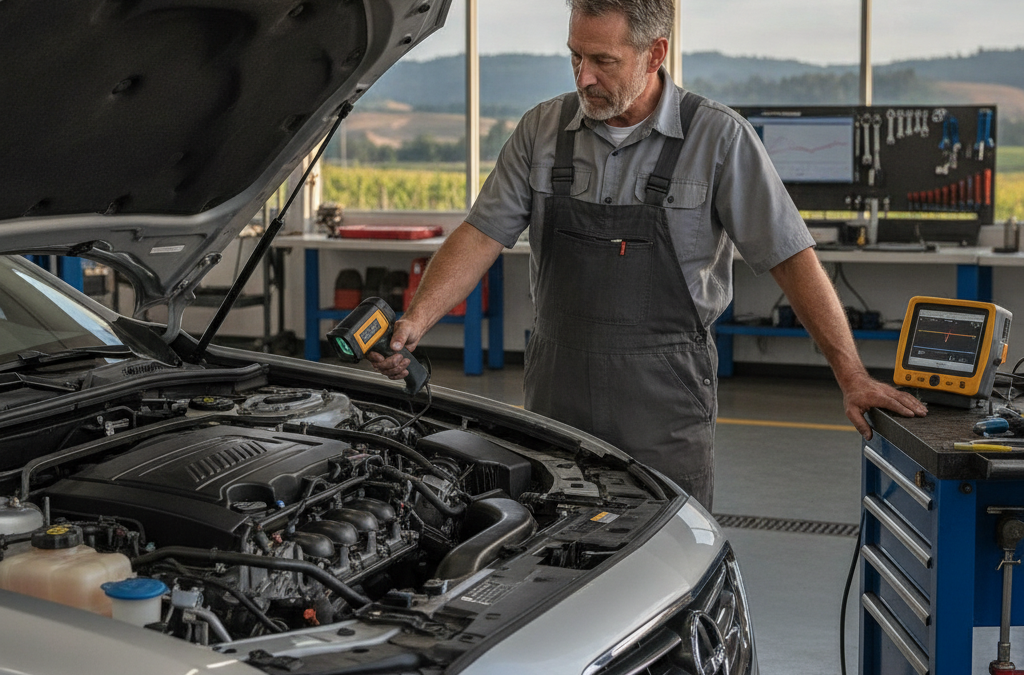
Why Is My Car Taking Forever to Warm Up in Rohnert Park? What a Slow-Warming Engine Actually Means
If you’ve noticed your temperature gauge barely budging after 10 or 15 minutes of driving — or your heater is blowing lukewarm air even after a longer commute — your car is trying to tell you something. For drivers in Rohnert Park, Cotati, and the surrounding area, a slow-warming engine is one of those problems that’s easy to ignore right up until it starts costing you real money. The most common cause is a thermostat stuck in the open position, but there are a few other culprits worth knowing about. Here’s a plain-English breakdown of what’s going on, why it matters, and what to do about it.
What Does “Normal” Engine Warm-Up Actually Look Like?
Most cars are designed to reach operating temperature — typically somewhere between 195°F and 220°F — within the first five to ten minutes of driving under normal conditions. Once the engine hits that range, everything runs more efficiently: fuel burns cleaner, oil flows better, and emissions drop. Your temperature gauge needle should settle in the middle of its range and more or less stay there.
If your gauge is creeping up slower than usual, sitting well below the middle, or if it takes 20-plus minutes of driving on a mild Sonoma County morning before you feel any real heat from the vents — that’s not normal, and it’s worth paying attention to.
The Most Likely Culprit: A Stuck-Open Thermostat
The thermostat is a small, inexpensive valve that sits between your engine and radiator. Its job is to block coolant flow when the engine is cold, letting the engine heat up quickly, and then open up once the engine reaches operating temperature so the radiator can do its job and keep things from getting too hot.
When a thermostat gets stuck in the open position — which is actually the more common failure mode — coolant circulates through the radiator all the time, even when the engine is cold. The result is an engine that warms up painfully slowly or sometimes never reaches full operating temperature at all.
You might think a stuck-open thermostat is the safer failure compared to one stuck closed (which causes overheating), and in the short term that’s true. But running an engine that’s chronically under-temperature creates its own set of problems, which we’ll get into below.
Why a Slow-Warming Engine Is Harder on Your Car Than You’d Think
This is the part most people don’t realize. Running cold isn’t just uncomfortable — it’s genuinely hard on your engine and your wallet over time. Here’s what’s happening under the hood when your car never fully warms up:
- Fuel economy drops. Your engine management system uses a richer fuel mixture when the engine is cold. Once you hit operating temperature, it leans that mixture out for efficiency. If the engine stays cold, you’re burning more fuel than necessary every single time you drive.
- Oil doesn’t circulate as well. Cold oil is thicker and takes longer to reach all the tight clearances inside your engine. Extended cold running means more wear on engine components — especially in an older, higher-mileage vehicle.
- Your heater won’t work properly. Your cabin heater relies on heat from the engine coolant. If the engine never gets hot enough, you’ll be stuck with lukewarm air on cold Rohnert Park mornings, no matter how high you crank the knob.
- The check engine light may come on. Your car’s computer monitors coolant temperature. If it decides the engine isn’t warming up fast enough, it will often set a fault code — commonly P0128 — and light up that orange warning on your dash.
- Increased emissions. Engines running below operating temperature don’t combust fuel as completely, which means more unburned hydrocarbons going through your exhaust system. That’s bad for the environment and could cause you to fail a smog check.
Other Reasons Your Engine Might Be Slow to Warm Up
A stuck-open thermostat is the usual suspect, but it’s not the only possibility. A few other things worth having checked:
- Low coolant level. If your cooling system is low on coolant, the engine can take longer to heat up and the temperature gauge can behave erratically. It can also point to a small leak somewhere in the system worth finding before it becomes a bigger problem.
- A faulty coolant temperature sensor. This sensor tells your car’s computer how hot the coolant is. If it’s sending the wrong reading, your engine might actually be at normal temperature while your gauge reads low — or vice versa. A proper diagnostic scan can sort this out quickly.
- A coolant flush that’s overdue. Old, degraded coolant doesn’t transfer heat as efficiently as fresh fluid. If you can’t remember the last time your cooling system was serviced, that’s worth addressing on its own — most manufacturers recommend a flush every 30,000 to 50,000 miles depending on the type of coolant your vehicle uses.
If you’re not sure which of these applies to your situation, a proper diagnostic inspection is the fastest way to get a straight answer instead of guessing.
What This Looks Like Across Different Makes and Models
In our experience working on vehicles throughout Rohnert Park, Santa Rosa, and Petaluma since 2011, thermostat issues don’t discriminate by brand — but some vehicles are more prone to them than others.
Toyota and Honda engines are generally reliable, but their thermostats do eventually wear out like any other part, especially past the 100,000-mile mark. Subaru owners dealing with a slow warm-up should also have the head gasket situation evaluated, since a slow-to-warm engine can occasionally mask early signs of coolant mixing issues. German vehicles like Volkswagen and certain Mercedes models have plastic thermostat housings that can crack or leak over time, which complicates the picture a bit. Ford and Chevy trucks with higher mileage are also regular visitors for thermostat replacement.
The good news: a thermostat is one of the more affordable cooling system repairs you can have done. The part itself is inexpensive, and the labor is straightforward on most vehicles. Catching it before it triggers a fault code or compounds into something bigger is always the better move.
Sonoma County Winters Are Mild — But That Doesn’t Mean Your Cooling System Gets a Pass
One thing we notice every year: drivers in Rohnert Park, Cotati, and Santa Rosa tend to put cooling system maintenance on the back burner because our winters aren’t exactly brutal. True — we’re not dealing with Minnesota-style cold. But Sonoma County’s wet, cool winters paired with dry, hot summers actually create real thermal stress on cooling system components year-round. A thermostat that’s been limping along through summer heat may finally give out right as you need heat the most.
If your temperature gauge has been doing anything unusual — sitting too low, taking longer than it used to, or bouncing around — don’t wait until it turns into an overheating problem headed the other direction. Getting your cooling system inspected before it becomes an emergency is almost always cheaper and less stressful.
Frequently Asked Questions
How much does it cost to replace a thermostat in Rohnert Park?
Thermostat replacement is generally one of the more affordable cooling system repairs. The exact cost depends on your vehicle’s make, model, and how accessible the thermostat is in your engine bay. We give free estimates before any work begins, so you’ll know what to expect upfront — no surprises.
Can I drive with a stuck-open thermostat?
Technically, yes — a stuck-open thermostat is far less dangerous than one stuck closed. But you shouldn’t ignore it long-term. Running chronically cold damages your engine over time, hurts your fuel economy, and will likely trigger a check engine light. It’s worth fixing sooner rather than later.
My temperature gauge is reading low but my heater is blowing cold. Are those related?
Almost certainly. Both symptoms point to the same root cause — your engine isn’t reaching normal operating temperature. A stuck thermostat, low coolant, or a faulty temp sensor are all possibilities. Have it diagnosed properly so you’re fixing the right thing.
What’s a P0128 code and should I be worried?
P0128 means your car’s computer has detected that the engine coolant temperature is running lower than expected. It’s almost always related to a stuck-open thermostat. It won’t cause immediate breakdown, but it does need to be addressed — and it will cause you to fail a smog check if left unresolved.
How often should I have my cooling system serviced?
A coolant flush is typically recommended every 30,000 to 50,000 miles, though your owner’s manual will have the specific interval for your vehicle. Along with the flush, it’s worth having your thermostat, hoses, and radiator cap inspected at the same time — they’re all part of the same system.
Let’s Get Your Car Warming Up the Way It Should
If your engine is slow to warm up, your heater isn’t cutting it, or your temperature gauge is doing something unusual, don’t leave it to chance. At On Site Auto Repair in Santa Rosa, we’ve been diagnosing and fixing cooling system problems for drivers all over Rohnert Park, Cotati, Petaluma, and Sonoma County since 2011. We’ll give you an honest assessment, a free estimate, and a straight answer — no upselling, no runaround.
Contact us today to schedule an inspection and we’ll get you sorted out. We treat your car the same way we’d treat our own.