
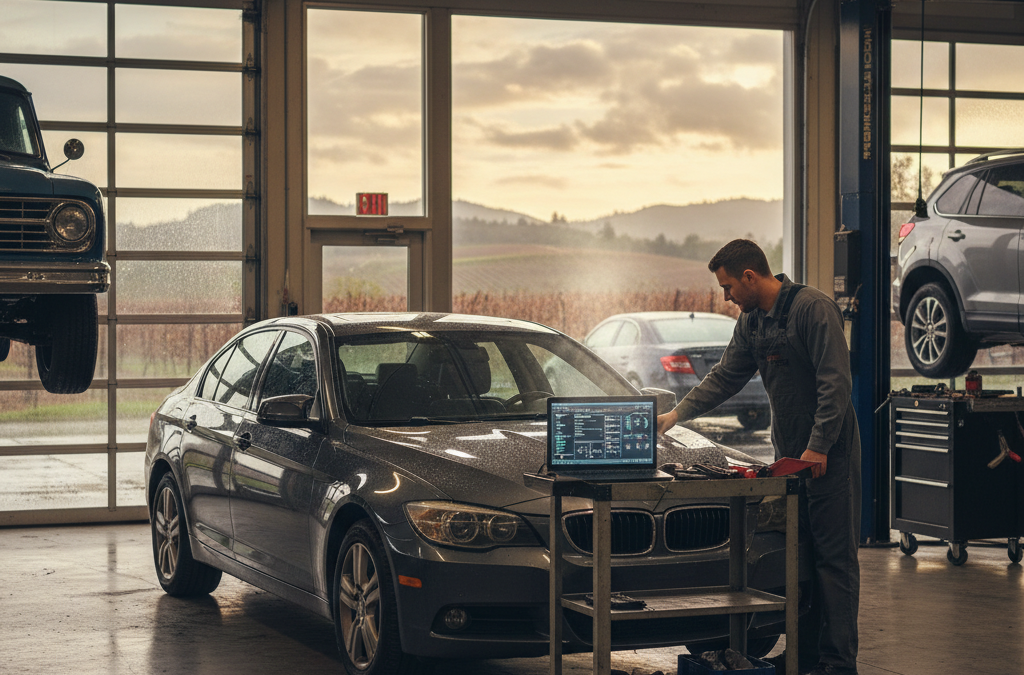
Why Is My Car’s Heater Not Working in Sebastopol? What to Check Before Winter Gets Worse
If your car’s heater is pumping cold air when it should be warming you up, you’re not just uncomfortable — you may also have a compromised defroster, reduced visibility on foggy Sonoma County mornings, and possibly an underlying engine cooling issue that won’t fix itself. Drivers in Sebastopol, Graton, Forestville, and throughout the Santa Rosa area deal with this more than people expect. Our winters are mild compared to the Sierra Nevada, but damp 38-degree mornings at 7 AM with a fogged-up windshield are no joke. The good news is that most heater problems have a clear root cause, and most of them are fixable without a huge bill — if you catch them early.
Why Your Car’s Heater and the Cooling System Are Basically the Same Thing
This surprises a lot of people: your car’s cabin heater doesn’t have its own separate heat source. It uses the heat that your engine’s coolant generates while the engine runs. Hot coolant flows through a small radiator-like component behind your dashboard called the heater core. A blower fan pushes air across it and into the cabin. If anything interrupts that flow of hot coolant — or if the heater core itself has a problem — you get cold air instead of warm air.
That means a failing heater is often a signal that something is off with your cooling system, not just your comfort features. The two systems are deeply connected, and diagnosing one often means looking at both.
The Most Common Reasons a Car Heater Stops Working
1. Low Coolant Level
This is the first thing to check and often the simplest fix. If your coolant level is low, there may not be enough hot fluid circulating through the heater core to produce warm air. Low coolant can be caused by a slow leak, a cracked hose, or a cooling system that was never properly topped off. Don’t just add water — use the right coolant mix for your vehicle. And if it keeps going low, that leak needs to be found.
2. A Stuck or Failing Thermostat
Your engine thermostat controls when coolant starts flowing through the system. If it’s stuck open, coolant circulates before the engine warms up — and the engine may never reach full operating temperature. You’ll notice the temperature gauge barely moves off the cold end, and the heater blows air that feels barely warm at best. A thermostat replacement is usually a straightforward, reasonably priced repair and makes a huge difference in winter comfort and fuel efficiency.
3. A Clogged or Leaking Heater Core
The heater core can clog with old coolant deposits over time, especially in vehicles that have gone too long between coolant flushes. When it clogs, hot coolant can’t flow through it effectively. When it leaks, you may notice a sweet smell inside the car, foggy windows that don’t clear properly, or even a wet spot on the passenger-side floor mat. A leaking heater core is a more involved repair since it’s tucked behind the dashboard, but it’s not something you want to ignore — coolant leaking inside your cabin is a health concern and can damage your vehicle’s interior electronics.
4. A Faulty Blend Door Actuator
Modern vehicles use small electric motors called blend door actuators to control the mix of hot and cold air flowing into the cabin. When one of these fails, you might get stuck with either full cold or full hot air regardless of what you set on the climate control dial. Sometimes you’ll hear a clicking or tapping noise from behind the dashboard when you adjust the temperature — that’s often a blend door actuator trying and failing to move. This is a common issue on a number of Ford, GM, and Jeep platforms, and it’s frequently misdiagnosed because the symptom looks like a heater problem when it’s actually a controls problem.
5. Air Pockets in the Cooling System
If your cooling system wasn’t properly bled after a coolant flush or repair, air pockets can get trapped in the heater core and block the flow of coolant. The fix is usually purging the system — a job that sounds simple but requires knowing how to properly bleed the system for your specific vehicle make and model.
Don’t Overlook the Cabin Air Filter — Especially After Wildfire Season
A dirty or clogged cabin air filter won’t prevent the heater from producing heat, but it will dramatically reduce how much of that warm air actually reaches you. If your air flow feels weak even with the fan on high, the cabin filter is often the culprit. This is especially relevant here in Sonoma County, where wildfire smoke and ash can clog a cabin filter in a single fire season. Drivers in Sebastopol, Cotati, Rohnert Park, and throughout the Santa Rosa area should check their cabin filters annually — more often if you drove through smoky conditions. It’s one of the most overlooked maintenance items and one of the cheapest to fix.
You can learn more about our full AC and heating repair services in Santa Rosa — we handle everything from cabin filter replacement to full heater core jobs on all makes and models.
What We See That Competitors Often Miss: The Thermostat-Heater Connection
One gap we notice in how other local shops talk about heater problems — when they address it at all — is that they tend to focus on the heater core and skip past the thermostat. But in our experience, a stuck-open thermostat causing an engine that never fully warms up is actually one of the more frequent causes of a weak or cold heater, particularly on Toyota, Honda, and Subaru models that have seen higher mileage. It’s an inexpensive part, but if you only focus on the heater core and miss a bad thermostat, you’ll replace a perfectly good part and still have a cold car.
We also see this misdiagnosed the other way — a shop replaces the thermostat without checking coolant condition, and the real issue is a partially clogged heater core from years of degraded coolant. A proper diagnosis looks at the whole system, not just the most obvious suspect.
Why Santa Rosa’s Winter Climate Makes Heater Problems Harder to Ignore
Sonoma County isn’t a place where most people think of extreme winter driving — but our cool, wet season runs from roughly November through March, and those foggy, damp mornings along the Highway 101 corridor and on the backroads through Graton and Forestville require a working defroster and good cabin visibility. If your heater isn’t working, your defroster isn’t working either. That’s a safety issue, not just a comfort one.
Commuters heading south on 101 toward Petaluma or Marin County on cold mornings especially need their defrost systems working properly. And if your temperature gauge isn’t climbing to the normal range because of a stuck thermostat, your engine is running less efficiently and burning more fuel on every cold commute.
Heater Problems by Vehicle Type: What to Know
Different makes and models have their own heater system quirks worth knowing:
- Subaru: Coolant issues on higher-mileage Subarus (especially older 2.5L engines) can affect heater performance. If you’ve had any head gasket history on a Subaru, the cooling and heating system deserve a close look.
- Ford F-150 and Explorer: Blend door actuator failure is common on these platforms. The clicking noise behind the dash is a telltale sign.
- Honda and Toyota: Generally reliable heater systems, but coolant neglect on high-mileage examples leads to heater core clogging. Coolant flushes on schedule matter more than most owners realize.
- Older GM vehicles (Chevy, Buick, GMC): Heater cores on these tend to develop slow leaks around the 100K-150K mile range. Watch for that sweet smell and fogged windows.
- Volkswagen and European vehicles: These often have more complex climate control systems where electrical faults in the HVAC module can mimic heater core problems. Proper diagnostic scanning is important before replacing parts.
If you’re not sure what’s going on with your vehicle’s heating system, a proper diagnostic inspection is the right place to start — not guessing which part to replace.
Frequently Asked Questions About Car Heater Problems in Sonoma County
How long does it usually take for a car heater to start blowing warm air?
Most vehicles should start producing noticeable heat within 5 to 10 minutes of driving, once the engine reaches operating temperature. If you’re still getting cold air after 15 minutes of driving, something is likely wrong — most commonly a stuck thermostat or low coolant.
Can I drive my car if the heater isn’t working?
It depends on the cause. If the issue is a stuck-open thermostat or low coolant, driving isn’t immediately dangerous for the engine — but a leaking heater core or a coolant leak affecting overall cooling system pressure is a different story. When in doubt, get it checked before you end up stranded.
How much does heater repair usually cost?
It varies widely depending on the cause. A thermostat replacement is typically one of the more affordable fixes. A cabin air filter swap is inexpensive. A heater core replacement is more involved because of the labor required to access it — but it’s worth doing right rather than patching around it. We give honest, no-pressure estimates so you know exactly what you’re dealing with before any work begins.
Could a heater problem damage my engine?
In most cases, a heater that stops working won’t damage your engine on its own. But if the underlying cause is a coolant leak or a thermostat stuck closed (causing overheating rather than undercooling), then yes — that can cause serious engine damage quickly. Pay attention to your temperature gauge any time your heater starts acting up.
How often should I flush my coolant to prevent heater core problems?
Most manufacturers recommend a coolant flush every 30,000 to 50,000 miles, though some newer vehicles with long-life coolant extend that interval. Driving in Sonoma County’s variable climate — hot dry summers and cool wet winters — is exactly the kind of thermal cycling that wears coolant down over time. Staying on schedule is one of the best things you can do for both your heater and your engine.
Get Your Heater Diagnosed Right — Before the Next Cold Morning Hits
Whether you’re in Sebastopol, driving through Graton on your morning commute, or heading south out of Santa Rosa on 101 with a fogged-up windshield, a broken heater is something worth addressing now rather than after it gets worse. At On Site Auto Repair, we’ve been diagnosing and fixing heater and cooling system problems for drivers throughout Sonoma County since 2011. We don’t guess — we diagnose properly, explain what we find in plain language, and give you honest options without pushing repairs you don’t need.
Ready to get warm again? Contact us or request a free estimate — we work on all makes and models, and we’re here to help you figure out exactly what’s going on with your vehicle’s heating system.