Why Are My Shocks and Struts Wearing Out So Fast in Sonoma County? What Drivers in Healdsburg and Surrounding Areas Need to Know
If your ride has started to feel more like a boat on choppy water than a car on pavement, there’s a good chance your shocks or struts are due for attention. For drivers in Healdsburg, Cloverdale, Guerneville, and throughout Sonoma County, suspension components tend to wear faster than the national average — and it’s not your imagination. The roads, the terrain, and the way most of us drive around here all work together to shorten the life of these parts. Here’s what you need to know.
What Shocks and Struts Actually Do
A lot of drivers think shocks and struts are just about ride comfort — that they’re a “nice to have” rather than a safety item. That’s a misconception worth clearing up right away. Yes, they smooth out bumps, but they also keep your tires in contact with the road. When you hit a pothole on Dry Creek Road outside Healdsburg or take a tight turn on a Fountaingrove hillside, your shocks and struts are doing serious work to keep the vehicle stable and steerable.
Shocks are standalone dampers. Struts are a structural part of your suspension — they do the same dampening job, but they’re also load-bearing. On most modern vehicles, the front suspension uses struts; the rear may have shocks, struts, or a combination depending on the design. Either way, when they start to fail, the effects show up throughout the whole vehicle.
Why Sonoma County Roads Accelerate Suspension Wear
Here’s something the national averages don’t account for: Sonoma County is genuinely hard on suspension. A few reasons why:
- Hilly terrain. Neighborhoods like Bennett Valley, Oakmont, and Fountaingrove in Santa Rosa put constant stress on shocks and struts — especially on the way down, when your suspension is compressing and rebounding on every dip and rise. The same goes for the winding roads between Healdsburg and Cloverdale through Alexander Valley, or the switchbacks leading into Guerneville from Highway 116.
- Rural road conditions. Many of the backroads through Wine Country — the kind that lead to small wineries, vacation rentals, and farm stands — haven’t been repaved in years. Gravel shoulders, cracked asphalt, and drainage dips off the main roads add up quickly.
- Pothole season after wet winters. Every spring, the freeze-thaw cycle and heavy rainfall open up new potholes along roads that were already marginal. If you commuted through Windsor or drove Westside Road during last winter’s storm season, you know exactly what we mean.
- Heavy loads and towing. A lot of folks in Sonoma County use trucks and SUVs for real work — hauling equipment, towing trailers, or carrying landscaping loads. That kind of weight accelerates wear on rear shocks and struts faster than the manufacturer’s estimates suggest.
The Warning Signs: What to Look and Listen For
Suspension wear is gradual, which makes it easy to miss. You adjust to a slightly rougher ride, and one day someone else drives your car and says, “Does it always bounce like that?” Here are the signs to pay attention to:
- Excessive bouncing after hitting a bump. Good shocks absorb impact and settle quickly. If the rear end keeps bobbing after you go over a speed bump, that’s a classic sign of worn shocks.
- Nose-diving when braking. If the front of your car pitches sharply forward when you brake — especially at highway speed on Highway 101 — the front struts may not be providing enough dampening resistance.
- Body roll on turns. That swaying feeling when you take a curve a little faster than usual isn’t just unsettling — it’s a real handling problem. Worn suspension components mean less lateral stability.
- Clunking or knocking sounds. A rhythmic clunk over bumps often means a strut mount or shock bushing has worn through. This is especially common on older Subarus, Tacomas, and high-mileage Hondas driven on rough roads.
- Uneven tire wear. Your tires can tell the story. Cupped or scalloped wear — where the tread looks wavy or uneven — is a sign your tires are bouncing instead of rolling smoothly, usually due to worn shocks.
- A pulling sensation or wandering steering. When struts are worn unevenly side to side, the car can drift or feel vague, especially at highway speeds.
If you’re noticing any of these, it’s worth getting a steering and suspension inspection before the problem compounds into something more expensive — like accelerated tire wear or stress on your wheel bearings.
How Long Should Shocks and Struts Last? The Honest Answer
You’ll often see the figure “50,000 miles” quoted online as the replacement interval for shocks and struts. That’s a rough baseline — and it assumes average conditions on average roads. For drivers who spend real time on Sonoma County’s rural routes, hilly neighborhoods, or gravel access roads to vacation properties in Guerneville or Sebastopol, 40,000 miles is a more realistic benchmark to start watching for symptoms.
On the flip side, some drivers on smooth urban streets with lighter vehicles can go 70,000 or more before noticing any real degradation. Mileage matters, but so does where and how you drive. A Subaru Outback used for weekend adventures on unpaved Russian River Valley roads will need suspension attention sooner than the same model driven mainly on Highway 101 to commute to the Bay Area.
What the Repair Actually Looks Like (And What It Costs)
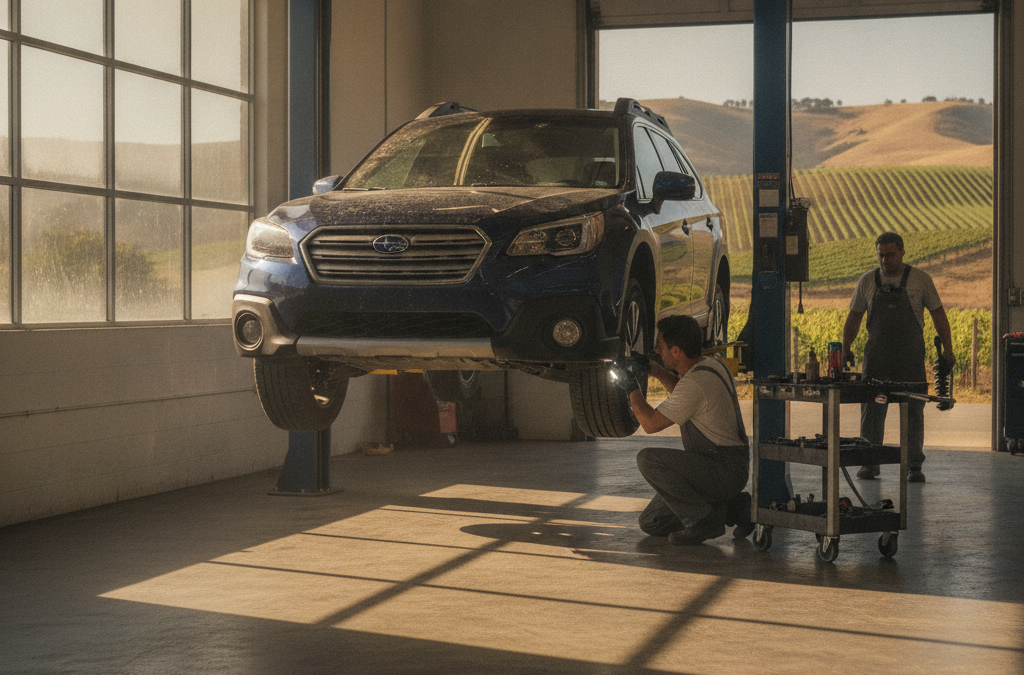
When shocks or struts need replacement, the work is typically done in pairs — both fronts or both rears at the same time — so your ride characteristics stay balanced side to side. Replacing struts is a more involved job than shocks because struts are structural; it often requires removing the spring from the old assembly using a spring compressor before the new one can go in. That’s one reason you’ll want a shop with actual experience doing this work, not a quick-lube place upselling you on a part they barely touched.
While the car is already in the air for strut replacement, it’s also a good time to check wheel alignment. Strut replacement almost always shifts your alignment slightly, so most shops — including us — will recommend an alignment check afterward. Skipping it means your new struts may wear unevenly from day one, which defeats the purpose.
For rough cost context: strut replacement on a typical front-wheel-drive sedan or crossover generally runs in the low-to-mid hundreds per axle for parts and labor, though this varies significantly by make and model. German vehicles, trucks, and performance cars often cost more. We’ll always give you a clear, honest estimate before any work starts — no surprises at the end.
A Note on OEM vs. Aftermarket Parts
Not all shocks and struts are equal, and this is an area where cutting corners tends to backfire. We’ve seen budget-brand struts from overseas warehouses fail within 20,000 miles on vehicles driven on Sonoma County roads. The brand-name aftermarket options — KYB, Monroe, Bilstein, and Gabriel are all well-regarded — perform reliably and are what we typically recommend for most vehicles. For trucks and SUVs that see heavier use or off-road conditions, we’ll talk through the options with you and explain what the tradeoffs actually are.
For preventive maintenance across your whole vehicle, including periodic suspension checks, see our preventive maintenance services page for what we cover and when.
Frequently Asked Questions
Can I drive with bad shocks or struts?
Technically yes, at least for a while — but it’s not a good idea. Worn shocks and struts increase your stopping distance, reduce stability in emergency maneuvers, and accelerate tire wear. The longer you wait, the more it typically costs in related damage. If you’re hearing clunking or the car feels seriously bouncy, get it looked at soon.
How do I know if it’s the shocks, struts, or something else in my suspension?
That’s exactly the kind of question a proper inspection answers. Sway bar links, ball joints, control arm bushings, and strut mounts can all produce similar symptoms. Rather than guessing, have a technician put the car on a lift and inspect the whole system. We check all of it and only recommend what actually needs work.
Do I need an alignment after strut replacement?
Almost always, yes. Strut replacement disturbs the suspension geometry, which affects alignment. Driving on a fresh set of struts with the alignment off is a good way to wear through your tires unevenly in short order. We recommend pairing strut replacement with a four-wheel alignment check.
My car has 85,000 miles and rides fine — do I still need to check the shocks?
Yes. Suspension wear is gradual enough that most drivers don’t notice it until it’s quite advanced. If your car hasn’t had a suspension inspection in 40,000–50,000 miles, it’s worth having someone put it on a lift and take a look — especially if you drive a lot of hilly or rural roads around Healdsburg, Oakmont, or the Russian River area.
Are shocks and struts covered under any kind of warranty?
Original equipment struts are often covered under your bumper-to-bumper warranty if the vehicle is still within that period. After that, the parts we install come with a warranty from the manufacturer, and we stand behind our labor as well. Ask us about warranty coverage when you come in.
Ready to Get Your Suspension Checked?
If your ride feels off — bouncy, clunky, or just not as solid as it used to be — don’t wait until it shows up as a tire or alignment bill. The team at On Site Auto Repair has been diagnosing and repairing suspension systems on all makes and models in Santa Rosa and throughout Sonoma County since 2011. We’ll tell you exactly what we find, explain your options clearly, and never sell you something you don’t need. Contact us to schedule an inspection or request a free estimate — we’re straightforward about what your car actually needs, and we treat every vehicle like it’s our own.