Why Is My Car’s Wheel Bearing Humming or Grinding in Sonoma County? What Drivers in Cloverdale and Beyond Need to Know
If you’ve noticed a low, steady hum coming from somewhere near your wheels — one that gets louder the faster you go, or shifts pitch when you change lanes — there’s a good chance you’re dealing with a failing wheel bearing. It’s one of those sounds that’s easy to dismiss at first, especially on a long stretch of Highway 101 heading south from Cloverdale toward Healdsburg. But ignoring it can turn what’s usually a straightforward repair into a much more expensive and dangerous situation.
Wheel bearings are small but critical. They sit inside your wheel hub and allow your wheels to spin with minimal friction. When they start to wear out — and they do, especially on vehicles racking up miles on Sonoma County’s rural two-lanes and highway commutes — the consequences range from annoying noise to a wheel that’s no longer safely attached to your car.
What Does a Bad Wheel Bearing Actually Sound Like?
Most drivers describe it as a humming, growling, or grinding noise that seems to come from one side of the car. It’s different from tire noise because it often changes based on your steering input — you might notice it gets louder when you turn slightly left but quiets down when you drift right, or vice versa. That directional shift is one of the clearest signs you’ve got a bearing on its way out.
Here’s a quick breakdown of what to listen and feel for:
- Low, persistent hum that increases with vehicle speed — not engine speed
- Grinding or growling that gets worse when turning or lane-changing
- Vibration in the steering wheel or through the floor at highway speeds
- Clunking or knocking when going over bumps, which may indicate the bearing has failed significantly
- Uneven tire wear, which can result from a bearing that’s allowed excessive wheel play
One easy test: find a safe, empty road and gently swerve back and forth while maintaining a steady speed around 40–50 mph. If the noise gets louder when you swerve one direction and quieter when you swerve the other, that usually tells you which side the bad bearing is on.
Why Sonoma County Roads Are Hard on Wheel Bearings
Wheel bearings don’t just wear out randomly — road conditions and driving habits accelerate the process considerably. If you’re commuting daily from Cloverdale or Geyserville down to Windsor or Santa Rosa, you’re covering a lot of highway miles, which puts steady stress on your bearings. Highway driving at sustained speed generates more heat than stop-and-go, and heat is one of the main enemies of bearing longevity.
Rural roads in northern Sonoma County also throw potholes, rough patches, and edge-crumbling asphalt into the mix. Every hard impact transfers force directly into the bearing assembly. If you’ve hit a pothole lately and the hum started shortly after — or got noticeably worse — that impact may have been the final insult to a bearing that was already wearing down.
Drivers heading into Mendocino County territory via Highway 128 out of Cloverdale deal with curves and rough road surfaces that add lateral stress to the bearings. That’s a different kind of wear than highway straight-line driving, and it can take bearings out sooner than you’d expect.
Is It Safe to Drive on a Bad Wheel Bearing?
Short answer: not for long. A wheel bearing in early failure — just starting to hum — gives you some time, but you shouldn’t put it off for weeks. As the bearing deteriorates, it allows the wheel to develop play, meaning it’s no longer held perfectly true. That can affect your alignment, accelerate tire wear, and in severe cases, cause the wheel to wobble visibly or seize up while driving.
In the worst-case scenario — a fully failed bearing on a vehicle still being driven — you risk the wheel separating from the hub entirely. That’s rare, but it happens, and it’s the kind of thing that doesn’t end well at highway speeds. If the grinding has gotten loud or you’re feeling vibration in the floor or steering, get it looked at today, not next week.
If your steering already feels off or you’re noticing other handling problems alongside the noise, a full inspection of your steering and suspension system is a smart move — bearings don’t always fail alone, and other wear items sometimes show up at the same time.
What Does Wheel Bearing Replacement Actually Involve?
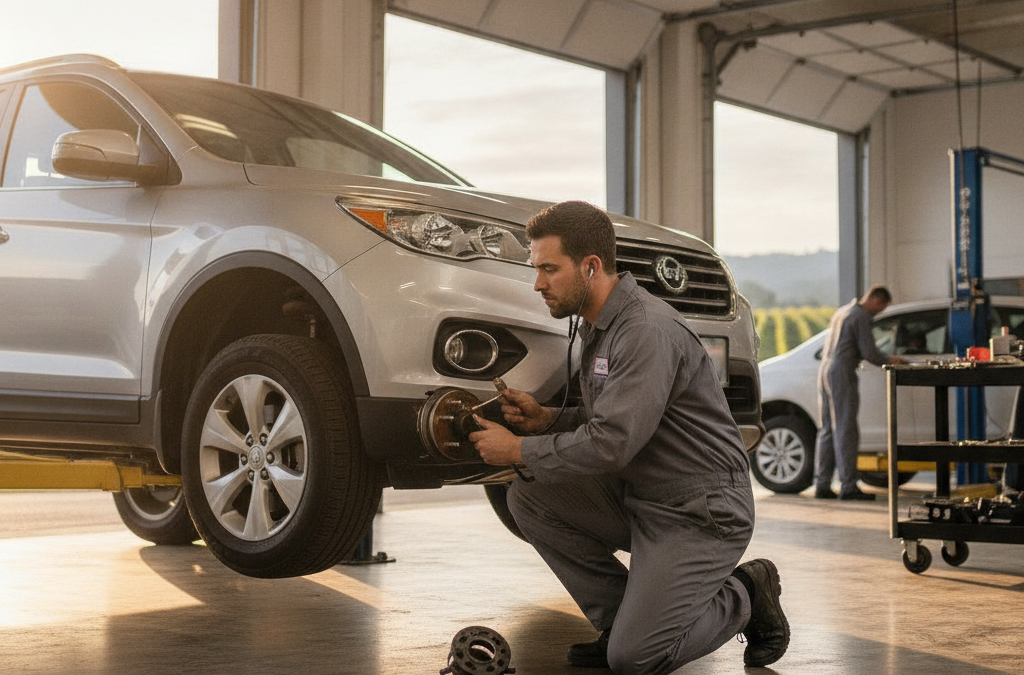
The repair process depends on your vehicle. On many modern cars, the wheel bearing is integrated into a hub assembly — the whole unit gets replaced as one piece, which is actually cleaner and faster than the old style where bearings were pressed in separately. On older trucks and some larger vehicles, bearings are still serviceable individually, which can be more labor-intensive.
Either way, here’s what to generally expect:
- The wheel comes off, the brake caliper and rotor are moved aside
- The hub assembly (or bearing) is removed and inspected
- A new hub assembly or bearing is installed and torqued to spec
- An alignment check is usually recommended after the job since the suspension geometry can shift slightly
Timelines vary — a single front wheel bearing on a Toyota Camry or Honda Accord is typically a same-day repair. Rear bearings on certain AWD vehicles like Subarus can take longer because of how the rear assembly is put together. Ask your shop upfront what’s involved for your specific make and model.
What Most Local Shops Don’t Tell You About Wheel Bearings
Here’s a gap worth addressing directly: most auto repair websites in the area — including several local Sonoma County shops — either don’t mention wheel bearings at all or lump them into a vague “suspension service” category without any real explanation. That leaves drivers confused about whether their noise is a tire issue, a brake issue, or something more serious.
A few things worth knowing that often get skipped:
- Bearings on one side often predict the other side soon. If one side has failed, the other has usually experienced similar conditions. It doesn’t always need to be replaced at the same time, but it’s worth monitoring.
- Noise can be masked by other problems. A worn tire can mimic bearing noise, and vice versa. Proper diagnosis on a lift — checking for play and spin resistance by hand — is the right way to confirm.
- Not every bearing noise is urgent at the same rate. A faint hum at high speed is different from loud grinding at low speed. A good mechanic will give you an honest read on how much time you realistically have.
- OEM vs. aftermarket parts matter. For brands like Toyota, Honda, and Subaru, quality-matched aftermarket bearings are generally fine. For German vehicles like Volkswagen or Mercedes, OEM or high-quality OE-equivalent parts often hold up better. Don’t let a shop put the cheapest possible bearing in your car without asking.
Brands We See Most Often for Wheel Bearing Repairs
Wheel bearings are a universal issue — every vehicle has them — but some patterns show up more than others in the Sonoma County area. Subaru AWD models, especially older Outbacks and Foresters, can develop rear bearing wear earlier than expected. Ford F-150 and F-250 trucks, common throughout the Cloverdale and Healdsburg ranching corridor, see front hub assemblies go out with regular use. Nissan and Hyundai SUVs have also shown up with bearing issues at higher mileage, and Jeep Grand Cherokees with four-wheel-drive systems put extra stress on both front and rear assemblies.
Whatever you drive, if the hum is there, it needs to be checked. We work on all makes and models and can usually get you an honest diagnosis the same day you bring it in.
For drivers coming from Windsor, Geyserville, or further north, we’re centrally located in Santa Rosa and easy to reach via Highway 101. And if your bearing failure is part of a bigger concern about your vehicle’s overall health, we can roll that into a complete vehicle inspection so nothing gets missed.
Frequently Asked Questions About Wheel Bearing Noise in Sonoma County
How do I know if the noise is a wheel bearing or my tires?
Tire noise tends to be consistent regardless of steering input and often has a rhythmic quality. Wheel bearing noise typically shifts — getting louder or quieter — when you swerve gently at speed. A mechanic can confirm on a lift by checking for play and resistance in the hub by hand.
Can a wheel bearing fail suddenly, or does it always give warning?
Usually it gives warning through noise and vibration first. But a bearing that’s been humming for a long time can reach a point of rapid deterioration, especially after a hard impact. If the sound has changed dramatically in a short period of time, get it checked right away.
Do I need to replace bearings on both sides at the same time?
Not always, but it depends on mileage and condition. If one side has failed and the other is showing signs of wear, replacing both during the same service saves labor costs later. We’ll give you an honest assessment of both sides before recommending anything.
Will a bad wheel bearing affect my alignment?
Yes — a failing bearing allows the wheel to develop slight play, which throws off alignment and accelerates tire wear. After a bearing replacement, an alignment check is recommended, especially if the vehicle has been driven on the bad bearing for a while.
How long does wheel bearing replacement typically take?
Most single-bearing replacements are completed within a few hours. More complex setups — AWD rear assemblies, integrated hub units on certain trucks — can take longer. We’ll give you a realistic time estimate upfront so you can plan your day.
Hearing a Hum? Don’t Wait to Find Out
Wheel bearing issues are one of those repairs that are genuinely straightforward when caught early and genuinely costly — or dangerous — when ignored. If you’re hearing something you can’t quite explain, especially at highway speeds heading down from Cloverdale, Healdsburg, or anywhere else in Sonoma County, bring it in and let us take a look. We’ll tell you exactly what we find, give you an honest repair estimate, and never push you toward a fix you don’t need.
Reach out to On-Site Auto Repair to schedule an appointment or ask about same-day availability. We’ve been working on Sonoma County vehicles since 2011, and we’ll treat yours with the same care we’d give our own.