
Why Is My Car’s Spark Plugs Fouling or Misfiring in Guerneville? What Russian River Valley Drivers Need to Know
If your car has been running rough lately — maybe it hesitates when you accelerate, idles unevenly at a stop sign, or seems to be getting noticeably worse gas mileage on your commute out to Santa Rosa — there’s a good chance your spark plugs are due for attention. Spark plugs are one of those parts most drivers don’t think about until something goes wrong, but they play a critical role in how your engine runs every single day. And if you’re driving regularly through the Russian River Valley — navigating the winding roads between Guerneville, Forestville, Monte Rio, and Occidental — your ignition system may be working harder than you realize.
What Spark Plugs Actually Do (and Why It Matters)
Each spark plug fires a small electrical charge at exactly the right moment to ignite the air-fuel mixture in your engine’s cylinders. When that happens properly, you get smooth power delivery and good fuel efficiency. When a plug is worn, fouled, or failing, the combustion event becomes inconsistent — and that’s when you start to feel it.
A misfiring cylinder can feel like a stumble or shudder, especially under load. It might be subtle at first — just a slight roughness at idle or a hesitation when merging onto Highway 116 heading toward Sebastopol. Left alone, it gets worse. Your engine management system will eventually flag it as a fault code, the check engine light comes on, and what started as a $30–$80 maintenance item can spiral into an oxygen sensor replacement or catalytic converter damage if ignored long enough.
Signs Your Spark Plugs Are Fouled or Worn Out
You don’t need to be a mechanic to notice these warning signs. Here’s what to pay attention to:
- Rough idle: The engine shakes or vibrates more than usual when you’re sitting at a light or in a parking lot
- Sluggish acceleration: The car feels hesitant or underpowered when you press the gas, especially going uphill
- Worse fuel economy: You’re filling up more often than you used to for the same driving routine
- Hard starts: The engine cranks longer before firing, especially on cold mornings
- Check engine light: Often triggered by a misfire fault code — P0300 through P0308 depending on which cylinder is affected
- Engine smell: Unburned fuel smell from the exhaust, especially at startup
Any one of these symptoms on its own is worth having looked at. More than one together, and it’s time to stop putting it off.
Why Russian River Valley Driving Is Harder on Spark Plugs Than You’d Think
Here’s something most drivers don’t consider: short trips and stop-and-go driving actually accelerate spark plug fouling. When an engine doesn’t get fully up to operating temperature, moisture and carbon deposits build up on the plug tips over time. If most of your driving is short hops around Guerneville — running to the grocery store, dropping kids at school, making a quick trip into Monte Rio — your plugs may never get a good long burn-off cycle.
The same applies in Occidental and the surrounding hills, where idling in traffic on narrow roads or frequent low-speed driving in and out of town keeps combustion temperatures on the lower end. Add in the seasonal moisture of the Russian River Valley — the cool, foggy mornings that persist well into spring — and you’ve got conditions that are genuinely harder on ignition components than, say, highway driving out of Santa Rosa toward the Bay Area.
Vehicles with oil consumption issues — and certain engines are known for this — can also foul plugs faster as oil gets past worn piston rings or valve seals and contaminates the plug tip. If you drive a higher-mileage vehicle and haven’t had your plugs inspected recently, it’s worth knowing what they look like.
How Often Should Spark Plugs Be Replaced?
This depends on the type of plug your vehicle uses:
- Copper plugs: Typically every 20,000–30,000 miles. Older or budget vehicles often use these.
- Platinum plugs: Usually every 60,000 miles. Common in mid-range vehicles from the 2000s and 2010s.
- Iridium plugs: Often rated for 60,000–100,000 miles. Standard on most modern Toyotas, Hondas, Subarus, Fords, and others.
Those mileage intervals are a reasonable starting point, but they’re not the whole picture. If your engine has been running rich (too much fuel), if you’ve had oil consumption issues, or if you’re seeing any of the symptoms listed above, your plugs may need attention before the scheduled interval — and it’s never a bad idea to have them inspected as part of a broader preventive maintenance check.
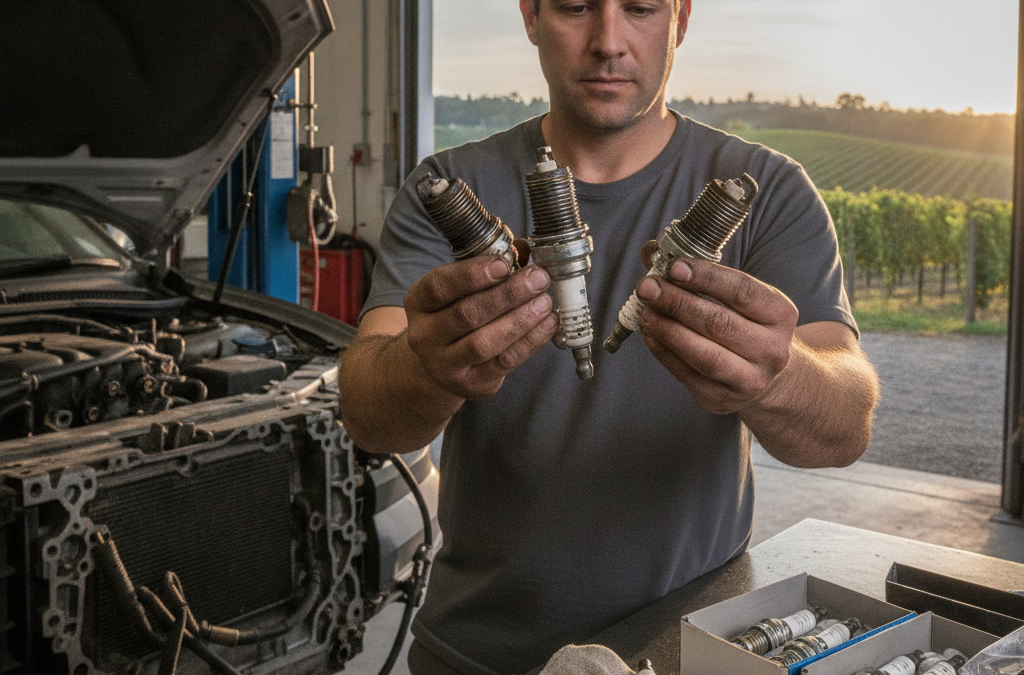
What “Fouled” Actually Means — and What a Tech Looks For
When a mechanic pulls your spark plugs, the condition of the tip tells a story. A healthy plug has a light tan or gray deposit — totally normal combustion residue. A fouled plug might show:
- Black, sooty carbon buildup: Usually from a rich fuel mixture or short-trip driving patterns
- Oil fouling: Dark, wet-looking deposits — a sign that oil is getting into the combustion chamber
- White or chalky deposits: Can indicate coolant intrusion — a more serious issue worth diagnosing right away
- Eroded electrode: Simply worn out from age and mileage — time to replace
A good tech won’t just swap the plugs and call it done. If the plugs show unusual wear patterns, that’s diagnostic information pointing toward a bigger issue — like a leaking valve cover gasket, a failing fuel injector, or even early coolant leakage. At On-Site Auto Repair, we look at what the plugs are telling us, not just what’s written on the service schedule.
Does It Matter What Brand or Type of Plug Goes In?
Yes — more than most drivers know. Using the wrong heat range, the wrong gap, or a lower-spec plug than the manufacturer recommends can cause misfires, rough idle, and premature wear even with a brand-new part. This is especially true for European vehicles, certain Subaru engines, and turbocharged engines where combustion temperatures and pressures are higher than average. Buying a cheap set of plugs online and assuming they’ll work is a gamble that doesn’t always pay off.
We use quality OEM-spec or OEM-equivalent plugs for every vehicle we service, and we set the gap correctly for your specific engine. It sounds like a small detail — and it is — but it’s the kind of detail that makes the difference between a repair that lasts and one that doesn’t.
If you’re also dealing with a check engine light alongside your rough idle, a proper diagnostic scan will confirm which cylinder is misfiring and help narrow down whether the plug itself is the culprit or whether a coil pack, fuel injector, or compression issue is involved.
A Note on DIY Spark Plug Replacement
On some vehicles — older trucks, simple four-cylinder engines with easy top-end access — swapping spark plugs yourself is a reasonable weekend job if you’re mechanically comfortable and have a torque wrench. On others, it’s a nightmare. Some V6 and V8 engines require removing the intake manifold to reach the rear bank of plugs. Certain Ford and Toyota engines have plugs that are notorious for seizing in the head if they’re not removed carefully and with the right technique. On-Site Auto Repair has seen more than a few broken plugs that cost far more to extract than a professional installation would have.
Know your vehicle before you dive in. And if you’re not sure, a quick call to us is always free.
Frequently Asked Questions — Spark Plugs and Ignition Issues in Sonoma County
Can fouled spark plugs cause my car to fail a smog check?
Yes. A misfiring engine produces elevated hydrocarbon emissions — one of the things the smog test measures. If your car is misfiring at idle, it’s likely to fail. Replacing and properly gapping fresh plugs often resolves this, though you may need to drive a few cycles to reset the emissions monitors before retesting.
My car has 80,000 miles and runs fine. Do I really need to replace the spark plugs?
If you have iridium plugs and the vehicle is running well, you may still be within spec. But at 80,000 miles it’s worth having them inspected — especially if you bought the car used and can’t confirm the service history. We’ve pulled plugs at 80K that looked like they’d never been changed.
How do I know if it’s a spark plug or a coil pack causing the misfire?
A diagnostic scan will pull the specific cylinder fault code. From there, swapping the plug and coil to an adjacent cylinder and rescanning tells you whether the fault follows the component (bad part) or stays in the same cylinder (possible compression or injector issue). It’s a methodical process — not guesswork.
I drive mostly between Guerneville and Forestville — short trips. Does that really matter?
It does. Consistent short-trip driving is one of the most common causes of premature plug fouling and accelerated engine wear in general. If this describes most of your driving, consider a longer highway drive once or twice a month to get the engine fully up to temperature, and stick to the lower end of your manufacturer’s replacement interval.
Will new spark plugs improve my gas mileage?
If your current plugs are worn or misfiring, yes — noticeably. A misfiring cylinder means wasted fuel and incomplete combustion. Properly firing plugs restore fuel efficiency and can also restore power and throttle response you might not have realized you’d lost.
Ready to Get Your Ignition System Checked?
If your car is running rough, hesitating, or just doesn’t feel quite right — and you’re anywhere in the Russian River Valley, from Guerneville and Monte Rio to Occidental and Sebastopol — we’d be glad to take a look. On-Site Auto Repair has been serving Sonoma County drivers since 2011, and we’re straightforward about what your car actually needs versus what it doesn’t. No upselling, no pressure — just honest work on your vehicle.
Reach out through our contact page to schedule an appointment or ask a question. We’ll give you a clear answer and a fair estimate before anything gets touched.