
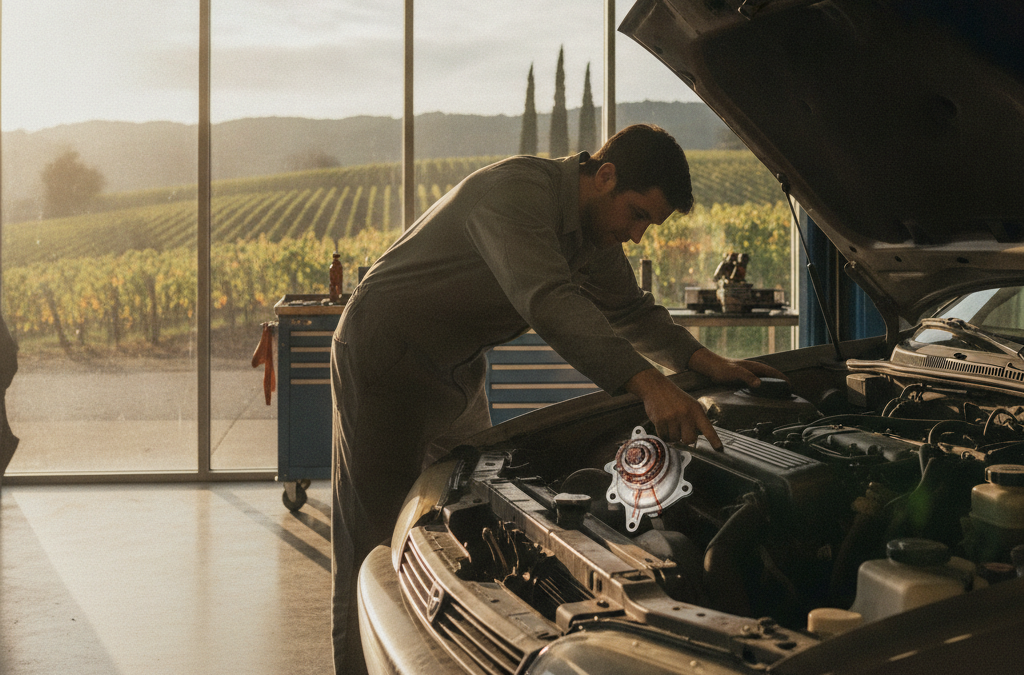
Why Is My Car’s Water Pump Failing in Sebastopol? What Sonoma County Drivers Need to Know
If your temperature gauge has been creeping higher than usual, you’re noticing a faint sweet smell near the engine, or you’ve spotted a small puddle of coolant under your car in the morning — your water pump might be the problem. For drivers in Sebastopol and the surrounding West County area, a failing water pump is one of those issues that almost never announces itself loudly until it’s too late. The good news is, when you catch the warning signs early, it’s a very manageable repair. When you ignore it, you’re looking at potential engine damage that can cost several times more.
What Does a Water Pump Actually Do?
Your engine generates an enormous amount of heat when it runs. The water pump is the part responsible for keeping coolant circulating through the engine and radiator to carry that heat away. Think of it like the heart of your cooling system — it keeps everything moving. If it slows down, seizes, or starts leaking, coolant stops flowing properly, and your engine temperature climbs fast.
Most water pumps are driven by either the timing belt or the serpentine belt, depending on your vehicle. That matters a lot when it comes to repair planning, because if your water pump is belt-driven, many shops — including ours — recommend replacing the pump and belt together while everything’s already apart. It saves you from doing the same job twice a year later.
Warning Signs You Shouldn’t Ignore
Water pump problems usually give you some warning before they cause real damage. Here’s what to watch and listen for:
- Temperature gauge rising higher than normal — especially in stop-and-go traffic or on a warm day. If it’s creeping toward the red, pull over safely and call for help before you drive further.
- Coolant leak near the front of the engine — water pumps have a weep hole that drips coolant as a signal the internal seal is failing. A small puddle of green, orange, or pink fluid under the front of your car is a red flag.
- Whining or grinding noise from the engine bay — a worn bearing inside the water pump often makes a low whine or rumble that gets louder with engine speed. It’s easy to mistake for a different pulley, so getting a proper diagnosis matters.
- Steam from under the hood — this is the system already overheating. Don’t keep driving.
- Coolant residue or deposits around the pump — dried coolant crust around the pump housing is a sign of slow seepage that’s been going on for a while.
If you’re seeing any of these signs, the smart move is to get it checked before the next drive — not after. Our cooling system service includes a full inspection of the water pump, thermostat, hoses, and coolant condition so you know exactly what you’re dealing with.
Why West County Roads Are Especially Hard on Cooling Systems
Sebastopol sits at the gateway to some of Sonoma County’s most scenic — and most demanding — driving terrain. If you’re regularly heading out toward Graton, Occidental, or Forestville, or making runs along the winding two-lane roads through the Russian River Valley toward Guerneville, your cooling system is working harder than it would on a flat freeway commute.
Hilly terrain means your engine is working under load more often. That produces more heat, which puts more demand on the water pump and radiator to keep up. Add a hot Sonoma County summer to the equation — where daytime temperatures regularly hit the mid-to-upper 90s inland — and a cooling system that’s “just barely okay” in April can turn into a breakdown waiting to happen in July or August.
We also see this with vehicles driven by commuters heading south toward Rohnert Park or Petaluma daily. Long stretches on Highway 101 with the AC running full blast on a hot afternoon put sustained thermal load on the engine. If the water pump is already showing wear, that kind of driving accelerates the timeline significantly.
How Long Do Water Pumps Last — and What Affects That?
Most water pumps are designed to last somewhere between 60,000 and 100,000 miles, though that varies considerably by make, model, and how well the cooling system has been maintained. A few factors that shorten water pump life:
- Old or degraded coolant — coolant that hasn’t been flushed on schedule becomes acidic over time and corrodes the pump’s internal impeller and seals from the inside out. This is one of the most common causes of premature water pump failure we see.
- Mixing coolant types — different coolant formulas don’t always play nicely together. If someone topped off your coolant reservoir with the wrong type, you may have a corrosion problem building up.
- Deferred belt service — if a timing-belt-driven water pump goes beyond its service interval, the belt can fail and take the pump (and potentially the engine) with it.
- Overheating events — even a single overheating incident can accelerate seal wear inside the pump.
For Toyota, Honda, and Subaru owners in the area — three of the most common vehicles we work on — water pump service intervals and access points vary quite a bit by engine design. Subaru’s EJ-series engines, for example, have a history of cooling system issues that make staying on top of water pump and coolant service especially important. If you’re not sure where your vehicle stands, it’s worth asking us to check.
Water Pump Replacement: What to Expect
Water pump replacement isn’t a quick oil change — it’s a real repair job that typically takes two to four hours depending on the vehicle. Labor time is the main cost driver because access to the pump varies widely. On some engines it’s straightforward. On others, you’re removing belts, tensioners, and other components to get there.
What a fair repair should include:
- Removal and replacement of the pump with a quality OEM-equivalent or better part
- Coolant drain and refill with the correct fluid type for your vehicle
- Inspection or replacement of the drive belt and tensioner if applicable
- Thermostat inspection — since you’re already in the area, it often makes sense to replace a thermostat that’s near the end of its service life at the same time
- System pressure test after reassembly to confirm no leaks
We always give you a straight estimate before any work starts. No surprise add-ons, no pressure to approve repairs you’re not ready for. That’s just how we’ve operated since 2011.
What the Competitors Aren’t Telling You About Water Pump Service
Here’s something you won’t find clearly explained on most local shop websites: not all water pump failures look the same, and diagnosing the actual failure mode matters before you commit to a repair. A bearing failure, a seal leak, and a cracked impeller all require the same basic fix — pump replacement — but they can present with different symptoms. A bearing noise with no visible leak can easily be misdiagnosed as a belt tensioner or idler pulley problem by someone not looking carefully.
We’ve seen cars come in after a “water pump replacement” elsewhere that were still running hot because the underlying issue was a clogged impeller on an otherwise intact pump housing — and the shop replaced it without flushing the system first. Two weeks later, the problem was back. A proper cooling system flush before and after pump replacement isn’t optional — it’s what keeps the new part from failing prematurely for the same reason the old one did.
That’s the kind of detail that doesn’t make it onto most shop websites, but it makes a real difference in whether your repair actually holds up. Staying on top of preventive maintenance — including coolant flushes on schedule — is the best way to make sure your water pump reaches its full service life in the first place.
Frequently Asked Questions
Can I drive with a failing water pump?
Only if the failure is very minor and you’re driving a short distance to a shop immediately. A water pump that’s actively leaking coolant or making bearing noise should not be driven. Overheating an engine even once can warp the head gasket or cause worse internal damage — repairs that cost far more than the water pump itself.
How do I know if it’s the water pump or the thermostat causing overheating?
Both can cause overheating, but they behave slightly differently. A stuck-closed thermostat usually causes the temperature to rise quickly from a cold start. A failing water pump more often causes gradual overheating under load. The only reliable way to tell them apart is a proper diagnostic inspection — which is why we never guess when it comes to cooling system problems.
Does my coolant type matter when replacing a water pump?
Yes, it matters a lot. Different vehicles require different coolant formulas — and mixing them causes corrosion that damages the new pump from the inside. Always make sure the shop uses the correct coolant spec for your vehicle’s make and model, not just whatever’s on the shelf.
Should I replace the thermostat at the same time as the water pump?
In many cases, yes — especially if the thermostat is approaching its service interval or if it hasn’t been replaced in a long time. Since both components are in the same area of the engine and you’re already doing a coolant drain and refill, the additional cost to replace the thermostat at the same time is usually modest compared to doing it as a separate job later.
Do you service water pumps on all vehicle makes and models in the Sebastopol area?
Yes. We work on all makes and models, including Toyota, Honda, Subaru, Ford, Chevrolet, Nissan, Kia, Hyundai, Volkswagen, Mazda, and more. If you’re in Sebastopol, Graton, Forestville, Occidental, or anywhere in West County, we’re your local option for honest, experienced cooling system repair without dealership prices.
Don’t Wait Until Your Engine Overheats
A water pump that’s starting to fail won’t get better on its own. The longer you drive with a worn bearing, a slow leak, or a degraded impeller, the more likely you are to end up on the side of the road in the middle of a hot Sonoma County afternoon — or worse, with an overheated engine that needs far more than just a pump replacement.
At On Site Auto Repair in Santa Rosa, we’ve been keeping Sonoma County vehicles running since 2011. We’ll tell you straight what’s going on, give you an honest estimate, and do the job right the first time. If you’re in Sebastopol, Rohnert Park, Petaluma, or anywhere else in the area and you think your cooling system needs attention, reach out to us today and we’ll get you taken care of.