
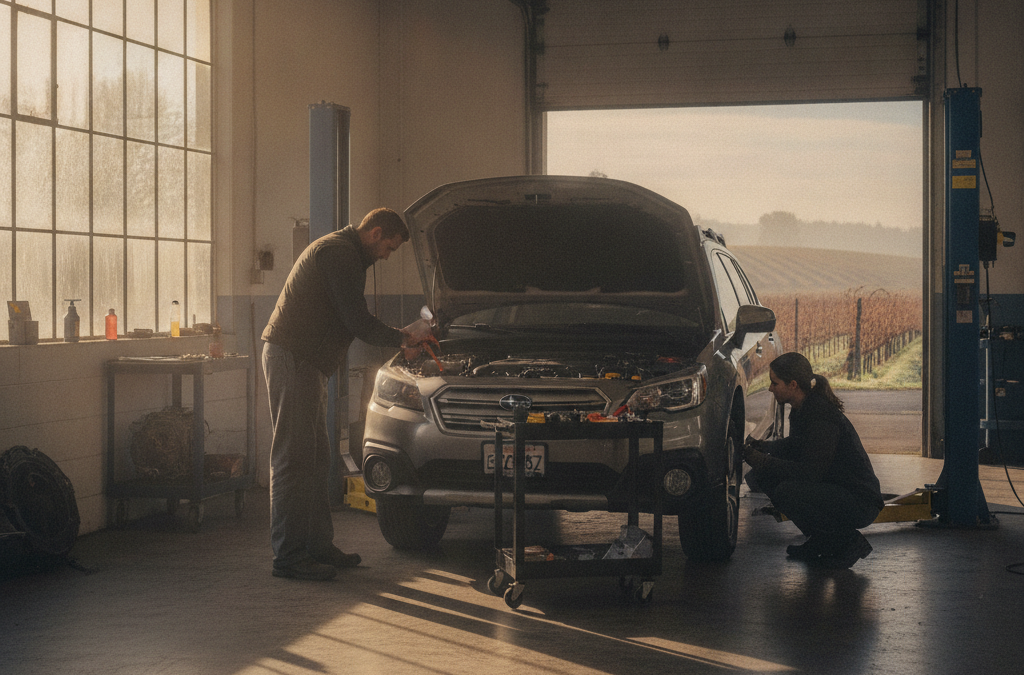
Why Is My Car Hard to Start on Cold Mornings in Sonoma County? What’s Actually Going On
If your car has been dragging its feet on cold Sonoma County mornings — slow crank, a few extra turns before it catches, or a flat-out refusal to start — you’re not alone, and you’re not imagining it. Cold weather genuinely stresses several systems in your vehicle at once. The good news is that most cold-start problems come down to a handful of known culprits, and catching them early is a lot cheaper than being stranded on the side of Highway 101 trying to get to work in Santa Rosa.
This article breaks down the most common reasons a car is hard to start in cold weather, what’s actually happening inside your engine, and how to tell whether this is a quick fix or something that needs a closer look from a mechanic you trust.
Why Cold Weather Makes Starting Harder in the First Place
When temperatures drop — even into the mild 35–45°F range that’s common in Sonoma County during December through February — a few things happen simultaneously that all work against a smooth start.
Your battery loses cranking power in the cold. Engine oil thickens slightly, creating more resistance during startup. Fuel doesn’t vaporize as efficiently in a cold engine. And if any of your ignition components are already a little worn, cold conditions will expose that weakness fast.
Sonoma County doesn’t get brutal winters like the Midwest, but those damp, foggy mornings in Cotati, Cloverdale, and the lower Russian River Valley are cold enough to expose a marginal battery or a fuel system that’s been coasting on borrowed time. Drivers who commute south on 101 toward Petaluma or Marin County know that a car that barely starts at 7 a.m. is a car that might leave you stranded by 7:15.
The Most Common Causes of Hard Cold Starts
1. A Weak or Aging Battery
This is the number one cause of cold-morning starting problems, full stop. Car batteries are rated in cold cranking amps (CCA) — the power they can deliver at 0°F. As a battery ages (typically after 4–5 years), it loses CCA capacity. What started as a 600 CCA battery might only be putting out 350 CCA by year five. That’s often enough to start the car on a warm September day but not enough when it’s 38°F and foggy in Windsor or Sebastopol.
\p>Signs your battery is the culprit: slow crank on cold mornings, lights that seem dimmer than normal when starting, or a clicking sound instead of a crank. If your battery is over four years old and you’re noticing any hesitation, it’s worth having it load-tested. A simple test can tell you whether it’s holding its charge properly — and it’s the kind of thing we check for free before recommending a replacement.
2. Worn Spark Plugs or Ignition Issues
Spark plugs that are past their service life don’t fire as reliably, and cold air makes that problem worse. A plug that produces a weak spark at 70°F might misfire repeatedly at 40°F. The same goes for ignition coils that are starting to fail.
If your engine cranks and turns over but runs rough or stumbles for the first minute or two on cold mornings before smoothing out, ignition wear is a likely contributor. Spark plugs have service intervals that vary by vehicle — typically between 30,000 and 100,000 miles depending on whether you have standard or iridium/platinum plugs — but many drivers in Roseland and the Montgomery Village area push well past those intervals without realizing it.
3. Fuel System Problems
Cold temperatures affect how fuel is delivered and vaporized in the combustion chamber. If your fuel injectors are dirty or partially clogged, they may not atomize fuel correctly during a cold start, leading to hard starts, rough idle, or the engine catching and then dying. A failing fuel pump can also make itself known on cold mornings when the added resistance of a cold engine demands more fuel pressure than a weak pump can provide.
If you notice your car starts better after the second or third attempt, or stalls shortly after starting until it warms up, the fuel system deserves a closer look. A proper diagnostic scan can often identify fuel trim issues and low fuel pressure readings that point directly to these problems.
4. A Failing Starter Motor
The starter motor draws a huge amount of current to crank the engine. Starters that are wearing out often show their weakness in cold weather, when the battery is already taxed and the engine oil is slightly thicker. A clicking sound with no crank, or a groan followed by nothing, can point to a starter that’s on its way out. This is less common than a battery issue but worth ruling out once you’ve confirmed the battery is in good shape.
5. Thick or Degraded Engine Oil
If you’re running conventional oil or you’ve gone significantly past your oil change interval, your oil may be thicker than it should be in cold temperatures. That extra resistance makes the engine harder to crank and puts more strain on the starter and battery. This is one of the simplest fixes — the right oil viscosity for your climate and driving habits makes a real difference on cold starts.
Most modern vehicles in Sonoma County do well with a full synthetic 0W-20 or 5W-30, which flows much more readily in cold conditions than conventional 10W-30. If you’re not sure what’s in your engine right now, that’s a good starting point. Preventive maintenance — including the right oil for your driving conditions — goes a long way toward preventing cold-start headaches before they start.
What About Diesel Vehicles and Older Cars?
Diesel engines have their own cold-start challenges — glow plugs instead of spark plugs, fuel that can gel in cold weather, and longer warm-up times. If you’re driving a diesel truck or SUV in the northern parts of Sonoma County, especially up toward Cloverdale or into Mendocino County in winter, glow plug condition is worth checking annually. A diesel that cranks for 10 seconds before catching is often telling you the glow plugs aren’t doing their job.
Older vehicles — especially those still running on carbureted engines, which you’ll still occasionally find in Roseland or working-class neighborhoods where folks keep their cars running for decades — have their own cold-start quirks. Choke systems and accelerator pump wear can make a carbureted car finicky in the cold in ways that differ from fuel-injected vehicles.
What This Looks Like Across Different Makes
Some vehicles are more prone to specific cold-start issues than others. Subarus with higher mileage sometimes develop fuel pressure bleed-down issues overnight, causing extended cranks on the first start of the day. Older Hondas and Toyotas are generally very reliable cold-starters, but their batteries still age like everyone else’s. Ford F-150s and Chevy Silverados — popular work trucks throughout Sonoma County — often have high parasitic drain from aftermarket accessories that kills batteries faster than expected. German vehicles like VW and Mercedes tend to have more complex fuel systems that benefit from clean injectors and fresh fuel filters to maintain reliable cold starts.
The point is: the fix depends on what you’re driving and how it’s been maintained. A thorough diagnosis beats guessing, especially when you’re dealing with multiple possible causes at once.
When Should You Actually Bring It In?
If your car is starting slowly but consistently, and it’s been a few years since anyone checked your battery or changed your spark plugs, bring it in before it gets worse. A car that’s borderline now will become a no-start when you least expect it — like on a cold Tuesday morning in Rohnert Park when you’re already running late.
If it’s completely failing to start, cranking but not firing, or stalling immediately after startup, don’t keep trying to force it. Call us and we can walk you through what to do next or get you scheduled for a same-day look.
Frequently Asked Questions
How cold does it have to be to affect my car battery in Sonoma County?
Battery performance starts dropping noticeably below 40°F. Sonoma County doesn’t get extreme cold, but those damp winter mornings — especially in lower elevations near Petaluma or inland valleys near Sebastopol — are cold enough to expose a battery that’s already weakened with age.
My car eventually starts after a few tries. Is that okay?
No — that’s your vehicle telling you something is marginal. Whether it’s the battery, fuel pressure, or ignition, a hard start that resolves after multiple attempts will eventually become a no-start. Don’t wait until it strands you.
Can the wrong motor oil cause hard cold starts?
Yes. If your engine is running a heavier viscosity oil or oil that’s past its useful life, it’ll be thicker in cold temperatures and harder for the starter to crank through. Using the manufacturer-recommended synthetic oil is one of the easiest ways to improve cold-start performance.
What’s the difference between a slow crank and a click-click-click with no start?
A slow crank usually means a weak battery that still has some capacity left. Rapid clicking with no crank typically means the battery is nearly dead or there’s a bad connection. Both point to the battery as the first thing to test.
Do I need a special battery for winter driving in Sonoma County?
Not necessarily a special one, but you do want a battery with adequate CCA for your vehicle and climate. When we replace a battery, we match it to your vehicle’s specs rather than just grabbing the cheapest one on the shelf. That matters more than most people realize.
Let Us Take a Look Before It Leaves You Stranded
Hard starts are one of those problems that feel minor until they’re not. If your car has been slow to fire up on cool mornings around Santa Rosa or anywhere else in Sonoma County, it’s worth getting checked out now — before a cold snap turns a marginal battery or a worn spark plug into a full-blown no-start situation.
At On-Site Auto Repair, we’ve been diagnosing and fixing cold-start problems on everything from Toyotas and Hondas to Ford trucks and Subarus since 2011. We’ll tell you exactly what’s going on, what actually needs attention, and what can wait — no guessing, no upselling. Reach out to schedule a free estimate and let’s get your car starting reliably again, whatever the weather.