
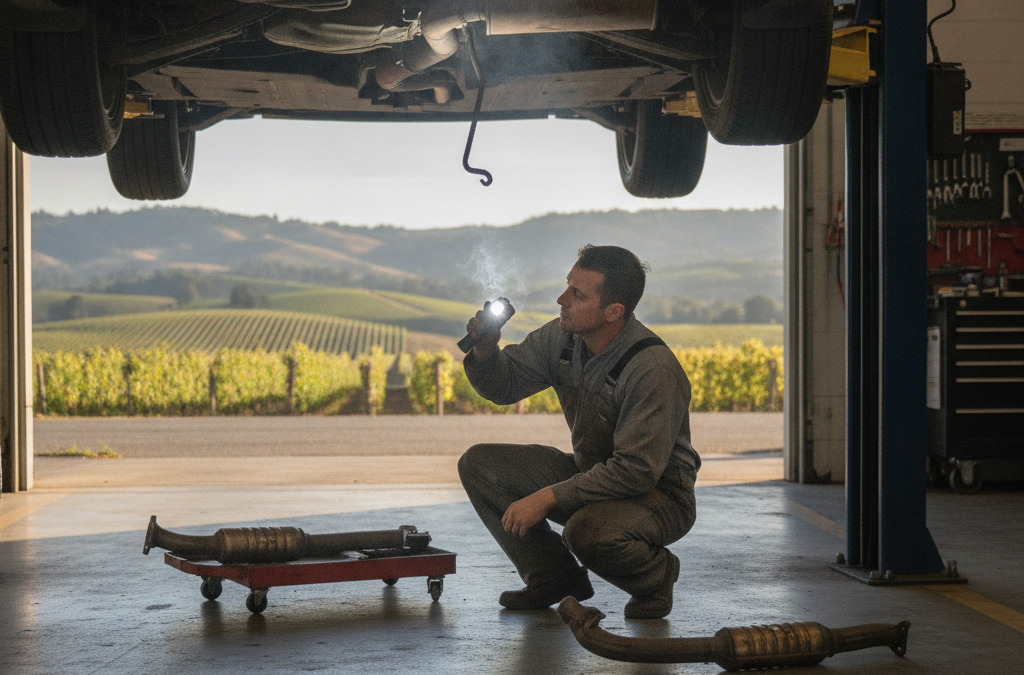
Why Is My Car’s Exhaust Making Noise or Smelling Odd in Healdsburg? What Sonoma County Drivers Need to Know About Exhaust System Problems
If your car has suddenly gotten louder on the road, you’re noticing a rattle coming from underneath when you accelerate, or there’s a weird sulfur or burning smell following you around — your exhaust system is trying to tell you something. For drivers in Healdsburg, Windsor, and the surrounding Wine Country area, exhaust problems are actually more common than you’d expect. Between long Highway 101 runs, twisty backroads heading toward Cloverdale and Geyserville, and vehicles that put on serious miles, exhaust components take a beating. The good news is that most exhaust issues are diagnosable and repairable before they turn into something much more expensive — or dangerous.
What Does the Exhaust System Actually Do?
Your exhaust system isn’t just a pipe that routes fumes out the back of your car. It’s a series of connected components — starting at the engine and ending at the tailpipe — that together manage emissions, reduce engine noise, improve fuel efficiency, and keep harmful gases from entering the cabin. The key parts are the exhaust manifold, oxygen sensors, catalytic converter, resonator, muffler, and the pipes connecting them. When any one of these fails, you’ll usually hear it, smell it, or feel it — sometimes all three.
Common Exhaust Noises and What They Mean
Loud Roaring or Rumbling That Gets Worse Under Acceleration
This is one of the most common complaints we hear. If your car suddenly sounds like a muscle car when you hit the gas — and you’re driving a Camry or a Subaru Outback — something has likely rusted through or cracked in your muffler or exhaust pipe. Sonoma County’s wet winters and foggy coastal air are hard on metal components. Vehicles parked outside in areas like Windsor or near the Russian River corridor are especially prone to undercarriage rust over time. A cracked or separated muffler isn’t just loud — it’s a sign exhaust gases could be leaking closer to the cabin.
Rattling or Clunking from Underneath
If you’re hearing a metallic rattle — especially at idle or when you go over bumps — there’s a good chance a heat shield has come loose, or a hanger bracket holding up part of the exhaust pipe has corroded and broken. This is extremely common on vehicles with higher mileage and happens to all makes and models. A loose heat shield is usually inexpensive to address. What you don’t want to do is ignore it: a heat shield or exhaust section that drops onto the road is both a hazard and a much bigger repair.
Hissing or Ticking Noises Near the Engine
A hissing or rhythmic ticking that speeds up with the engine is often a sign of an exhaust manifold leak — a crack or a failed gasket right where the exhaust exits the engine. This one tends to be louder when the engine is cold and may quiet down after it warms up. Don’t let that fool you into thinking it’s gone away. Manifold leaks can pull in outside air, mess with oxygen sensor readings, and eventually cause engine performance problems. They’re also a check engine light trigger.
The Smell Problem: What That Odor Is Actually Telling You
Exhaust smells inside or directly behind your car are always worth investigating — some are minor, some are urgent.
- Rotten egg or sulfur smell: Usually points to a failing catalytic converter struggling to process sulfur compounds from the fuel. This often comes with a check engine light and reduced performance. If you’ve noticed your car running a little rough or sluggish on longer drives between Healdsburg and Santa Rosa, this combination of symptoms is a strong signal.
- Burning or smoky smell: Can mean oil or coolant is somehow contacting hot exhaust components — either from a leak above or a breach in the exhaust system itself. Bluish smoke from the tailpipe suggests oil; white or sweet-smelling smoke suggests coolant. Neither should be ignored.
- Exhaust smell inside the cabin: This is a safety concern, full stop. Carbon monoxide is odorless, but if you’re smelling exhaust fumes in the passenger area, there’s likely a leak somewhere in the system routing gases toward the cabin rather than out the back. Pull over, get fresh air, and have the car towed or inspected before driving it again. Don’t assume you’ll just crack a window and be fine.
Why Exhaust Problems Are Commonly Missed at Quick Lube Shops
Here’s a gap we see regularly that most local shops don’t talk about openly: quick lube and oil change-only shops rarely get underneath your car in any meaningful way. They might spot an obvious drip or crack, but a systematic inspection of exhaust hangers, heat shields, manifold gaskets, and pipe integrity typically doesn’t happen at a 15-minute oil change bay. By the time a customer notices something is wrong, a small and cheap fix has often turned into a full exhaust section replacement.
At On-Site Auto Repair, a proper visual inspection of your undercarriage — including the exhaust system — is part of how we approach any service visit. We’re not looking to sell you things you don’t need. If something looks fine, we’ll tell you that. If something has three months left on it, we’ll show you and let you decide. That’s the honest approach we’ve worked by since 2011, and it’s why a lot of our customers from Healdsburg, Cloverdale, and Windsor keep coming back rather than heading to a chain shop.
Exhaust Issues Specific to Wine Country Driving Conditions
Drivers in this part of Sonoma County deal with some conditions that specifically accelerate exhaust wear. The rural roads heading into the Alexander Valley and Dry Creek Valley areas — popular with locals and Wine Country tourists alike — involve a lot of low-speed idling (think winery parking, traffic near harvest season), short trips, and occasionally rough gravel or chip-sealed surfaces that kick debris up toward the undercarriage. Short trips are actually harder on exhaust systems than highway driving because the system never fully heats up and moisture accumulates internally, speeding up rust from the inside out.
If you’re regularly doing short errands around Healdsburg or nearby Geyserville and haven’t had your exhaust inspected in the last couple of years, it’s worth a look — especially if your vehicle is getting past the 80,000- or 100,000-mile mark. Preventive maintenance that includes an undercarriage inspection can catch exhaust problems early, when they’re usually a simple fix.
Repair vs. Replacement: What to Expect
Not every exhaust problem means replacing the whole system. Many times, a single section of pipe, a muffler, or a gasket is the only thing that needs attention. A straightforward muffler replacement or a re-weld on a separated joint is a much smaller cost than a full system replacement. The key is getting an honest assessment from someone who’ll tell you exactly what’s needed and nothing more.
We’ll always give you a clear explanation of what we found, what it means, and what your options are — whether that’s a targeted repair or a more complete fix if the system is heavily corroded. We don’t believe in recommending a full replacement just because a single component has worn out. Our complete auto repair services cover exhaust diagnostics and repair across all makes and models, from older Toyotas and Hondas to newer trucks, SUVs, and European vehicles.
Frequently Asked Questions: Exhaust Problems in Sonoma County
Can I drive with an exhaust leak?
Briefly and only if you must — but it depends on where the leak is. A leak near the tailpipe or muffler is less immediately dangerous than one near the engine or midpipe. If you’re smelling exhaust inside the cabin at all, don’t drive the vehicle. Otherwise, get it looked at as soon as you can. Exhaust leaks don’t repair themselves, and they tend to get worse quickly.
Will an exhaust problem trigger my check engine light?
It can, especially if the leak is affecting oxygen sensor readings or if the catalytic converter is failing. Not every exhaust problem will trigger a light immediately, though. A loud muffler or a broken hanger won’t necessarily flag a code — which is one reason physical inspection matters as much as a diagnostic scan.
My car is louder but running fine. Should I still bother?
Yes — even if performance seems unaffected. A louder exhaust usually means combustion gases are escaping somewhere they shouldn’t. Over time this can affect back pressure, fuel economy, and emissions compliance. California emissions testing is real and failing it means repair costs anyway.
How long does an exhaust repair typically take?
Straightforward muffler or pipe repairs can often be completed the same day. More involved work — like replacing a catalytic converter or addressing a manifold leak — may take a bit longer depending on parts availability for your specific vehicle. We’ll give you a realistic timeline upfront.
Does exhaust repair cost more on European or luxury vehicles?
It can, primarily because parts cost more and the system design is sometimes more complex. German vehicles like Volkswagen, Mercedes, and Audi, as well as Land Rover, often have more elaborate exhaust routing. That said, we work on all makes and models and we’ll give you an honest estimate before any work begins — no surprises.
Bring It In Before That Rattle Becomes a Real Problem
If your exhaust is making noise, producing odd smells, or you just haven’t had an undercarriage check in a while — don’t wait for it to get worse. We serve drivers throughout Healdsburg, Windsor, Cloverdale, and all of Sonoma County, and we’re straightforward about what we find and what it’ll take to fix it.
Contact On-Site Auto Repair to schedule an inspection or ask us a question. No pressure, no upselling — just honest answers and solid work from a shop that’s been taking care of Sonoma County vehicles since 2011.