Why Is My Car’s Brake Fluid Dark or Contaminated in Windsor? What Sonoma County Drivers Need to Know About Brake Fluid Service
If you’ve ever popped the hood and noticed that the fluid in your brake reservoir looks more like old motor oil than the clear or pale yellow it should be, your brake fluid is trying to tell you something. For drivers in Windsor, Healdsburg, and the northern stretch of Sonoma County, this is more than a cosmetic issue — contaminated brake fluid directly affects how well your car stops, and that matters a lot when you’re coming down from the hills around Larkfield-Wikiup or navigating the wine country backroads after harvest season. Here’s what’s actually happening, why it matters, and when to get it taken care of.
What Does Brake Fluid Actually Do?
Brake fluid is what makes your brakes respond when you press the pedal. It’s the hydraulic link between your foot and your brake calipers — when you push the pedal, pressurized fluid travels through the lines and squeezes the pads against the rotors to slow you down. Without it functioning properly, that whole chain of events breaks down.
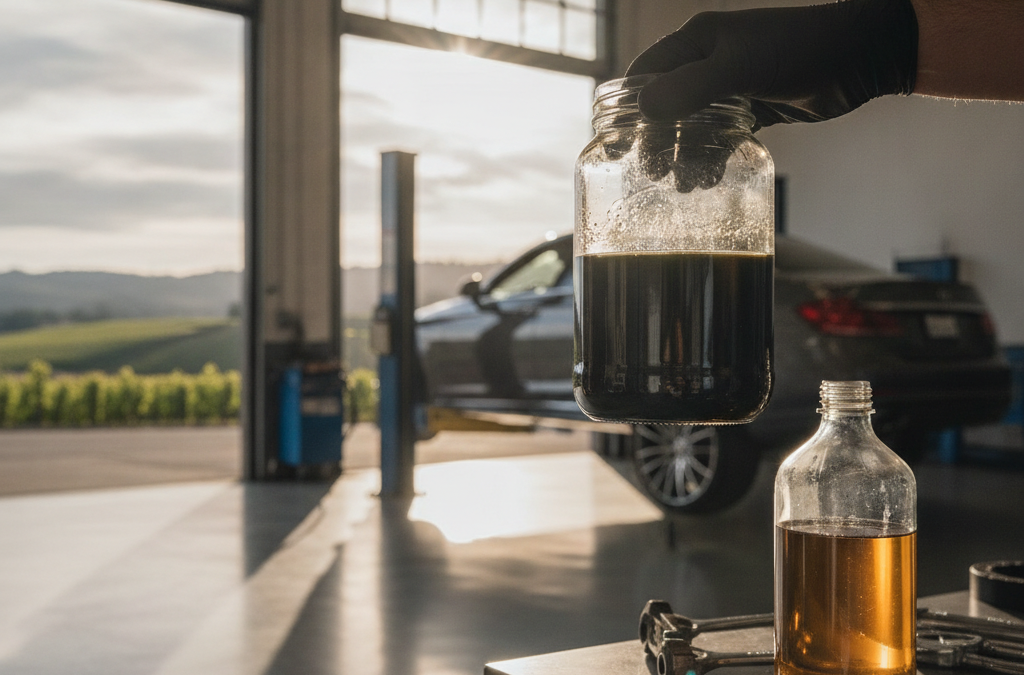
Fresh brake fluid is typically clear to very light amber. It should feel slick between your fingers, not gritty or thick. Over time, brake fluid absorbs moisture from the air — this is called being hygroscopic, meaning it’s chemically attracted to water. That absorbed moisture lowers the fluid’s boiling point and causes internal corrosion in brake lines, calipers, and wheel cylinders. It also turns the fluid dark, cloudy, or sludgy.
Why Dark Brake Fluid Is a Real Safety Problem
Here’s the part most drivers don’t think about: when brake fluid gets water-logged, its boiling point drops significantly. Under heavy braking — coming down a grade, towing, or emergency stops — that fluid can actually boil inside your brake lines. When fluid boils, it turns to vapor, and vapor doesn’t transmit hydraulic pressure the way liquid does. The result is a spongy pedal or, in severe cases, dramatically reduced braking. That’s what mechanics call brake fade from fluid vapor lock, and it’s a serious situation.
For drivers in Windsor and Healdsburg who regularly use Chalk Hill Road, Dry Creek Road, or Alexander Valley routes, the combination of hilly terrain and degraded brake fluid is a risk worth taking seriously. These roads aren’t the kind where you want to discover your brakes feel soft at the bottom of a long descent.
How Often Should Brake Fluid Be Changed?
This is where things get surprisingly inconsistent — even among automakers. Some manufacturers, like BMW and Honda, specify brake fluid replacement every two years regardless of mileage. Others suggest every 45,000 miles. Many vehicles’ owner’s manuals are frustratingly vague on this topic entirely.
A practical rule of thumb that we stand behind at On Site Auto Repair: have your brake fluid tested every two years, and change it if moisture content is above 3%. We use a simple test strip or a digital moisture tester — it takes about 30 seconds and gives you a clear answer. No guessing, no upselling.
If you can’t remember the last time your brake fluid was changed, and your car has more than 50,000 miles on it, there’s a good chance it’s due. This is especially true for used vehicles and fleet vehicles — brake fluid is one of the most commonly skipped maintenance items.
Signs Your Brake Fluid Needs Attention
- Dark brown or black fluid in the reservoir — fresh fluid is clear to pale amber; anything darker means it’s been in there too long
- Spongy or soft brake pedal — if the pedal feels mushy or sinks lower than usual, moisture-contaminated fluid may be to blame
- Longer stopping distances — subtle at first, but worth paying attention to, especially on unfamiliar roads
- Brake warning light — if the light comes on and your pads aren’t worn down, low or degraded fluid can trigger the sensor
- Visible corrosion or rust around brake components — contaminated fluid accelerates internal corrosion in calipers and wheel cylinders
None of these symptoms should be dismissed as minor, especially if you’re doing regular highway driving between Windsor and Santa Rosa on Highway 101 — where traffic can stop suddenly and your reaction time depends on your brake system being in top shape.
DOT 3 vs. DOT 4: Does It Matter Which Fluid Your Car Uses?
Yes, it matters. The DOT rating refers to the fluid’s boiling point specification. DOT 4 has a higher dry boiling point than DOT 3, which makes it better suited for vehicles that generate more heat — performance cars, trucks that tow, and vehicles driven in hilly areas. Many European vehicles specify DOT 4 from the factory. Putting DOT 3 in a car that calls for DOT 4 is technically within spec, but it’s not ideal.
There’s also DOT 5, which is silicone-based and not compatible with most modern ABS and traction control systems — it’s mainly used in collector cars. And DOT 5.1 is glycol-based (like DOT 3 and 4) but with a very high boiling point, sometimes used in performance applications. When in doubt, check your owner’s manual or ask your mechanic — mixing incompatible fluids is a mistake worth avoiding.
What Happens During a Brake Fluid Flush?
A proper brake fluid flush isn’t just topping off the reservoir. It means removing the old, contaminated fluid from the entire system — the master cylinder, the ABS modulator, all four corners — and replacing it with fresh fluid. This is typically done using a pressure bleeder or vacuum bleeder, working through each brake caliper bleed screw in sequence.
The job takes roughly 30 to 60 minutes depending on the vehicle. It’s not expensive relative to what it protects. And it’s one of those services where you genuinely feel the difference — a firmer, more responsive pedal right after the service is common, especially if the old fluid was significantly degraded.
At On Site Auto Repair, we’ll always show you what your old fluid looks like before we flush it so you can see exactly why we’re recommending the service. No mystery, no pressure. Our brake repair and service covers everything from fluid flushes to pad replacements to caliper work — and we do it for all makes and models.
Is This Something You Can DIY?
Technically, yes — brake fluid is sold at any auto parts store, and you can top off the reservoir yourself. But a full flush is a different story. Bleeding brakes requires working through the system in a specific order, applying the right pressure, and making sure no air enters the lines. If you introduce air into the brake system, you get that spongy pedal problem — and now you have two issues instead of one.
For most Windsor and Cloverdale drivers, this is a job best left to a shop that can do it right the first time and verify the results. The cost savings from DIY rarely outweigh the risk of doing it incorrectly.
Brake Fluid and Your Whole Brake System
Brake fluid doesn’t exist in isolation — it’s part of a system that includes your pads, rotors, calipers, brake lines, and ABS components. When we inspect brake fluid, we also check the condition of those related components. Corroded brake lines, sticking calipers, and leaking wheel cylinders are all things contaminated fluid can accelerate. Catching them early as part of routine preventive maintenance is almost always cheaper than waiting for a failure.
If you drive a Toyota, Honda, Subaru, Ford, or any other vehicle with over 50,000 miles on the clock and you’re not sure when the brake fluid was last serviced, it’s worth having it checked. It takes a few minutes and gives you a clear picture of where your brake system stands.
Frequently Asked Questions About Brake Fluid in Sonoma County
How can I tell if my brake fluid is contaminated without a test strip?
Look at the color in the reservoir — if it’s dark brown, murky, or has visible debris, it needs attention. You can also press the pedal and check for sponginess. A quick visual is a good starting point, but a proper moisture test gives you an accurate picture.
Can I just top off the reservoir instead of doing a full flush?
Topping off is fine if your level is low due to a small leak or pad wear, but it doesn’t remove the old contaminated fluid already in the system. Think of it like adding fresh water to old coffee — it dilutes but doesn’t fix the problem. A full flush is the right solution.
Does driving in hilly areas like Larkfield-Wikiup or Healdsburg really affect brake fluid faster?
It can. Repeated hard braking generates more heat in the system, which accelerates fluid breakdown and moisture absorption over time. Drivers who regularly navigate steep grades will benefit from checking fluid condition more frequently than someone who mostly drives flat terrain.
How much does a brake fluid flush typically cost?
Prices vary by shop and vehicle, but it’s generally one of the more affordable fluid services — especially relative to what it protects. Contact us for a free estimate and we’ll give you a straightforward number with no surprises.
My car’s ABS light came on — could it be related to the brake fluid?
It’s possible. Contaminated or low brake fluid can trigger ABS warning lights in some vehicles, especially if the fluid has degraded to the point where the ABS modulator isn’t getting proper pressure. We’d want to run a diagnostic scan to identify the specific fault code before assuming it’s just a fluid issue.
Get Your Brake Fluid Checked — It Only Takes a Few Minutes
Brake fluid service is one of the most overlooked items in routine maintenance, and it’s one of the most straightforward to address. If you’re in Windsor, Healdsburg, Cloverdale, or anywhere in northern Sonoma County and you haven’t had your brake fluid checked in the last couple of years, it’s worth a quick stop. We’ve been taking care of Sonoma County drivers since 2011, and we treat every vehicle like it belongs to someone we know — because it usually does.
Contact On Site Auto Repair to schedule a brake fluid inspection or get a free estimate. We’re straightforward about what we find and honest about what actually needs to be done — no unnecessary upsells, no guesswork.