Why Is My Car’s Power Steering Hard to Turn in Petaluma? What Sonoma County Drivers Need to Know About Steering System Problems
If your steering wheel has started to feel unusually stiff, like you’re suddenly wrestling with your car through every turn, that’s your vehicle telling you something is wrong with the power steering system. For drivers in Petaluma, Rohnert Park, Cotati, and throughout Sonoma County, this isn’t a problem to put off. Power steering issues can get worse fast — and in some cases, a failure while driving can make it genuinely difficult to control your vehicle safely.
The good news is that most power steering problems are diagnosable and repairable before they become dangerous or expensive. Here’s what you need to know.
Hydraulic vs. Electric Power Steering: Why It Matters
Before getting into the causes, it helps to know what type of power steering your vehicle has — because the symptoms and repairs are different.
Hydraulic power steering (HPS) uses a pump driven by your engine, power steering fluid, and a network of hoses to assist your steering. Older vehicles and many trucks still use this system. If the pump fails, the fluid leaks, or a hose cracks, you’ll feel it immediately in the wheel.
Electric power steering (EPS) uses a motor and sensors to do the work without fluid. Most vehicles built after 2010 — including Toyota Camrys, Honda CR-Vs, Subaru Outbacks, Ford Escapes, and many others — use this system. EPS problems often show up as a warning light on your dash, inconsistent steering assist, or a sudden heavy feeling.
Knowing which system your car has helps you describe the problem clearly when you bring it in. If you’re not sure, any qualified mechanic can tell you at a glance.
Common Reasons Your Steering Feels Stiff or Heavy
Low or Contaminated Power Steering Fluid (Hydraulic Systems)
This is the most common culprit in older vehicles. If your power steering fluid is low — often because of a slow leak somewhere in the system — the pump can’t generate enough pressure to give you smooth steering assist. You might notice the stiffness is worse when the car is cold and improves once the engine warms up. That’s a classic low-fluid symptom.
Fluid can also break down over time, becoming dark, gritty, and less effective. Some manufacturers recommend flushing power steering fluid every 50,000 miles or so, though many owners skip this service entirely. If your fluid looks brown or smells burnt, it’s overdue.
Failing Power Steering Pump
When a hydraulic power steering pump starts to go, you’ll often hear a whining or groaning noise when you turn the wheel — especially at low speeds or when parking. The steering may feel heavy all the time, not just when cold. Left alone, a failing pump can eventually stop assisting altogether, making the car very difficult to steer at low speeds.
Leaking or Cracked Power Steering Hoses
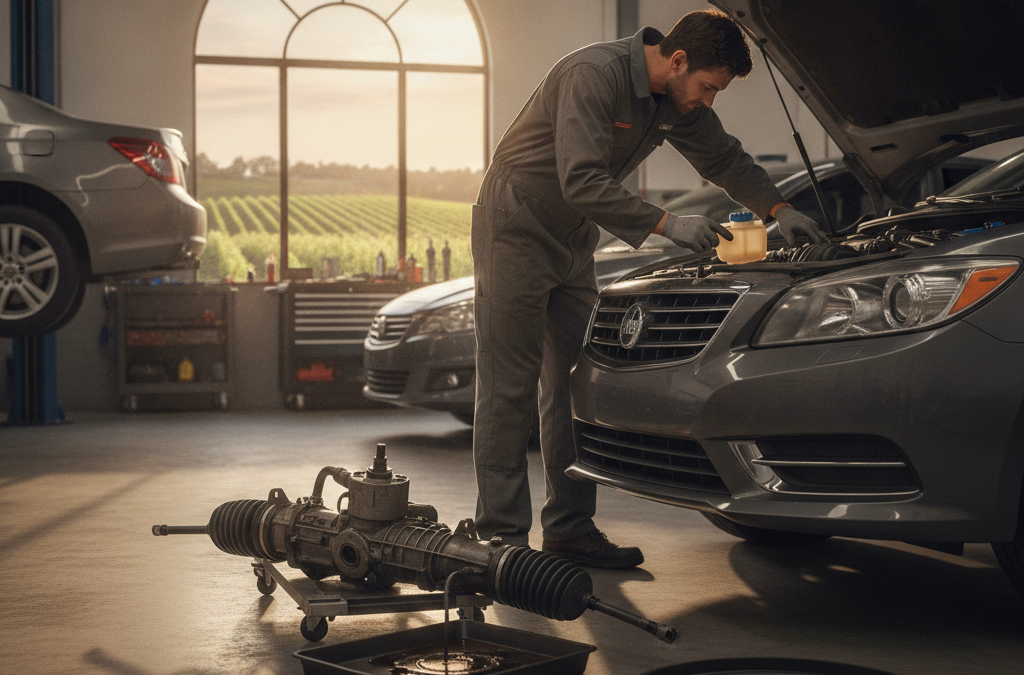
Hoses carry pressurized fluid from the pump to the steering rack and back. They can crack from age, heat cycles, or wear — and Sonoma County’s combination of cool wet winters and hot dry summers is genuinely hard on rubber components over time. A leaking hose will drop your fluid level, reduce steering assist, and eventually leave a reddish or brownish puddle under the front of your car.
Worn Steering Rack
The steering rack converts your wheel-turning input into actual movement of the front wheels. When it wears out, you might notice stiff spots at certain wheel positions, wandering steering, or a clunking or knocking sensation when turning. Steering rack replacement is a more involved job, but it’s manageable when caught before the rack fails completely.
Electric Power Steering Motor or Sensor Failure
On EPS-equipped vehicles, the most common problems involve the steering assist motor, the torque sensor that tells it how hard you’re turning, or the control module. These issues almost always trigger a warning light — often a steering wheel icon or an EPS light. You might feel normal steering sometimes and suddenly heavy steering other times. This kind of intermittent behavior usually means a sensor or electrical connection issue rather than a full mechanical failure.
If your EPS light comes on, don’t dismiss it. A proper auto diagnostic scan will pull the fault codes and point your mechanic toward the specific component causing the problem — no guesswork required.
Local Conditions That Accelerate Steering Wear
Petaluma and the surrounding area have driving conditions that are genuinely harder on steering components than a flat urban environment. Highway 101 commuters heading north through Cotati and Rohnert Park into Santa Rosa put consistent high-speed miles on their vehicles. Stop-and-go driving combined with tight parking maneuvers in Petaluma’s older downtown streets puts a lot of low-speed stress on the steering pump and rack.
Sebastopol drivers who navigate rural roads with potholes and uneven pavement — and anyone taking their vehicle out toward the Russian River Valley on winding two-lane roads — know that steering components take a beating. Worn bushings, loose tie rod ends, and degraded mounts all affect steering feel, and they tend to wear faster on rough or curvy roads.
That’s also why a proper steering and suspension inspection is worth doing periodically, especially if you’ve been driving rural Wine Country roads regularly or you’re noticing any pull, wander, or heaviness in the wheel.
Warning Signs You Shouldn’t Ignore
- Steering wheel is stiff or hard to turn, especially at low speeds or when parking
- Whining, groaning, or squealing when you turn the wheel
- Steering feels light sometimes and heavy others — inconsistent assist is a red flag
- A reddish or brownish puddle under the front of your vehicle (power steering fluid leak)
- Steering wheel vibrates or shudders when turning
- EPS, steering, or power steering warning light on your dash
- Car pulls to one side without you steering that way
Any one of these symptoms is reason enough to have the system looked at. Two or more at once means you should bring it in soon rather than waiting.
What to Expect When You Bring It In
A steering system inspection at On-Site Auto Repair starts with a physical check of the fluid level and condition (on hydraulic systems), a visual inspection of hoses, the pump, and the rack, and a check of related components like tie rod ends, steering linkage, and power steering pressure. On EPS vehicles, we’ll pull any fault codes stored in the system and test the sensor inputs.
We’ll tell you clearly what we found, what it means, and what it’ll take to fix it — with no pressure and no made-up urgency. If the problem is minor, we’ll say so. If it’s something that needs to be addressed soon for safety reasons, we’ll tell you that too and explain why.
Frequently Asked Questions
Can I drive my car if the power steering isn’t working?
Technically yes — your car will still steer — but it takes significantly more effort, especially at low speeds and in tight spots. It’s not dangerous on a highway at steady speed, but it can be very difficult in a parking lot or during an emergency maneuver. We’d recommend getting it looked at as soon as possible rather than making a habit of driving without assist.
How often should power steering fluid be changed?
Most manufacturers recommend checking it at every oil change and flushing it somewhere between 50,000 and 100,000 miles, depending on the vehicle. If you’ve never had it done and your car has over 75,000 miles, it’s worth having the fluid inspected. Dark, gritty fluid is a sign it’s past due.
My EPS warning light came on but the steering feels normal. Should I still bring it in?
Yes. EPS warning lights often come on before you feel a noticeable change in steering. It could be a sensor, a software issue, or an early-stage motor problem. Catching it early usually means a simpler and less expensive fix. Waiting until the steering actually fails isn’t worth the risk.
Is power steering repair expensive?
It depends entirely on the cause. A fluid flush or hose replacement is relatively straightforward. A power steering pump or steering rack replacement is more involved. We always give you an honest estimate upfront so you know what you’re looking at before any work begins. Contact us for a free estimate specific to your vehicle.
Does a Subaru, Toyota, or Honda handle power steering differently?
Yes — different makes use different systems, and repair procedures vary. Many newer Toyotas and Hondas use fully electric systems with no fluid at all, while older Subarus often use hydraulic setups that benefit from periodic fluid service. We work on all makes and models and know the differences between them.
Get Your Steering Checked Before It Gets Worse
Steering problems have a way of starting subtle and getting worse gradually — until one day you realize your car is a lot harder to control than it should be. Whether you’re driving through Petaluma’s downtown, commuting up 101 through Rohnert Park, or winding through Sebastopol toward the coast, you need to trust your steering completely.
At On-Site Auto Repair, we’ve been diagnosing and fixing steering problems on all makes and models since 2011. We’ll give you a straight answer about what’s wrong, what it costs, and what happens if you wait. No upselling, no guessing, no surprises.
Contact us today to schedule an inspection or request a free estimate. We serve Petaluma, Rohnert Park, Cotati, Sebastopol, Santa Rosa, and drivers throughout Sonoma County.