Why Is My Car’s Brake Fluid Dark or Low in Oakmont? What Sonoma County Drivers Need to Know About Brake Fluid Service
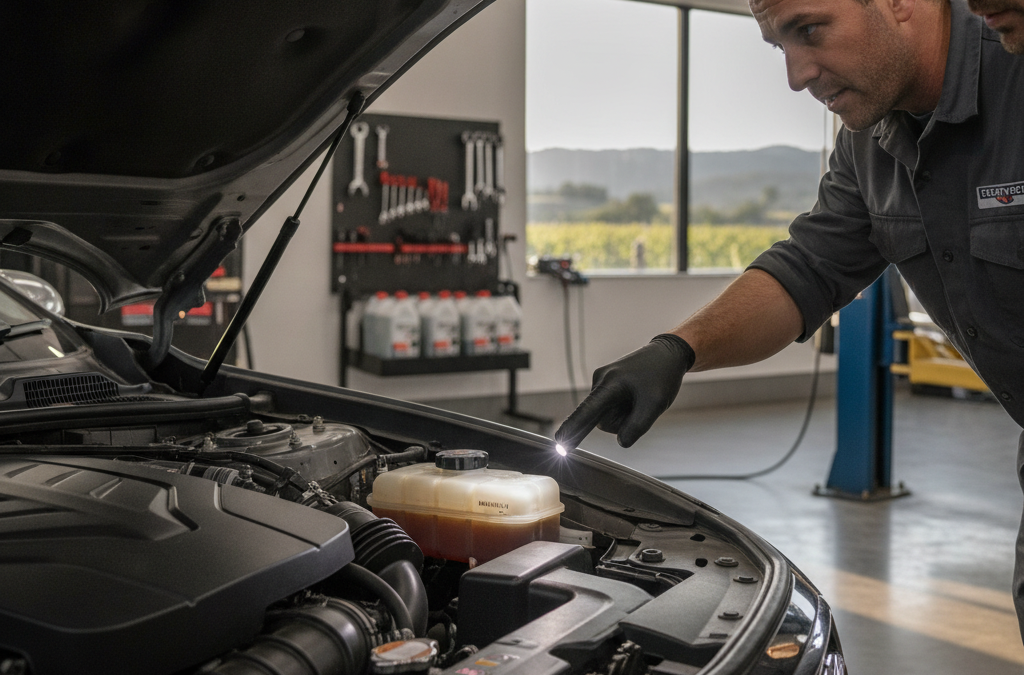
If you pop the hood and peek at your brake fluid reservoir — that small translucent plastic container near the back of the engine bay — and the fluid looks brown, murky, or is sitting below the “MIN” line, your brake system is trying to get your attention. For drivers in Oakmont, Bennett Valley, and the hillier parts of Sonoma County, this isn’t something to put off. Brake fluid is the hydraulic backbone of your entire stopping system, and when it degrades or gets low, your brakes can become less predictable — sometimes at exactly the wrong moment, like heading downhill on a winding road toward Sonoma Valley.
What Brake Fluid Actually Does (and Why It Breaks Down)
Brake fluid is a hygroscopic fluid — meaning it naturally absorbs moisture from the air over time. That might not sound like a big deal, but water contamination significantly lowers the fluid’s boiling point. When brake fluid overheats from moisture absorption, it can vaporize inside your brake lines and create what’s called vapor lock — a condition where your brake pedal suddenly feels soft or spongy and your stopping power drops dramatically.
Fresh brake fluid is typically a pale yellow or nearly clear color. When it starts turning brown or dark — almost like dirty motor oil — that’s a sign it’s loaded with moisture, metal particles from internal brake components, and general contamination. At that point, it’s no longer doing its job reliably.
There’s also a simpler explanation for low fluid: worn brake pads. As your pads wear down, the brake calipers extend further to compensate, and that draws fluid from the reservoir. If your fluid level is dropping steadily, it might just mean your pads are due for replacement. But a sudden or steep drop in fluid level can also point to a brake fluid leak somewhere in the lines or at a caliper — and that’s a situation that needs attention right away.
Why This Matters More in Oakmont, Fountaingrove, and Bennett Valley
Not all driving conditions are equal, and Sonoma County throws a few extra challenges at your brake system compared to flat-terrain driving. If you live in Oakmont, Fountaingrove, or the Bennett Valley area of Santa Rosa, you’re probably navigating elevation changes every single day — whether that’s descending Adobe Canyon Road, coming down the backside of Fountaingrove Parkway, or heading out through the winding roads toward Sonoma.
Downhill driving puts sustained load on your brakes in a way that flat-road stop-and-go traffic doesn’t. That repeated heat cycling accelerates fluid degradation and accelerates wear on pads and rotors alike. Drivers who commute toward Rohnert Park or Petaluma via Highway 101 may not think of their daily drive as particularly hard on brakes — but if that commute starts or ends with a long downhill stretch, the fluid is working harder than you might expect.
You can learn more about our full brake system services at On-Site Auto Repair’s brake repair page — we handle everything from fluid flushes to pad and rotor replacement across all makes and models.
How Often Should Brake Fluid Be Replaced?
This is one of those topics that gets surprisingly little attention, even from shops that advertise brake services prominently. Most vehicle manufacturers recommend a brake fluid flush every 2 years or 30,000 miles — whichever comes first. Some newer vehicles with more sealed systems can go a bit longer, but the 2-year guideline is a reasonable rule of thumb for most drivers in our area.
Here’s the thing: a lot of local drivers don’t realize brake fluid is a scheduled maintenance item at all. Many people drive their Toyota Camry or Honda CR-V for four, five, even six years without anyone mentioning brake fluid — and by that point, the fluid has absorbed enough moisture that it’s genuinely compromised. It’s one of those maintenance items that doesn’t announce itself dramatically until something goes wrong.
A simple test with a brake fluid moisture tester can tell you within seconds what percentage of water is in your fluid and whether a flush is overdue. We do this as part of our inspections, and it takes about two minutes.
DOT 3, DOT 4, DOT 5 — What Type Does Your Car Take?
Brake fluid comes in different specifications — most commonly DOT 3 and DOT 4 for everyday passenger vehicles. DOT 4 has a higher boiling point, which is one reason it’s standard on many European vehicles like BMW, Volkswagen, and Mercedes-Benz that are engineered for more aggressive driving dynamics. DOT 3 is common across a wide range of domestic and Asian-market vehicles.
DOT 5 is silicone-based and is not compatible with most ABS systems — it’s used primarily in military and specialty vehicles, and you almost certainly do not want it in your daily driver. Always check your owner’s manual or the cap on your brake fluid reservoir before adding fluid. Mixing incompatible fluid types can damage seals and cause serious system problems.
If you’re not sure what your vehicle requires, just ask us — we’ll confirm the right spec before we touch anything.
Warning Signs Your Brake Fluid Needs Attention Now
- Spongy or soft brake pedal: If your pedal feels mushy or travels further than usual before the brakes engage, moisture-contaminated fluid is one possible cause.
- Brake pedal slowly sinking to the floor: This can indicate a leak in the system — not just old fluid, but a more urgent issue.
- Dark brown or black fluid in the reservoir: Fresh fluid is pale and translucent. Dark fluid has absorbed too much contamination to be reliable.
- Fluid level dropping without obvious pad wear: A leak somewhere in the brake lines or at a caliper is the likely culprit and needs to be inspected immediately.
- Brake warning light on your dashboard: Some vehicles monitor fluid level and will trigger this light when it drops below the minimum threshold.
If you’re seeing any of these signs — especially a soft pedal or a steadily dropping fluid level — don’t wait on it. Our diagnostic team can inspect your entire brake hydraulic system and tell you exactly what’s going on without guesswork or pressure to approve unnecessary work.
What a Brake Fluid Flush Actually Involves
A brake fluid flush isn’t the same as just topping off the reservoir. Topping off adds fresh fluid on top of old contaminated fluid — which does very little to improve the quality of what’s already in your lines and calipers. A proper flush pushes new fluid through the entire system — master cylinder, brake lines, calipers or wheel cylinders — until all the old fluid is purged and replaced with clean, fresh fluid to spec.
The process typically takes less than an hour, and it’s one of the more affordable maintenance services you can do for your vehicle. It’s also the kind of service that’s easy to include when your vehicle is already in for something else — pad replacement, a tire rotation, an oil change. We’ll let you know if it’s due and give you a straight answer on whether it’s actually needed, not just a default recommendation to upsell you.
Frequently Asked Questions About Brake Fluid in Sonoma County
Can I just add brake fluid myself if it’s low?
You can top it off temporarily, but low fluid usually means either worn pads or a leak — both of which need to be diagnosed. Adding fluid without finding the cause is just masking a symptom. If the fluid is also dark, a full flush is the right move, not a top-off.
How much does a brake fluid flush cost?
We don’t post flat-rate pricing here because it varies by vehicle make, model, and the spec of fluid required — but it’s generally one of the more affordable brake services. Contact us for a free estimate specific to your vehicle.
Does brake fluid go bad if the car sits unused?
Yes. Even if you’re not driving much, brake fluid absorbs moisture from the air over time. If your vehicle has been sitting for more than a year or two, the fluid should be tested and likely replaced before you drive it regularly again.
My mechanic never mentioned brake fluid — is it really that important?
Unfortunately, brake fluid service is commonly skipped or overlooked, even at shops that do brake work. It doesn’t make noise, it doesn’t produce visible smoke, and most drivers never look at their reservoir. But contaminated fluid genuinely reduces your stopping reliability — and in hilly terrain like we have throughout Sonoma County, that’s not a gamble worth taking.
Does it matter which brand of brake fluid I use?
Brand matters less than meeting the correct DOT specification for your vehicle. Using a quality fluid that meets or exceeds your manufacturer’s spec — and flushing it on schedule — is what actually protects your brake system long-term.
Get Your Brake Fluid Checked in Santa Rosa — No Pressure, Just Honest Answers
At On-Site Auto Repair in Santa Rosa, we’ve been helping Sonoma County drivers maintain safe, reliable vehicles since 2011. Whether you’re driving a Subaru Forester through Oakmont every morning, a Ford F-150 up into the hills above Bennett Valley, or a Lexus RX on your Highway 101 commute from Petaluma, we treat your vehicle the same way we’d treat our own — with honest assessments and no unnecessary upselling.
Brake fluid service is quick, affordable, and genuinely important for anyone navigating the hills, curves, and long commutes that come with living in Wine Country. If you can’t remember the last time your brake fluid was flushed, or you’ve noticed your pedal feeling a little different than it used to, it’s worth getting it checked.
Reach out to us today for a free estimate — we’ll take a look at your brake system, test your fluid, and give you a straight answer on what it actually needs.