Why Is My Car’s Manual Transmission Grinding or Hard to Shift in Cloverdale? What Sonoma County Drivers Need to Know
If your stick shift has started grinding when you change gears, popping out of gear on its own, or suddenly feels stiff and reluctant to move, your manual transmission is trying to tell you something. For drivers in Cloverdale and throughout northern Sonoma County, these aren’t symptoms to shrug off — especially if you’re doing regular runs down Highway 101 or navigating the winding two-lane roads between here and Healdsburg. The good news is that manual transmission problems, caught early, are usually much more manageable than people assume.
The Most Common Manual Transmission Problems (And What They Actually Mean)
Manual transmissions are mechanically simpler than automatics in some ways, but they have their own set of wear points. Here’s what the most common symptoms usually point to:
- Grinding when shifting gears: This almost always means the clutch isn’t fully disengaging when you press the pedal, or your synchronizer rings — the small components that match gear speeds before engagement — are worn. Either way, it’s a problem that gets worse with continued driving.
- Gear popping out while driving: If third or fifth gear keeps popping back to neutral on its own, your shift fork or synchronizer hub is likely worn. This can also happen when transmission fluid is low or degraded.
- Stiff or hard-to-move shifter: A stiff shifter often comes down to low or dirty transmission fluid, a worn shift linkage, or in colder weather, fluid that’s thickened up. If it’s been a while since your fluid was changed, that’s usually the first place to look.
- Clutch pedal that feels soft, spongy, or sits too high or low: This points to the clutch hydraulic system — specifically the master or slave cylinder — or the clutch itself beginning to wear out.
- Burning smell when you release the clutch: Classic clutch slippage. If you’re smelling something like burning rubber or a hot friction smell, especially on hills or after heavy use, your clutch disc may be glazed or near the end of its life.
Why This Matters More in Northern Sonoma County
Cloverdale sits at the northern edge of Sonoma County, and the driving conditions here put a specific kind of stress on manual transmissions that flat-city drivers don’t deal with as much. The grades on Cloverdale Boulevard, the steep pull up into Geyserville, and the serpentine sections of Route 128 heading toward Alexander Valley all demand frequent clutch engagement and careful gear management. If you’re driving a truck, a delivery vehicle, or an older import through this terrain daily, you’re putting real wear on your clutch and transmission components.
Add to that the long Highway 101 corridor runs — a lot of folks between Cloverdale and Windsor commute south toward Santa Rosa or beyond — and you’ve got a recipe for accelerated clutch wear, especially in stop-and-go traffic where you’re constantly slipping the clutch to modulate speed.
Manual vs. Automatic Transmission Service: What’s Different?
This is one area where we’ve noticed a real gap in what’s being explained to drivers locally. Most shops talk about automatic transmission service all the time — fluid flushes, solenoid issues, slipping shifts — but manual transmission maintenance gets glossed over.
Here’s the honest rundown: manual transmissions still have gear oil (not the same as automatic transmission fluid), and it needs to be changed. Most manufacturers recommend a manual transmission fluid change somewhere between 30,000 and 60,000 miles, though that interval can shorten if you’re doing a lot of towing, mountain driving, or heavy clutch use. Old, dark, or contaminated gear oil loses its lubricating properties and accelerates synchronizer and bearing wear — the exact things that cause that grinding sensation you’re feeling.
The clutch itself is a wear item, and there’s no set mileage that applies universally. A driver with smooth technique on flat roads might get 100,000 miles out of a clutch. A driver doing a lot of hill starts or towing in northern Sonoma County might see 50,000 miles or less. If you notice the engagement point riding high (pedal barely depressed before it catches), or you have to rev higher than usual to pull away from a stop, your clutch is telling you it’s getting close.
Our transmission repair services cover both automatic and manual transmissions — we’re one of the few independent shops in the area that handles stick-shift repairs with the same thoroughness we give to automatic transmission work.
What to Expect When You Bring It In
When you come in with a manual transmission concern, we’re not going to immediately hand you a quote for a full rebuild. We start by listening to what you’re experiencing — when it happens, what gear, how long it’s been going on — because the symptom pattern tells us a lot before we even put it on the lift.
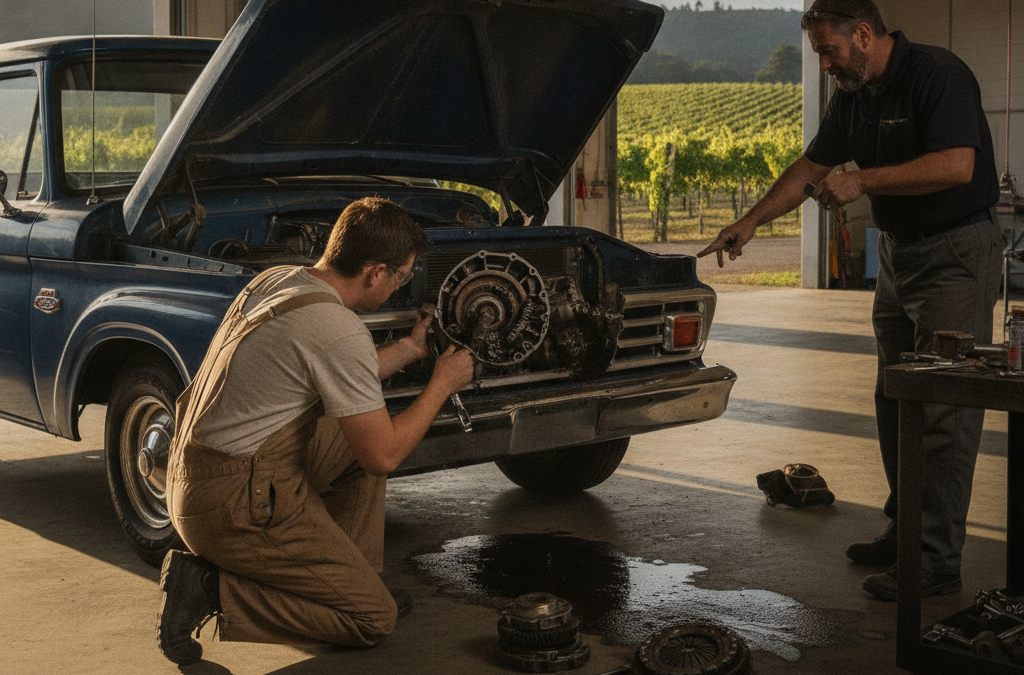
From there, we’ll do a test drive to replicate the issue, inspect the clutch hydraulics, check transmission fluid condition, and look at the linkage and mounts. A lot of what people assume is an internal transmission problem turns out to be a worn clutch master cylinder, a loose shift linkage, or low fluid — things that are relatively inexpensive to address.
We’ll give you a clear explanation of what we found and what it’ll take to fix it before any work begins. No pressure, no upselling. If your clutch has 20,000 miles left in it and doesn’t need immediate replacement, we’ll tell you that and let you know what to watch for.
Brands We See Most Often for Manual Transmission Work
In Sonoma County, the vehicles we most commonly work on for manual transmission service include Toyota Tacomas and older Corollas, Honda Civics and Fits, Subarus of various generations, Ford Rangers and older Mustangs, Mazda Miatas and Mazda3s, and Volkswagens. Each has its own quirks — Subaru’s six-speed units can be finicky about fluid spec, for example, and older VW gearboxes sometimes need specific attention to the shift linkage bushings.
If you drive one of these and your shifter is starting to feel different than it used to, it’s worth getting it looked at before a $200 fluid service turns into a $1,500 clutch job because the synchronizers were run dry too long. Our preventive maintenance services include transmission fluid checks and changes — a simple thing that most drivers don’t realize manual transmissions need at all.
When Does a Manual Transmission Actually Need to Be Rebuilt or Replaced?
This is a fair question and one worth answering honestly. If your synchronizers are worn to the point where grinding happens every shift regardless of how carefully you’re driving, or if the transmission is leaking from multiple seals and the bearings are noisy, a rebuild or replacement starts to make sense. We’ll always walk you through the cost comparison — a quality rebuilt transmission versus a used unit versus a new one — so you can make the decision that fits your situation and how long you plan to keep the vehicle.
For an older truck that’s otherwise in great shape, a rebuilt gearbox can absolutely be worth it. For a high-mileage vehicle where the engine is also showing wear, we’ll give you our honest read on the math.
Frequently Asked Questions
How often should I change my manual transmission fluid?
Most vehicles call for a manual transmission fluid change every 30,000 to 60,000 miles. Check your owner’s manual for the specific interval, and mention if you do a lot of towing or hill driving — that can shorten the interval. Many drivers in Cloverdale and northern Sonoma County skip this service entirely because shops don’t bring it up, and then wonder why shifting becomes difficult.
Can I keep driving if my transmission is grinding between gears?
You can, but every grind is wearing down your synchronizer rings a little more. What might be a straightforward fluid change or clutch adjustment today can turn into a full synchronizer replacement if you wait too long. It’s worth getting it checked sooner rather than later.
Is it the clutch or the transmission causing my problem?
Good question — and it’s not always easy to tell without a hands-on inspection. Clutch problems typically show up as slipping (high revs before the car moves), difficulty disengaging, or a burning smell. Transmission problems tend to show up as grinding, popping out of gear, or stiff shifting even when the clutch is fully depressed. We’ll sort out which is which when you bring it in.
Do you service manual transmissions for all makes and models?
Yes. We work on manual transmissions across a wide range of makes — domestic and foreign, trucks, cars, and SUVs. Whether you’re driving a Toyota Tacoma out of Windsor or a Subaru WRX from Healdsburg, we’ve got the experience to diagnose and repair it properly.
What does a clutch replacement actually cost?
Clutch replacement costs vary depending on the vehicle — a Honda Civic is different from a Ford F-150, which is different from a Subaru WRX. We always give you a full written estimate before any work begins, so there are no surprises. Contact us for a free estimate specific to your vehicle.
Ready to Get Your Stick Shift Sorted Out?
If your manual transmission is grinding, slipping out of gear, or just not feeling right, don’t wait until it gets worse. On-Site Auto Repair has been diagnosing and repairing manual transmissions for Sonoma County drivers since 2011 — and we’re straightforward about what you actually need versus what you don’t. Whether you’re in Cloverdale, coming down from Geyserville, or heading up from Windsor or Healdsburg, we’re happy to take a look.
Contact us today to schedule your inspection or request a free estimate — no pressure, no surprises, just honest work from a shop that treats your car like our own.