Why Is My Car’s Battery Dying in Cotati? What Sonoma County Drivers Need to Know About Battery and Electrical System Problems
If your car is slow to crank in the morning, your lights seem dimmer than usual, or you’ve already needed a jump start once this month — your battery is trying to tell you something. And if you’re in Cotati, Rohnert Park, or anywhere else in Sonoma County, the answer isn’t always “just replace the battery.” A dead or dying battery is often a symptom of a larger electrical system problem, and swapping out the battery without checking the rest of the system is one of the most common — and costly — mistakes drivers make.
At On-Site Auto Repair, we’ve been working on electrical system issues since 2011, and we see this play out constantly: someone buys a brand-new battery from a parts store, installs it, and six weeks later they’re calling us because the car is dead again. We’ll explain why that happens, what to watch for, and how to make sure you’re actually fixing the problem — not just masking it.
What a Car Battery Actually Does (and What It Doesn’t)
Your battery’s main job is to start the engine. That’s it. Once the engine is running, your alternator takes over and powers everything — the lights, the radio, the charging port, the climate control — while also recharging the battery at the same time. When the alternator is working correctly, a healthy battery should last four to six years under normal conditions.
The problem is that most drivers think of the battery and the charging system as separate things. They’re not. They work together, and when one is struggling, it puts extra strain on the other. If your alternator is undercharging, the battery slowly drains down over days or weeks. If there’s a parasitic draw somewhere in the electrical system — a module that stays on when it should be off — your battery goes flat overnight even when the alternator is fine.
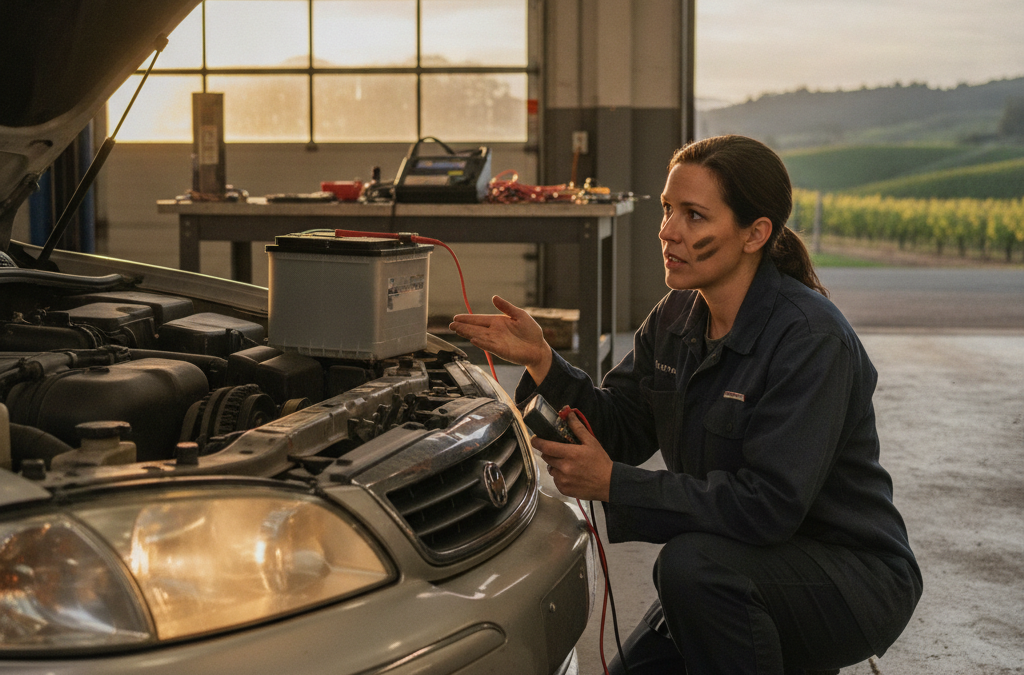
This is exactly why we don’t just swap batteries here. When someone brings a car in with a dead battery complaint, we test the alternator output, check for parasitic draw, and inspect the battery cables and terminals before recommending anything. That’s what a real diagnosis looks like.
Warning Signs Your Battery or Electrical System Is Failing
Don’t wait until you’re stranded in a Cotati parking lot to deal with this. Here are the signs to watch for:
- Slow or labored cranking — the engine turns over sluggishly when you start it, especially on cold mornings
- Dimming headlights — lights that brighten when you rev the engine and dim at idle are often a sign of a failing alternator
- Electrical gremlins — windows moving slowly, the radio resetting, dashboard warning lights flickering
- Battery warning light on the dash — this almost always points to a charging system issue, not the battery itself
- A battery that keeps dying — if you’ve jump-started the same car more than twice in a month, something else is going on
- Corrosion on the battery terminals — that white or bluish crusty buildup isn’t just cosmetic; it increases resistance and can prevent the battery from charging properly
Any one of these symptoms is worth getting checked. All of them together means you probably shouldn’t drive another week without a diagnostic appointment.
Why Sonoma County’s Climate Is Harder on Batteries Than You Might Think
Here’s something most drivers don’t realize: batteries don’t just hate cold — they hate heat even more. Extreme heat accelerates the internal chemical breakdown inside a battery and shortens its life significantly. And while Sonoma County isn’t Death Valley, our hot dry summers — especially in areas like Rohnert Park, Petaluma, and inland parts of the county — absolutely take a toll on battery chemistry.
Then we flip to cool, damp winters. Cold temperatures reduce the battery’s available cranking power, so a battery that was borderline weak all summer suddenly can’t start the engine on a 40-degree January morning. That’s why we see a spike in dead battery calls every November and December.
If your battery is already three or more years old going into summer, or you’re commuting regularly down Highway 101 with your AC blasting and phone plugged in and seat heaters running — all of that electrical load adds up over time. Getting a battery test before summer hits is one of the cheapest preventive maintenance moves you can make.
The Real Culprit: Parasitic Battery Drain
This is the one that competitors in the area rarely talk about in depth, and it’s the most frustrating issue to deal with if you don’t know what you’re looking for.
A parasitic drain is when something in your car’s electrical system keeps drawing power after the car is turned off and all the doors are closed. Every car has some baseline draw — the clock, the security system, the key fob receiver — and that’s normal. But when a module fails to go to sleep like it’s supposed to, or an aftermarket accessory is wired incorrectly, that drain can kill a battery in as little as 24 to 48 hours.
Common culprits include:
- Aftermarket audio systems or amplifiers wired to a constant power source
- Faulty body control modules that don’t enter sleep mode
- Trunk or glove box lights that stay on with the lid closed
- Failing door latch switches that tell the car the door is still open
- Cellular or GPS modules in newer vehicles that wake up unexpectedly
Diagnosing a parasitic draw takes time and a methodical approach — pulling fuses one at a time with a multimeter to isolate which circuit is the problem. It’s not something a quick parts-store battery test can catch, and it’s not something you can fix by just buying a better battery.
If you’re in Windsor, Sebastopol, Healdsburg, or anywhere else in the county and you’ve replaced your battery once already without solving the problem, this is probably what’s happening. A proper electrical diagnostic is the right next step.
How Long Should a Battery Last — and When Should You Replace It?
Most car batteries last between four and six years under normal conditions. If yours is pushing five years or older, it’s worth having it load-tested even if it seems fine right now. A battery can pass a basic voltage test (showing 12.6 volts at rest) and still fail under the actual load of starting an engine — especially on a cold morning or after the car has been sitting for a few days.
When a battery genuinely needs to be replaced, the cost is typically modest — and the right battery matters. We match the battery to your specific vehicle’s requirements, which is especially important for vehicles with start-stop technology, heavy accessory loads, or AGM (Absorbent Glass Mat) battery requirements. Toyota hybrids, newer Ford trucks, and many European vehicles have specific battery specs that a generic off-the-shelf replacement won’t fully meet.
We’ll also always check the charging system after installing a new battery — because if the alternator isn’t outputting properly, that new battery won’t last either. That’s just the honest way to do it.
Should You Jump-Start It or Call for Help?
Jump-starting is fine in a pinch, but it’s not a long-term strategy. If your car needed a jump, drive it for at least 20 to 30 minutes to give the alternator a chance to recharge the battery — not just around the block. And if it dies again within a day or two, don’t jump it a third time. That pattern is telling you the charging system has a real problem that needs attention.
For anyone with a newer vehicle — especially those with advanced driver assist systems, multiple control modules, or hybrid components — repeated jump-starts can sometimes trigger fault codes or, in rare cases, damage sensitive electronics. It’s better to get a proper preventive maintenance check than to keep rolling the dice.
Frequently Asked Questions
How do I know if it’s my battery or my alternator?
The easiest way is to get both tested. A battery that dies while you’re driving (not just at startup) usually points to the alternator — because once the engine is running, the alternator should be keeping everything powered. A battery that dies overnight or after sitting for a day or two is more likely a parasitic drain issue or a battery that’s simply worn out.
My battery light came on — can I keep driving?
Not for long. The battery warning light means the charging system isn’t working properly. If the alternator has stopped charging, you’re running entirely on battery power and you may have 20 to 40 minutes before the car dies — less if you have the AC, headlights, and other accessories running. Pull over safely and call for help rather than risk losing power in traffic.
Can I just test the battery myself at a parts store?
Parts stores offer free battery tests, and that’s a reasonable first step. But those testers only evaluate the battery — they don’t check the alternator output, the voltage regulator, or test for parasitic drain. If the battery test comes back “good” but your car keeps dying, you need a full electrical system diagnostic, not just a battery swap.
Does cold weather really affect batteries that much in Sonoma County?
Yes, more than most people expect. Our winters aren’t extreme, but even temperatures in the 40s reduce a battery’s cranking power by 20 to 30 percent. A battery that was borderline weak all summer is much more likely to fail in November or December. Getting a battery load test in September or October is genuinely good practice.
How much does it cost to diagnose an electrical problem?
At On-Site Auto Repair, we believe in honest, upfront estimates — we don’t charge you for a vague answer. The cost of a full electrical system diagnosis depends on what we’re looking at, but we’ll tell you what we find and what it costs to fix before we do any work. No surprises, no upselling.
Let’s Figure Out What’s Actually Going On
Whether you’re in Cotati, Rohnert Park, Petaluma, or anywhere else in Sonoma County — if your car’s battery keeps dying, the lights are dimming, or you’ve already replaced the battery once and you’re still having problems, it’s time to dig deeper. We’ve been solving electrical gremlins like these since 2011, and we’ll tell you exactly what’s wrong and what it actually costs to fix it.
Reach out to On-Site Auto Repair today to schedule a free estimate or ask us a question. We work on all makes and models — domestic, import, hybrid — and we treat every vehicle like it matters. Because to you, it does.