Why Is My Car’s Transfer Case Making Noise in Sebastopol? What 4WD and AWD Drivers in Sonoma County Need to Know
If you’re driving through Sebastopol — or heading out on Bodega Highway toward the coast, or winding up through Graton and Occidental on the way home — and you notice a grinding, humming, or clunking noise coming from somewhere underneath your vehicle, your transfer case may be the source. It’s one of the most overlooked drivetrain components out there, and it’s almost entirely absent from the service content published by local repair shops. That’s a problem, because transfer case issues are more common around here than most drivers realize, and catching them early can save you thousands of dollars.
What Exactly Is a Transfer Case — And Why Should You Care?
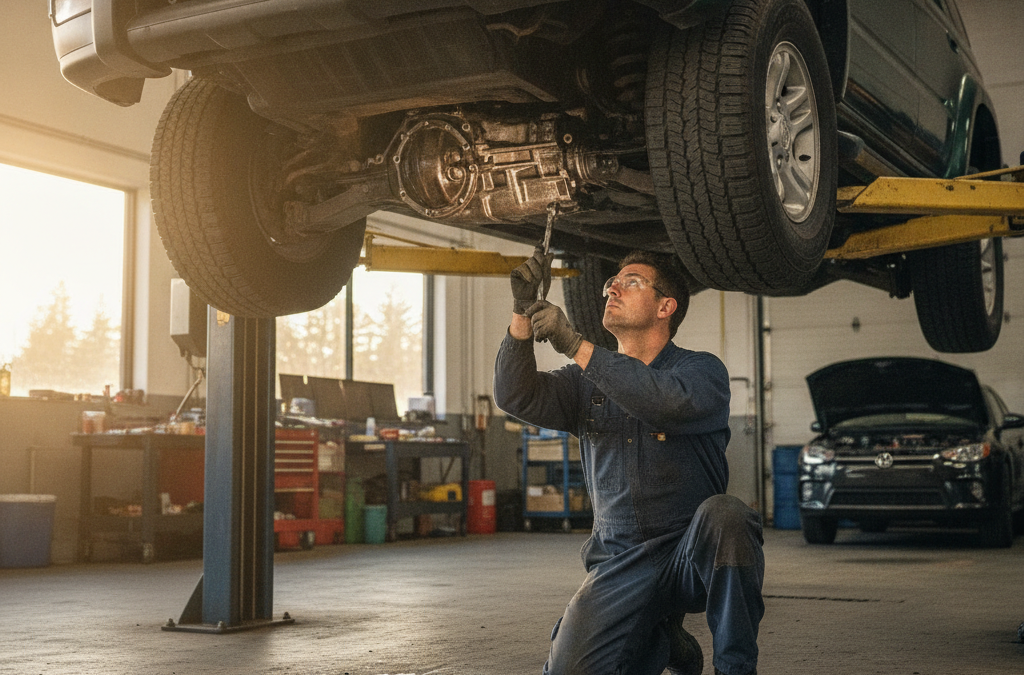
The transfer case is the component that sends power from your transmission to both your front and rear axles. It’s what makes four-wheel drive (4WD) and all-wheel drive (AWD) work. Without it, you’ve just got a regular two-wheel-drive vehicle — except with a lot more weight and complexity riding along for the trip.
On part-time 4WD trucks and SUVs — think Ford F-150s, Toyota Tacomas, Jeep Wranglers, and older Chevy Silverados — the transfer case has selectable modes: 2H, 4H, and 4L. On AWD vehicles like Subaru Outbacks, Audi Q5s, or Toyota RAV4s, the transfer case (sometimes called a power transfer unit or PTU) works automatically without any driver input.
Either way, the transfer case depends on clean, properly-filled fluid to keep its internal gears, bearings, and chain lubricated. When that fluid breaks down or gets low, the whole thing starts complaining — loudly.
Why Transfer Case Problems Are Common in Sonoma County
Here’s something worth knowing: the roads around Sebastopol, Forestville, Guerneville, Occidental, and the Sonoma Coast aren’t exactly freeway-smooth. They’re narrow, often rural, sometimes muddy in winter, and steep in places. Drivers in western Sonoma County tend to actually use their four-wheel drive systems — whether that’s getting to a Russian River cabin after a rainstorm or navigating a muddy vineyard road outside Healdsburg during harvest season.
That real-world use puts legitimate stress on the transfer case. And because most drivers never think about transfer case fluid service (the way they think about oil changes), a lot of transfer cases in this part of California are running on fluid that’s years or even decades overdue for a change.
Add in the fact that many Sonoma County families are driving older, higher-mileage vehicles — especially out in Graton, Monte Rio, and the smaller rural communities west of Santa Rosa — and you’ve got a recipe for drivetrain wear that sneaks up on you.
What Does a Failing Transfer Case Sound or Feel Like?
Transfer case symptoms aren’t always obvious at first, but they tend to follow a pattern. Here’s what to pay attention to:
- Grinding or growling noise — Usually heard while driving, especially when turning or accelerating. Often mistaken for wheel bearing noise. If it changes pitch with vehicle speed, the transfer case (or a related component) is worth investigating.
- Clunking when shifting into or out of 4WD — Some clunk is normal, but a heavy, metal-on-metal clunk that didn’t used to be there is a warning sign.
- Vibration at highway speeds — A rhythmic vibration that increases with speed can point to a worn chain inside the transfer case or damaged output shafts.
- Difficulty engaging or disengaging 4WD — If your 4WD light flickers, hesitates, or the system won’t engage or disengage cleanly, the transfer case or its electronics may be failing.
- Fluid leak underneath the vehicle — Transfer case fluid is similar in appearance to gear oil — dark, thick, and often with a distinct smell. If you’re seeing a puddle in the middle of the undercarriage (not at the front or rear, but in the middle), that’s a strong clue.
- Service light or 4WD warning light — On modern AWD vehicles especially, a fault in the transfer case will often trigger a warning light. Don’t ignore it and assume it’ll go away.
The Single Most Preventable Transfer Case Failure: Skipping Fluid Service
This is the part that most shops around Sonoma County simply don’t talk about — and it’s the most important thing you can do to protect your drivetrain. Transfer case fluid needs to be changed on a schedule, just like engine oil or transmission fluid. Most manufacturers recommend somewhere between 30,000 and 60,000 miles, but many drivers have never had it done — ever.
Old, degraded transfer case fluid loses its ability to lubricate the internal chain, gears, and bearings. Once that happens, metal-on-metal wear begins, debris circulates through the fluid, and what started as a $150–$200 fluid service turns into a $1,500–$3,500 transfer case rebuild or replacement. That’s a painful bill for something that was entirely preventable.
If you’re not sure when (or whether) your transfer case fluid has ever been serviced, bring it in. We can check the condition of the fluid and give you an honest assessment — no pressure, no upselling. Our complete auto repair services cover drivetrain work across all makes and models, including trucks, SUVs, and AWD crossovers.
Brand-Specific Notes: What We See Most Often
Subaru AWD systems are extremely popular in Sonoma County — for good reason. They handle well in wet conditions and the hilly terrain around here. But Subaru’s rear differential and transfer unit are known to be sensitive to fluid condition. Using the wrong fluid type (or skipping service) accelerates wear noticeably. If you drive a Subaru Outback, Forester, or Crosstrek and haven’t had your differential and transfer unit fluid checked recently, it’s worth doing.
Toyota Tacomas and 4Runners are workhorses, and many owners in Sonoma County use them exactly that way — towing, off-roading, or navigating the back roads between Santa Rosa and Bodega Bay. Toyota’s transfer cases are generally reliable, but they’re not maintenance-free. The front and rear differentials and the transfer case all have separate fluid service intervals that often get overlooked.
Jeep Wranglers and Cherokees are common throughout the area, and Jeep’s transfer cases — particularly on older models — have a known history of chain wear when fluid isn’t changed on schedule. If you’re hearing a slap or rattle at low speeds, that’s often a stretched chain inside the transfer case.
Ford F-150s and Super Dutys used by contractors, landscapers, and vineyard workers around the Healdsburg and Petaluma areas see real work. Towing and heavy use accelerate transfer case fluid degradation faster than normal driving, so more frequent service intervals make sense.
Can You Drive With a Noisy Transfer Case?
In the short term, maybe — but it’s not a good idea. A transfer case that’s already making noise is already failing. Continuing to drive on it without having it diagnosed typically accelerates the damage, which means a repair that might have been a fluid change and bearing replacement becomes a full transfer case replacement. If the transfer case seizes or fails completely while you’re driving, you can lose power to your wheels unexpectedly — which is a safety issue, not just a repair bill issue.
Get it looked at sooner rather than later. A proper diagnostic will tell you exactly what’s going on and give you a clear picture of your options before anything gets worse.
Frequently Asked Questions About Transfer Case Noise in Sonoma County
How often should transfer case fluid be changed?
Most manufacturers recommend every 30,000 to 60,000 miles, but check your owner’s manual for your specific vehicle. If you frequently use 4WD, tow, or drive off-road, err on the shorter end of that range. Many older vehicles in Sonoma County have never had this done — which is exactly why transfer case problems are so common.
Is transfer case noise the same as differential noise?
Not exactly, though they can sound similar. Both involve gears and bearings, and both can produce humming or grinding sounds. The key difference is location and behavior. Differential noise often changes when you shift your weight around a corner; transfer case noise tends to be more consistent with speed. A good diagnostic will clarify which system is the source.
My 4WD light is flashing — is that the transfer case?
It could be. A flashing 4WD light often signals an electrical or sensor fault within the transfer case system, but it can also point to issues with the actuator, the shift motor, or a wheel speed sensor. Don’t assume it’s minor. Have it scanned and diagnosed before the issue compounds.
Can I just top off my transfer case fluid instead of flushing it?
Topping off helps if the level is low due to a minor leak, but it doesn’t address degraded fluid. Old fluid that’s lost its lubricating properties needs to be fully drained and replaced — adding fresh fluid on top of dirty fluid doesn’t restore its performance. Think of it like adding clean oil to a filthy engine — you’re diluting the problem, not solving it.
Do AWD cars have a transfer case too?
Yes, though the design differs from traditional part-time 4WD systems. AWD vehicles often use a power transfer unit (PTU) or rear drive module (RDM) that performs the same basic function. These components have their own fluid service requirements and are just as prone to problems when neglected — especially on vehicles like the Ford Edge, Subaru Outback, or Audi Q5.
Get Your Transfer Case Checked Before the Problem Gets Bigger
If you’re hearing something new from underneath your truck or SUV — a hum, a grind, a clunk when you shift into 4WD — don’t put it off. The difference between catching a transfer case problem early and waiting until it fails completely can literally be thousands of dollars.
At On-Site Auto Repair, we’ve been diagnosing and repairing drivetrains across Santa Rosa and Sonoma County since 2011. We work on everything from Subaru Outbacks and Toyota Tacomas to Ford Super Dutys and Jeep Wranglers. We’ll give you a straight answer about what’s going on, what it’ll take to fix it, and what can wait — without padding the estimate or pushing repairs you don’t need.
Drivers from Sebastopol, Graton, Forestville, Guerneville, and all across the west county area are welcome. Reach out to us today to schedule a diagnostic or request a free estimate. Let’s figure out what that noise is before it turns into a bigger problem on the road.