Why Is My Car’s Power Window Not Working in Petaluma? What Sonoma County Drivers Need to Know About Window Regulator and Motor Problems
If your power window has stopped working — or it’s creeping up and down like it’s thinking about it — you’re probably dealing with a window motor, window regulator, or electrical issue. It’s one of those problems that’s easy to ignore until you’re stuck at a drive-through in Petaluma with a window that won’t come back up, or worse, sitting with a window stuck open during one of our cool, wet Sonoma County winters. Here’s what’s actually happening inside your door and what you should do about it.
What Controls Your Power Window?
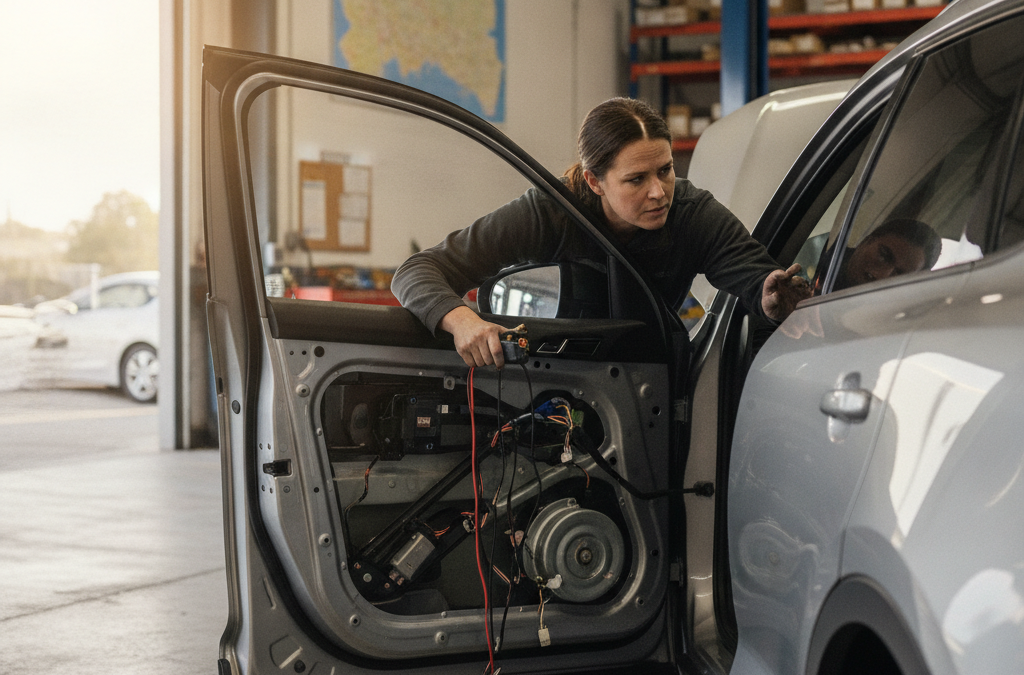
Your power window system has a few key parts working together. There’s the window motor — a small electric motor inside the door — and the window regulator, which is a mechanical arm or cable system that translates the motor’s rotation into the up-and-down motion of the glass. Add in a switch, wiring, and sometimes a dedicated fuse or relay, and that’s your whole system. When any one of those components fails, the window stops moving.
The most common failure point on most vehicles — especially those with higher mileage — is the regulator. On older designs, regulators used a scissor-style mechanism that could bend or break over time. On most modern vehicles (think your Honda Accord, Toyota Camry, Ford F-150, Subaru Outback, or Chevy Silverado), cable-style regulators are more common, and the cables can fray, jump their track, or snap entirely.
Warning Signs Your Power Window Is About to Fail
Power windows rarely die without warning. Here’s what to listen and watch for:
- The window moves slowly or hesitates. This usually points to a worn motor struggling to turn, or a regulator that’s starting to bind.
- You hear a grinding or clicking noise when you press the switch. That’s often a cable jumping off its pulley, or worn gears in the motor.
- The window drops on its own. If the glass slides down by itself when you close the door, the regulator has likely failed and can no longer hold the window in place.
- Nothing happens at all. No sound, no movement. Could be a blown fuse, a dead switch, a broken wire, or a motor that’s completely seized.
- Only one switch works. If the window moves from the driver’s master switch but not from the door’s own switch, the individual door switch has probably failed — often the cheapest fix of all.
Why Does This Happen? Sonoma County Factors That Accelerate Wear
Power window components are rated for a certain number of cycles, but a few things can shorten their lifespan faster than normal. If you’re driving through Rohnert Park or commuting down Highway 101 every day, you’re probably rolling your windows up and down multiple times a day — at toll booths, drive-throughs, or just to let in some of that Sonoma County air.
Our region’s climate plays a role too. The cool, damp winters — especially in areas like Sebastopol and along the Russian River Valley — can cause rubber door seals to stiffen and grip the glass harder than they should. That extra friction puts more load on the motor every time you operate the window. Over time, the motor overheats and burns out sooner. Wildfire ash and debris from past fire seasons can also work their way into door channels and create additional resistance that grinds on regulator components.
And if you’ve got an older vehicle — which is common in working-class neighborhoods throughout the county — the seals, tracks, and internal lubrication have had years to dry out and degrade. That combination of age and environmental exposure is usually what pushes these components over the edge.
Can You Drive With a Stuck Power Window?
If the window is stuck in the up position, you can drive the car safely for a while — but get it looked at soon, because there’s a risk the glass could drop unexpectedly. If the window is stuck down, that’s a more urgent situation. A window that won’t close is a security risk, a weather risk, and depending on where you live, a theft risk. Don’t leave the car unattended with a window stuck open if you can help it.
In some cases, a technician can manually hold the glass in place temporarily while the part is on order, but that’s a short-term fix. The right move is to get the regulator or motor replaced properly.
What the Repair Actually Involves — and What It Costs
Power window repair typically involves removing the door panel, inspecting the motor, regulator, wiring, and switch, and replacing whichever component has failed. In many cases, the motor and regulator come as an assembly and are replaced together — that’s actually more reliable than sourcing them separately.
Labor time varies by vehicle and which door is affected. Rear windows on some vehicles are easier to access than front windows, and some vehicles (especially European brands like Volkswagen or Land Rover) have door panels that require extra steps to remove without damage. On most everyday vehicles — Toyotas, Hondas, Subarus, Fords, Nissans, Chevys — this is a straightforward repair that a good shop can typically turn around in a few hours.
We don’t throw out pricing numbers here because parts costs vary quite a bit between a Honda Civic door motor and a Mercedes rear window regulator, but we’ll give you a straight, honest estimate before we touch anything. No surprises. Our complete auto repair services cover electrical and mechanical repairs like this for all makes and models across Sonoma County.
What Local Competitors Don’t Tell You About Power Window Repairs
Here’s something worth knowing: most local shop websites in Santa Rosa — and honestly, most shops in general — don’t say much about power window and door electrical repairs. It tends to get lumped under “electrical” or ignored entirely on their service pages. That leaves drivers guessing whether a local shop will even touch it or whether they need to go to a dealership.
The answer is: yes, a good independent shop handles this all the time. You don’t need to pay dealership rates for a window motor or regulator swap. What you do want is a shop that will properly diagnose the problem first — because jumping straight to replacing a motor when a $20 switch is the actual problem is exactly the kind of upselling we refuse to do. We test the circuit, check the fuse, test the switch, and confirm the failure point before any parts are ordered.
Brand-Specific Notes for Sonoma County Drivers
A few brands are worth calling out specifically:
- Honda and Toyota: Generally reliable, but high-mileage examples (200,000+ miles is not unusual here) do experience regulator cable failures. Usually a clean, uncomplicated repair.
- Ford F-150 and Chevy Silverado trucks: Rear window regulators on full-size trucks can be more labor-intensive because of the door size and panel design.
- Subaru: Rear door regulators on older Outbacks and Foresters are a known wear point. If you’ve got an Outback with 150K miles and a slow rear window, don’t be surprised.
- Volkswagen and Land Rover: Door panels are more complex to remove without breaking clips. Make sure whoever works on your car knows the vehicle — those clips are expensive to replace.
- Jeep (especially Wrangler): Wranglers use a completely different setup depending on whether you have hard doors, half doors, or soft doors. If you’re swapping between door configurations, switch and wiring connector issues are common.
If you’re driving a Jeep Wrangler or any other make and want to confirm your vehicle is covered, reach out and ask us — we work on all makes and models and will tell you straight whether we’re the right fit for your repair.
Frequently Asked Questions
Can a blown fuse cause my power window to stop working?
Yes, absolutely. A blown fuse is one of the first things to check — it’s quick and free to look at. That said, if the fuse keeps blowing, that’s a sign of a short in the wiring or a failing motor drawing too much current. Don’t just keep replacing fuses without finding out why they’re blowing.
Why does my window work sometimes but not others?
Intermittent operation usually points to a worn switch contact, a loose wiring connector inside the door, or a motor that’s overheating and cutting out. These can be tricky to diagnose without pulling the door panel, but it’s worth doing before the window stops entirely.
Is it safe to use aftermarket window regulators?
Aftermarket regulators have improved a lot in recent years, and for most everyday vehicles, a quality aftermarket part works fine and costs less than OEM. For certain European brands or luxury vehicles, we often recommend OEM or OEM-equivalent parts to avoid fit issues. We’ll walk you through the options.
My window fell into the door. What do I do?
Don’t try to force it back up — you could crack the glass or damage the regulator further. Tape some plastic sheeting over the opening to keep weather and debris out, and bring the car in as soon as possible. This is usually a regulator failure where the cable snapped or came off its pulley.
Can I just tape my window shut temporarily?
For a very short-term situation — like overnight — some plastic and tape works. But it’s not a real fix and it’s not waterproof for long. Get it repaired promptly, especially in the rainy season we get in Sonoma County between November and March.
Stuck Window? Let’s Get It Fixed.
A power window that doesn’t work is more than annoying — it’s a security issue, a weather issue, and if it’s your driver’s window, it’s a daily frustration every time you pull up to a speaker or a window. On Site Auto Repair has been diagnosing and fixing electrical and mechanical issues like this for Sonoma County drivers since 2011. We give you an honest assessment, a clear estimate, and we won’t suggest repairs you don’t need.
Whether you’re in Petaluma, Rohnert Park, Sebastopol, or anywhere else in the area, contact us today to schedule a diagnosis or request a free estimate. We’ll figure out exactly what’s going on and get your window working the way it should.