How Do You Know If Your Car Needs a Wheel Alignment in Windsor or Santa Rosa?
If your car is drifting to one side on a straight road, your steering wheel sits crooked when you’re driving straight, or you’ve noticed one edge of your tires wearing down faster than the other — those are all signs your alignment is off. It’s one of the most commonly overlooked maintenance items for drivers in Santa Rosa and up through Windsor, and it’s one that quietly costs you money in tire wear before most people even realize something is wrong.
The good news is that alignment problems are usually caught early if you know what to look for. And getting it corrected is a straightforward, relatively affordable service that makes a real difference in how your car handles and how long your tires last.
What Wheel Alignment Actually Is (and What It Isn’t)
A lot of people confuse wheel alignment with tire balancing — they’re different things. Balancing corrects vibration caused by uneven weight distribution in a tire-and-wheel assembly. Alignment is about the angles of your wheels relative to each other and to the road surface.
There are three main angles a technician adjusts during an alignment:
- Camber — the vertical tilt of the tire when viewed from the front. Too much inward or outward tilt causes uneven wear on the inside or outside edge of the tire.
- Toe — whether the fronts of your tires point slightly inward or outward when viewed from above. This is the most common setting that goes out of spec and is responsible for that feathering or edge wear you might notice.
- Caster — the angle of the steering axis, which affects steering feel and stability at highway speeds. Less commonly adjusted, but important for vehicles that feel loose or wander on the freeway.
When any of these angles are off — even slightly — your tires scrub against the road at the wrong angle every single mile you drive. You won’t feel it right away, but your tires will show it, and eventually your steering will too.
Warning Signs Your Alignment Is Off
Here’s what to actually pay attention to:
- The car pulls to the left or right on a flat, straight road when you loosen your grip on the wheel. A mild pull can also come from unequal tire pressure, so check that first — but if the pull is still there after airing up, it’s likely alignment.
- Your steering wheel isn’t centered when you’re driving straight. If the logo is rotated five or ten degrees to one side, that’s a sign your alignment — or your steering system — needs attention.
- Uneven tire wear is one of the clearest indicators. If one tire is worn down on the inner edge but the opposite side looks fine, or if you’re getting feathered wear across multiple tires, alignment is usually the culprit.
- The car feels loose or wanders on the highway, especially on long straightaways like Highway 101 between Petaluma and Windsor. If you find yourself constantly making small corrections to stay in your lane, that’s worth investigating.
- Handling feels off after a hard impact — a pothole, a curb strike, or bottoming out on a steep driveway. Your alignment can shift from a single incident.
Why Sonoma County Roads Are Especially Hard on Alignment
This is something local drivers deal with that doesn’t always come up when you search generic alignment guides written for flat, urban roads. The terrain here is genuinely punishing on your suspension and alignment settings.
If you live in Fountaingrove, Bennett Valley, or up near Healdsburg and you’re navigating steep, winding roads on a daily basis, the lateral stress on your suspension is significantly higher than someone driving flat city streets. The same goes for anyone regularly driving the rural backroads out toward Guerneville, the Sonoma Valley, or the Wine Country routes that run through Glen Ellen and Kenwood. Those roads aren’t smooth, and repeated impacts — even small ones — add up over time.
Highway 101 commuters heading south toward Marin County or Petaluma rack up miles fast, and at speed, even slight misalignment accelerates tire wear significantly. If you’re putting 20,000 miles a year on your car commuting out of Windsor or Rohnert Park, your alignment should be on your maintenance radar.
Additionally, after our wet winters, potholes show up all over Sonoma County roads — sometimes overnight. A single hard pothole hit is enough to knock your toe setting out of spec. It’s worth getting a quick alignment check any time you’ve had a rough impact or you’ve just replaced tires.
When Should You Actually Get an Alignment?
The honest answer is: more often than most shops tell you. Here’s a practical guide:
- Every 12 months or 12,000 miles as a general rule, especially if you drive hilly or rural roads regularly
- Any time you replace tires — putting new tires on a misaligned vehicle is a fast way to wear them out prematurely
- After any significant suspension or steering work — new struts, tie rods, control arms, or ball joints
- After hitting a significant pothole or curb at any meaningful speed
- If you notice any of the warning signs listed above, even if it’s subtle
Some manufacturers specify alignment checks as part of their scheduled maintenance — check your owner’s manual. But most owner’s manuals are written for ideal conditions, not the rolling hills and patchy pavement of Sonoma County.
What an Alignment Check Actually Involves
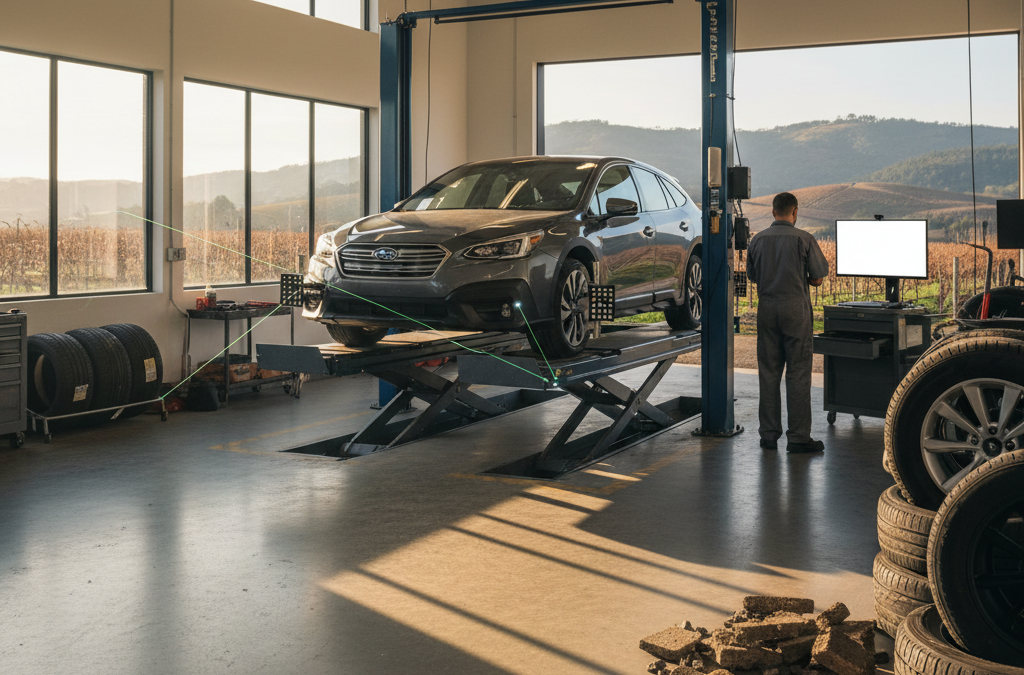
A proper alignment is done on a drive-on lift with computerized measurement equipment. The technician measures all four wheel angles (on front-wheel-drive vehicles, sometimes just the front two), compares them to your manufacturer’s specifications, and makes adjustments to bring everything into spec. It’s not a rushed service — a quality alignment takes 45 minutes to an hour when done properly.
Some shops will advertise a “free alignment check” and then quote you an alignment whether you need one or not. At On Site Auto Repair, we check your alignment honestly and tell you straight up whether an adjustment is actually needed. If you’re in spec, we’ll tell you — no invented problems, no upselling.
Alignment and Tire Life: The Connection Most Drivers Miss
This is the angle that doesn’t get enough attention. Misalignment is one of the top causes of premature tire wear, and tires aren’t cheap. A set of decent all-season tires for a Honda CR-V or Toyota Camry runs $400–$700 installed. If bad alignment shaves 15,000–20,000 miles off their lifespan, you’re essentially losing a couple hundred dollars in tire life for the cost of skipping a $100 alignment.
Keeping your alignment in check is genuinely one of the highest-return preventive maintenance items you can do. It’s not glamorous, but it saves money in a very direct, measurable way. Pair it with regular tire rotations and you’ll stretch a set of tires significantly further.
Does Every Car Get a 4-Wheel Alignment?
Not necessarily — it depends on your vehicle. Most modern front-wheel-drive cars with a fixed rear axle only get a front-wheel (2-wheel) alignment, because the rear wheels don’t have adjustable angles. All-wheel-drive vehicles, most trucks, and cars with independent rear suspension typically need a full 4-wheel alignment.
If a shop quotes you a 4-wheel alignment on a vehicle that doesn’t have adjustable rear geometry, that’s worth a question. A good technician will look up your vehicle’s specs and tell you exactly what’s being measured and adjusted.
Frequently Asked Questions About Wheel Alignment in Sonoma County
How long does a wheel alignment take?
A proper alignment typically takes 45 minutes to about an hour. If additional suspension parts are worn or need replacement first, it may take longer — but the alignment itself shouldn’t be rushed.
Can I get an alignment if my suspension parts are worn?
Not effectively. If your tie rod ends, ball joints, or control arm bushings are worn, the alignment measurements won’t hold — the worn components have too much play. Those parts need to be replaced first, then the alignment is done. A good shop will tell you this upfront rather than charging for an alignment that won’t last.
Will an alignment fix a car that pulls to one side?
Usually, yes — but not always. A pull can also come from unequal tire pressure, a tire with internal damage (conicity), or uneven brake drag. A thorough inspection will identify the real cause. Most of the time, if you’ve ruled out tire pressure, alignment is the culprit.
How much does a wheel alignment cost in the Santa Rosa area?
We don’t publish fixed prices here because it varies by vehicle type and whether it’s a 2-wheel or 4-wheel alignment. What we’ll tell you is that it’s a reasonable, transparent cost — and we’ll give you a clear quote before we do any work. Contact us for a free estimate.
Do I need an alignment after replacing just one tire?
It’s a good idea to at least have it checked. If the alignment was off before, the old tire may have worn unevenly — and putting a new tire in that position without checking alignment means the same wear pattern may repeat on the new tire. Better to know upfront.
Get Your Alignment Checked at On Site Auto Repair
Whether you’re driving in from Windsor, commuting along 101 out of Rohnert Park, or tackling the hills of Fountaingrove every day, alignment is one of those services that pays for itself in tire life and peace of mind. We’ve been working on vehicles throughout Santa Rosa and Sonoma County since 2011, and we’ll give you a straight answer about what your car actually needs — nothing more.
If you’re noticing any of the warning signs above, or if it’s simply been over a year since your last alignment check, reach out to us online or give us a call to schedule a free estimate. We work on all makes and models, and we treat every vehicle like it belongs to someone we know — because in a community like this, it usually does.