
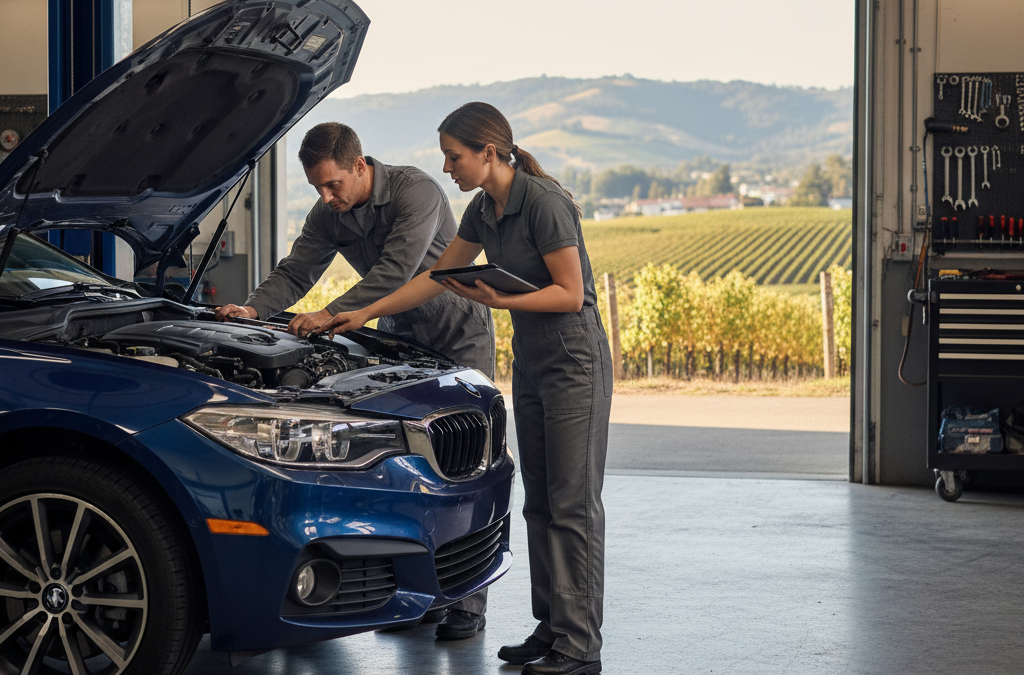
Why Is My Car Hesitating When I Accelerate in Santa Rosa? What’s Causing That Sluggish Response
If you press the gas pedal and your car seems to pause, stumble, or lurch before it picks up speed — or it just feels like it has no power when you need it — that’s called acceleration hesitation, and it’s one of the more frustrating symptoms a driver can deal with. It’s especially noticeable when you’re merging onto Highway 101 from Rohnert Park, climbing a grade in Fountaingrove, or trying to get up to speed on a busy Santa Rosa street. The good news is that hesitation almost always has a fixable cause. The not-so-good news: there are several possible culprits, and letting it go too long can turn a simple fix into a much bigger repair.
What Acceleration Hesitation Actually Feels Like
It’s worth being specific about what we’re talking about, because “hesitation” can mean slightly different things. You might notice:
- A brief stumble or pause when you first press the gas from a stop
- A surging or jerky response when accelerating at low speeds
- A flat spot where the engine feels like it’s not responding, then suddenly catches up
- Sluggish acceleration under load — like when you’re carrying passengers, towing, or going uphill
- The engine revving higher than expected before the car actually gains speed
Some of these feel like an engine problem. Some actually point to a transmission issue. We’ll cover both.
The Most Common Causes of Acceleration Hesitation
1. Worn or Fouled Spark Plugs
This is probably the most common cause we see, and it’s one of the most overlooked. Spark plugs ignite the air-fuel mixture in your engine. When they’re worn, coated with carbon deposits, or past their service interval, combustion becomes inconsistent — and you feel that as a stumble or hesitation when you accelerate. Most vehicles need new spark plugs somewhere between 30,000 and 100,000 miles depending on the plug type and the manufacturer’s recommendation. If yours are overdue, this is a logical first step. It’s also one of the more affordable fixes on this list.
2. Dirty or Failing Fuel Injectors
Fuel injectors spray a precise mist of fuel into the engine. When they get clogged or start to fail, the engine doesn’t get the right fuel mixture — especially under sudden demand like acceleration. You might also notice rough idling, poor fuel economy, or a faint fuel smell. Fuel injector cleaning is sometimes effective for mild deposits; actual injector replacement is needed when they’ve failed. Driving a lot of short trips around Santa Rosa or sitting in stop-and-go traffic can accelerate deposit buildup over time.
3. A Dirty Throttle Body
The throttle body controls airflow into the engine. Over time, a carbon buildup can form on the throttle plate and bore, which restricts airflow and causes a sluggish or stumbling response — especially right off idle. A throttle body cleaning is a relatively quick service and can make a noticeable difference in how the car responds. Many drivers in Sebastopol and the surrounding rural areas with dusty roads find this comes up more often than they’d expect.
4. A Failing Mass Airflow (MAF) Sensor
The MAF sensor measures how much air is entering the engine so the computer can calculate the right amount of fuel. When it’s dirty or failing, the engine management system gets inaccurate readings — and the result is often hesitation, rough running, or poor fuel economy. A check engine light may or may not be present. This is exactly the kind of problem that shows up in a proper diagnostic scan, not just a basic code reader. If you’ve had someone plug in a cheap OBD-II scanner and come up empty, a MAF issue can still be lurking in live sensor data that only a more thorough auto diagnostic inspection will catch.
5. A Weak Fuel Pump or Clogged Fuel Filter
When your engine demands more fuel — like during hard acceleration — a weak fuel pump may not be able to keep up. You’ll often feel this as hesitation specifically at higher throttle demand, not just at idle or low speed. A clogged fuel filter creates a similar bottleneck. Some vehicles have serviceable fuel filters on a maintenance schedule; others have them integrated into the fuel pump assembly. Either way, if the fuel delivery side of the system is struggling, your engine will let you know.
6. Transmission Hesitation — Not Always an Engine Problem
Here’s something a lot of drivers don’t realize: what feels like engine hesitation is sometimes actually a transmission problem. If your automatic transmission is slow to downshift, hesitates between gears, or slips when you accelerate, it can feel nearly identical to an engine stumble. You might also notice the RPMs climb before the car actually accelerates — that’s a classic sign of transmission slip. Low or degraded transmission fluid is often the culprit, but worn clutch packs or a failing torque converter can also be involved. If your transmission fluid hasn’t been changed in a long time, that’s worth looking at alongside the engine-side causes.
Why This Problem Gets Worse on Sonoma County Roads
Acceleration hesitation isn’t just annoying — in certain driving situations around here, it can actually be a safety issue. If you’re trying to merge onto Highway 101 from Windsor or Petaluma and your car stumbles when you floor it, that’s a problem. The same goes for pulling out onto a busy intersection on Mendocino Avenue or climbing the hills in Bennett Valley with a vehicle that just won’t respond when you need it to.
Wildfire smoke seasons also add a layer of concern. Ash and particulate matter can clog air filters faster than normal, and a severely restricted air filter can contribute to a rich fuel condition that causes stumbling under acceleration. If you haven’t changed your engine air filter since the last fire season, that’s a quick and inexpensive check.
What a Proper Diagnosis Actually Involves
One thing that sets a real diagnostic apart from a quick code scan is live data analysis. When a technician connects a professional scan tool and watches your MAF readings, fuel trim values, and throttle position data in real time — while the symptom is actually happening — they can pinpoint what the engine is actually doing wrong. A basic code reader that just pulls stored fault codes won’t catch a hesitation that hasn’t tripped a code yet. This is where experience matters.
We’ve been diagnosing driveability problems like this on all makes and models across Santa Rosa and Sonoma County since 2011, and hesitation complaints are something we take seriously because the same symptom can have five different root causes depending on the vehicle, its age, and how it’s been maintained.
If your vehicle is due for preventive maintenance — especially a tune-up or fuel system service — addressing hesitation at that visit is usually the most cost-effective approach. Catching a failing sensor or dirty injectors before they cause secondary damage (like a catalytic converter clog from chronic rich-running) can save you hundreds of dollars.
Brands We See This On Most Often
Acceleration hesitation isn’t brand-specific, but there are patterns. We see throttle body issues frequently on older GM vehicles — Chevys, Buicks, and GMC trucks especially. Ford F-150s and Explorers with high mileage often show up with MAF sensor issues. Subarus, which are extremely popular in Sonoma County, can develop hesitation from a combination of fuel system deposits and coil pack issues. Toyotas and Hondas are generally more tolerant, but even they aren’t immune when maintenance falls behind. Volkswagens and Audis can be particularly sensitive to MAF sensor contamination.
Whatever you drive, the underlying diagnostic process is the same: systematic, data-driven, and honest about what we find.
Frequently Asked Questions
Can I drive my car if it’s hesitating when I accelerate?
It depends on the severity. Mild hesitation is often safe to drive short distances, but you should get it checked soon. If the car is stumbling badly, stalling, or struggling to accelerate to highway speeds, that’s a safety concern — don’t delay getting it looked at.
Will a tune-up fix acceleration hesitation?
Sometimes, yes — especially if the root cause is worn spark plugs or a dirty throttle body. But a true tune-up without a proper diagnosis is a bit of a guess. We always recommend figuring out what’s actually causing the symptom first, so you’re not replacing parts that don’t need replacing.
My check engine light isn’t on. Can there still be a real problem?
Absolutely. Plenty of driveability issues — including hesitation from a partially clogged fuel injector or a borderline MAF sensor — won’t trigger a check engine light until the problem gets worse. A check engine light absence doesn’t mean everything is fine.
How much does it cost to diagnose acceleration hesitation?
Diagnostic costs vary by shop and by the complexity of the problem. At On Site Auto Repair, we’re upfront about what a diagnosis involves and what it costs before we start — no surprise charges. We’ll tell you what we find and give you an honest assessment of what it will take to fix it.
Could bad gas cause hesitation?
Yes, occasionally. If you filled up at an unfamiliar station and the symptom started shortly after, contaminated or low-quality fuel can cause stumbling. Running the tank lower and refilling with fresh fuel from a reputable station is worth trying if timing lines up. But if the problem persists, it’s more likely a mechanical or sensor issue.
Ready to Get It Checked Out?
Acceleration hesitation is one of those symptoms that tends to get worse over time, not better. Whether you’re dealing with a stumble off the line, a flat spot at highway speeds, or a sluggish response that’s making merging onto 101 feel like a gamble, we can help figure out what’s going on.
On Site Auto Repair serves drivers throughout Santa Rosa and Sonoma County — from Rohnert Park and Sebastopol to Windsor and beyond. We work on all makes and models, we’re honest about what we find, and we don’t push repairs you don’t need. Contact us today to schedule a diagnostic appointment or get a free estimate — let’s get your car responding the way it should.