Why Is My Car Making a Grinding Noise When I Turn in Petaluma? What’s Going On with Your CV Axles and Wheel Bearings
If you’re hearing a grinding, clicking, or clunking sound when you turn your steering wheel — whether you’re pulling out of a parking spot on Petaluma Hill Road or making a slow turn through a roundabout — that noise is worth paying attention to. In most cases, it points to one of two things: a worn CV axle or a failing wheel bearing. Neither one gets better on its own, and both can leave you stranded if you wait too long. Here’s what’s actually going on, how to tell the difference, and when it’s time to bring your vehicle in.
What Is a CV Axle and Why Does It Click When You Turn?
CV stands for constant velocity. The CV axle is the shaft that transfers power from your transmission to your wheels, and it’s designed to flex as your suspension moves and your wheels turn. On each end of the axle, there’s a joint — called a CV joint — protected by a rubber boot filled with grease. When that boot cracks or tears, the grease escapes, dirt gets in, and the joint starts to wear down fast.
The telltale sign of a bad CV joint is a clicking or popping sound that happens specifically when you turn — especially during slow turns with the wheel cranked to one side. You might notice it most when backing out of a parking space or making a tight left turn. The sound often gets louder as the joint deteriorates. Eventually, a severely worn CV joint can break completely, which means you lose power to that wheel entirely. That’s not a situation you want to deal with on Highway 101 during a commute from Petaluma into Marin County.
What Does a Bad Wheel Bearing Sound Like?
Wheel bearings are a little different. They’re what allow your wheels to spin freely with minimal friction, and when they start to fail, the sound they make is usually more of a grinding, humming, or rumbling — sometimes compared to driving on rough pavement even when the road is smooth. Unlike CV joint noise, wheel bearing noise often changes with your speed and sometimes shifts when you sway the car gently from side to side at highway speeds.
Here’s a simple test: if the grinding gets louder when you shift your weight to the left (by steering slightly right), the right bearing may be the problem — and vice versa. It’s not a perfect diagnosis, but it’s a useful clue before you bring it in. A mechanic can confirm it quickly with a proper inspection and road test.
Wheel bearings don’t always fail dramatically. Sometimes it’s a gradual groan that creeps in over weeks. But a severely worn bearing can cause your wheel to wobble, affect your steering, and in worst-case scenarios, seize up — which is genuinely dangerous at speed.
Why Sonoma County Driving Conditions Make These Problems Worse
If you’re driving in and around Santa Rosa, Sebastopol, or Cotati, your vehicle is dealing with a mix of stop-and-go surface streets, Highway 101 miles, and — depending on where you live — rural roads and uneven pavement that can accelerate wear on CV boots and wheel bearings alike.
Drivers in areas like Penngrove or out past the Sebastopol area who regularly take winding backroads to work or to access Wine Country tasting rooms put extra stress on their front-end components every single day. The combination of frequent turns, speed bumps, and rough pavement means CV boots take a beating. Once a boot cracks — especially in our dry summer heat — it doesn’t take long for the joint underneath to start failing.
We also see a fair number of vehicles where the CV boot was cracked for a while before anyone noticed. That’s understandable. It’s not something you see from the driver’s seat. But catching a cracked boot early, before the joint itself is damaged, is much cheaper than replacing the whole axle assembly. It’s one of the things we check during routine inspections, and it’s worth asking about if your car has higher mileage.
CV Axle vs. Wheel Bearing: How We Tell Them Apart
Because both problems can produce noise when turning, it helps to understand how a mechanic actually differentiates them. The short version:
- CV joint noise is typically most pronounced during slow, tight turns — the kind you make in parking lots or driveways. It clicks or pops and often quiets down at highway speed.
- Wheel bearing noise tends to be more constant, often present at higher speeds, and changes in pitch or volume when you shift lane positions. It may or may not change when turning.
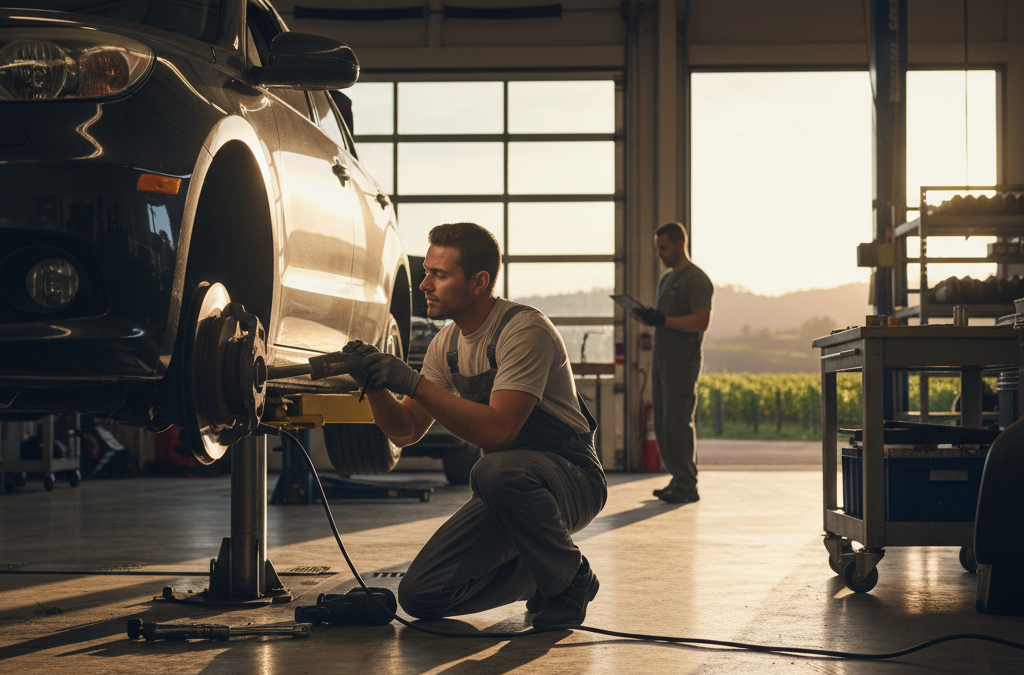
- A mechanic will lift the vehicle, check for play in the wheel (side-to-side and top-to-bottom), inspect the CV boots visually, and often do a road test to confirm the source.
If you bring your car in describing the noise you’re hearing and when it happens, that information helps us pinpoint things faster. You don’t need to know which part it is — that’s our job. You just need to tell us what you’re hearing and under what conditions.
What Happens If You Ignore It?
We’re not in the business of scaring people into unnecessary repairs. But with CV axles and wheel bearings, the honest answer is: both problems get progressively worse and more expensive the longer you wait. A cracked CV boot that costs relatively little to address can turn into a full axle replacement if the joint runs dry and destroys itself. A humming wheel bearing that’s ignored can eventually cause the wheel to pull, affect your ABS sensor (which lives right next to the bearing on most modern vehicles), and in serious cases, cause a wheel to seize or separate.
If you’re hearing something unusual when you turn, it’s worth getting it looked at sooner rather than later. That’s true whether you’re driving a front-wheel-drive Honda Civic, an all-wheel-drive Subaru Outback, or a Ford F-150 with four-wheel drive — these components exist on all of them, and all of them wear out eventually.
Our steering and suspension services include full inspection of CV axles, boots, and wheel bearings for all makes and models. We’ll tell you exactly what we find and what it actually needs — no guessing, no upselling.
What About All-Wheel-Drive Vehicles?
If you drive an AWD vehicle — which is pretty common in Sonoma County, especially among Subaru owners in Sebastopol and Windsor — you have more CV axles than a standard front-wheel-drive car. AWD systems use axles at all four corners, which means more potential failure points. If one axle is clicking, it’s worth checking the others at the same time, especially if the vehicle has significant mileage.
Subaru in particular has a well-documented reputation for CV axle wear, and we see it regularly on higher-mileage Outbacks and Foresters. If your Subaru is approaching 100,000 miles and you haven’t had the CV boots inspected, that’s a reasonable thing to add to your next service visit.
How to Get It Diagnosed in Santa Rosa or Petaluma
You don’t need to guess. If you’re hearing any kind of grinding, clicking, popping, or humming that seems related to your steering or wheel movement, bring it in and let us take a look. We do free estimates, we explain what we find in plain language, and we don’t recommend work your car doesn’t actually need.
On Site Auto Repair serves drivers throughout Sonoma County, from Rohnert Park and Cotati up through Santa Rosa and out to Sebastopol. If you’re in Petaluma or up near Windsor and you’re not sure what that noise is, reach out and we’ll help you figure it out. You can also learn more about our full range of complete auto repair services online.
Frequently Asked Questions
How long can I drive on a bad CV axle?
It depends on how far the joint has deteriorated. If you’re only hearing a faint click on tight turns, you might have some time — but it’s not something to put off for months. Once the clicking becomes constant or the joint starts to clunk under acceleration, you’re close to a failure point. Get it inspected as soon as you notice the sound.
Is a wheel bearing replacement expensive?
It varies by vehicle and which bearing is involved. Some vehicles use a simple bolt-on hub assembly that’s relatively straightforward. Others require pressing out the old bearing, which takes more time. We give honest estimates upfront so there are no surprises. Contact us for a free estimate on your specific vehicle.
Can I drive with a bad wheel bearing?
A mildly worn bearing might be drivable for a short period, but it’s not something to leave unchecked. A severely worn bearing can cause loss of steering control and wheel separation in extreme cases. If the grinding is loud or your steering feels off, don’t wait.
Does a CV axle problem affect my AWD system?
Yes. On an AWD vehicle, a failing CV axle can reduce power delivery to that wheel and in some cases trigger warning lights related to the traction control or AWD system. If those lights come on along with a clicking noise, that’s a pretty clear signal to bring it in for a diagnostic check.
How do I know if it’s the CV axle or something else entirely?
Clicking specifically during low-speed turns is a strong indicator of a CV joint. But other front-end components — like worn ball joints, tie rod ends, or even loose sway bar links — can also produce noises when turning. The best way to know for sure is a hands-on inspection. We’ll check all of it and give you an honest answer about what’s actually causing the noise.
If your car is making a noise you can’t quite explain when you turn, don’t wait for it to get worse. Contact On Site Auto Repair today to schedule a free inspection. We’ve been helping Santa Rosa and Sonoma County drivers get honest answers since 2011 — and we’ll treat your vehicle the same way we’d treat our own.