Why Is My Tire Pressure Light On in Sonoma County? What TPMS Warnings Actually Mean
If that little horseshoe-shaped light with an exclamation point just came on in your Santa Rosa commute, here’s the short answer: your tire pressure monitoring system (TPMS) is telling you that one or more of your tires is significantly under-inflated — or, less commonly, that a sensor itself has a problem. It doesn’t always mean you have a flat or a blowout in progress, but it does mean you shouldn’t ignore it and keep driving indefinitely. Most of the time it’s a straightforward fix. Sometimes it points to something more serious. Here’s how to tell the difference.
What Is TPMS and Why Does Your Car Have It?
Since 2008, federal law has required all new passenger vehicles sold in the United States to include a Tire Pressure Monitoring System. The system uses small sensors — usually mounted on the valve stems inside each wheel — to continuously measure air pressure and alert you when a tire drops 25% or more below the recommended pressure. For most passenger cars, that recommended pressure is somewhere between 30 and 35 PSI; for trucks and SUVs it can be higher. You’ll find your vehicle’s specific recommended pressure on the sticker inside your driver’s door jamb, not on the tire sidewall (that number is the maximum, not the target).
There are two types of TPMS: direct and indirect. Direct systems use physical sensors in each wheel. Indirect systems use your ABS wheel speed sensors to estimate pressure based on how fast each tire rotates. Most modern vehicles use direct TPMS, which is more accurate — but those sensors can also fail, corrode, or get damaged during a tire rotation if the shop isn’t careful.
The Most Common Reason: Temperature Changes in Sonoma County
Here’s something a lot of drivers don’t realize: tire pressure drops about 1 PSI for every 10-degree Fahrenheit drop in outside temperature. That means when Sonoma County wakes up to a cold October or November morning — after a stretch of warm September weather that kept your tires inflated just fine — your TPMS light might be on before you’ve even left the driveway.
This is especially common in areas like Sebastopol and the Russian River Valley, where nighttime temperatures can swing dramatically from summer to fall. Drivers coming down from Fountaingrove or Bennett Valley on a cold morning may also notice the light flicking on during the descent, then shutting off once the tires warm up. If that’s what’s happening with your vehicle, it’s still worth checking your pressure — but it’s not a crisis. Add air to the manufacturer’s spec, and the light should reset on its own within a few miles of driving.
The flip side happens in summer. When Healdsburg or Sonoma hits 100 degrees and you’ve been sitting in Wine Country traffic, tire pressure builds up with heat. That won’t trigger your TPMS warning (it only alerts for low pressure), but it’s a reminder that tires need seasonal attention year-round here in Sonoma County.
When the TPMS Light Means Something More Serious
If your light is on and adding air doesn’t make it go away — or if the light is blinking rather than staying solid — you’re likely looking at one of these scenarios:
- A slow leak or puncture. A nail, screw, or piece of debris from the road (common on rural backroads near wineries and in construction zones along Highway 101) can cause a tire to lose pressure gradually. You might not notice it immediately, but the TPMS will catch it before your tire is visibly flat.
- A damaged or corroded TPMS sensor. The sensors sit inside the wheel and are exposed to moisture, road salt, and the chemicals used in tire sealants. They also get bumped during tire changes if the shop isn’t careful. A dead or damaged sensor will typically trigger a blinking TPMS light, whereas a simple low-pressure situation gives you a steady light.
- A tire that’s been plugged or patched improperly. Temporary roadside sealant (like Fix-a-Flat) can clog TPMS sensors and cause false readings or permanent sensor damage. If you’ve used a sealant kit, let your mechanic know — the sensor may need to be replaced or at minimum cleaned and re-tested.
- Worn-down tires with uneven pressure distribution. If one tire is consistently losing pressure faster than the others, that’s a sign the tire itself may be at the end of its life, or that the bead seal around the rim is compromised.
What Sonoma County Roads Do to Your Tires (That You Might Not Think About)
Driving around Santa Rosa isn’t exactly easy on tires. The hilly terrain in neighborhoods like Fountaingrove and Bennett Valley means your tires work harder on acceleration and braking than they would on flat ground. The winding rural roads to Occidental, Guerneville, or out toward Bodega Bay have more edge debris and less-maintained pavement than the main Highway 101 corridor. And if you’re one of the thousands of Sonoma County residents doing a daily Bay Area commute — whether you’re in Rohnert Park, Cotati, or Windsor — that kind of highway mileage adds up fast.
All of that means tire pressure should be something you’re checking at least once a month, not just when a warning light comes on. A properly inflated tire wears more evenly, handles better in emergency situations, and gets you better fuel economy. Under-inflated tires run hotter, wear faster on the outer edges, and are more likely to fail at highway speeds.
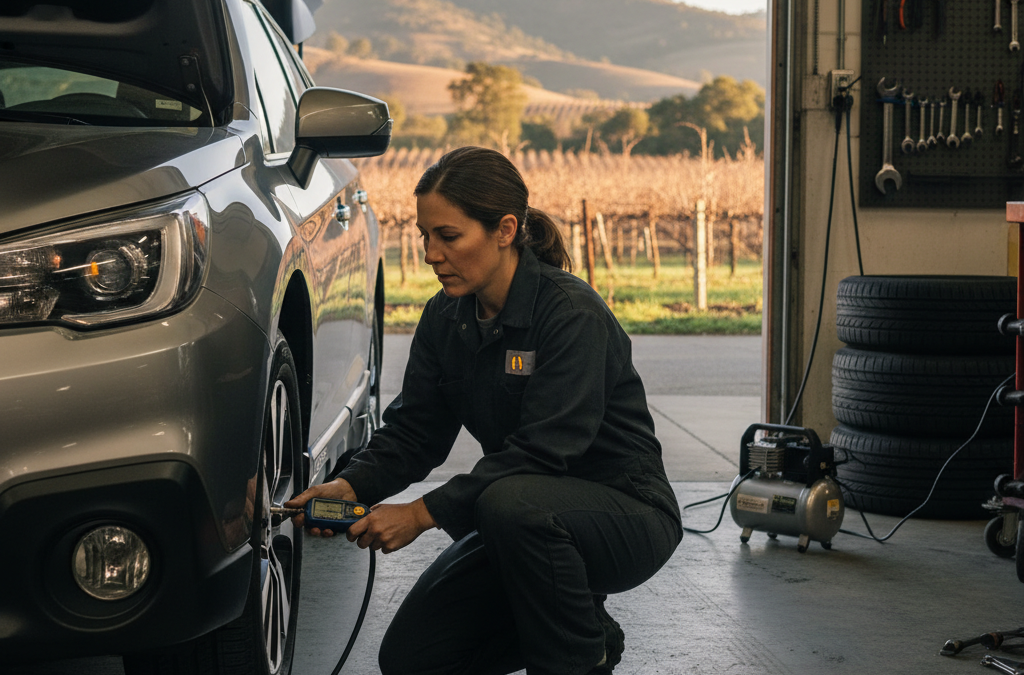
Our tire services in Santa Rosa and Sonoma County cover everything from pressure checks and rotations to full tire replacement and TPMS sensor diagnostics — so if you’re not sure what your light is telling you, we can figure it out quickly.
What Competitors Aren’t Telling You About TPMS Sensor Replacement
Here’s the gap most local shops — including several here in Sonoma County — don’t bother to explain: when you buy new tires, your TPMS sensors don’t automatically get replaced. They stay in your old wheels and get transferred, or in some cases the shop will reuse them without testing them. If those sensors are five or six years old, corroded, or running on low battery, you might be driving away from a new tire install with a TPMS system that’s about to fail.
TPMS sensor batteries are sealed units — they can’t be replaced separately. When the battery dies (usually after 5–10 years), the whole sensor needs to be replaced. A good shop will check sensor condition and battery life during any tire service and give you an honest heads-up if you’re close to needing new sensors. What you don’t want is to find out a sensor is dead when you’re stuck on the side of 101 with no idea whether your tire is actually low or the light is just a ghost.
We’ve been doing this kind of honest, thorough inspection since 2011, and we’re not going to hand your car back with an unresolved warning light and a shrug.
Can You Drive With the TPMS Light On?
It depends. If the light just came on during a cold morning and your tires look visually normal, you can usually drive carefully to the nearest air pump and check each tire’s pressure. If one or more tires are significantly low (more than 5–8 PSI below spec), add air and see if the light resets within a few miles.
What you shouldn’t do is ignore a TPMS light for days or weeks, especially if you’re not sure which tire is affected or by how much. A tire running 10–15 PSI below spec is handling differently than it should — and in an emergency braking situation on a wet Sonoma County road, that matters. Staying on top of preventive maintenance, including regular tire pressure checks, is one of the simplest things you can do to stay safe on the road.
Frequently Asked Questions About TPMS in Sonoma County
Why does my TPMS light come on in the morning and turn off after I drive a few miles?
This is the classic cold-weather pressure drop. Tire pressure decreases when air is cold and increases as the tires warm up from driving. If the light consistently comes on in the morning and goes off after warming up, your tires are right at the edge of the threshold. You should add a few PSI — it won’t hurt anything, and you’ll stop triggering the alert every cold morning.
My TPMS light is blinking, not solid. What does that mean?
A blinking or flashing TPMS light usually indicates a system malfunction — meaning one of the sensors itself is faulty, not just that a tire is low. This needs to be diagnosed with a scan tool that can communicate with the TPMS module. Adding air won’t fix it.
How much does it cost to replace a TPMS sensor?
Sensor cost and labor varies depending on your vehicle’s make and model. Some sensors are inexpensive and widely available; others (particularly on European vehicles or newer trucks) are more specialized. We’ll always give you an honest estimate before touching anything — no surprises.
Will my TPMS light reset automatically after I add air?
Usually, yes — within 10–20 minutes of driving at normal speeds. Some vehicles require a manual reset procedure (often holding a TPMS reset button while the car is on). If the light doesn’t reset after you’ve confirmed all tires are properly inflated, there may be a sensor issue worth looking into.
Can I use Fix-a-Flat or a tire sealant if I have TPMS sensors?
You can in an emergency, but be aware that the sealant can damage or clog TPMS sensors. If you use one of these kits, tell your mechanic right away — they’ll want to check sensor function before the sealant hardens inside the wheel.
Get Your TPMS Warning Diagnosed in Santa Rosa
A tire pressure warning light is one of those things that’s easy to dismiss — especially when you’re rushing out to work in Rohnert Park or heading up to Healdsburg for the weekend. But it’s one of the few dashboard warnings that’s directly tied to your immediate safety on the road. Don’t just add air and hope for the best if the light stays on or keeps coming back.
At On Site Auto Repair in Santa Rosa, we’ll check your tire pressures, inspect your TPMS sensors, and tell you exactly what’s going on — no guesswork, no upselling. If it’s a simple pressure adjustment, that’s all we’ll do. If a sensor needs to be replaced or a tire has a slow leak, we’ll show you what we found and give you a straight answer on what it’ll take to fix it.
Contact us or request a free estimate — we’re here to help Sonoma County drivers stay safe and informed.