How Do You Know When Your Car Battery Is Dying in Windsor or Santa Rosa? Signs, Tests, and What to Do
If your car has been slow to start on cool mornings, your headlights look a little dim, or you heard a rapid clicking when you turned the key last week — your battery is probably trying to tell you something. In Santa Rosa and the surrounding Sonoma County area, battery problems spike twice a year: late summer when the heat has quietly cooked the battery all season, and again in late fall when the first cold snaps hit and suddenly expose how little capacity is left. The good news is that a failing battery almost always gives you warning signs before it leaves you stranded. The trick is knowing what to look for.
The Warning Signs Most Drivers Ignore Until It’s Too Late
Battery failure rarely happens all at once. Most of the time it’s a slow decline, and the early symptoms are easy to write off as something else. Here’s what to pay attention to:
- Slow cranking at startup: If your engine turns over sluggishly — especially on a cool morning — that hesitation is one of the clearest early signs. A healthy battery cranks the engine fast and confidently. A weak one drags.
- A clicking sound when you turn the key: One solid click usually points to a starter issue. Rapid clicking — click-click-click-click — typically means the battery doesn’t have enough charge to engage the starter motor at all.
- Dim headlights or interior lights: If your lights look noticeably dimmer than usual, especially at idle, your battery or charging system isn’t keeping up.
- Electrical gremlins: Random issues — power windows moving slowly, the radio cutting out, the clock resetting itself — can all be related to a battery that’s not holding a stable voltage.
- A swollen or bloated battery case: If you pop the hood and the battery looks puffy or misshapen, that’s a sign of heat damage. In a place like Windsor or Healdsburg where summer temperatures can push well past 100°F, this is more common than you’d think.
- Your battery light comes on: This one seems obvious, but plenty of drivers ignore it. The battery light doesn’t always mean a dead battery — it can also indicate an alternator problem — but either way, it needs immediate attention.
Why Sonoma County’s Climate Is Unusually Hard on Batteries
Here’s something most drivers don’t realize: heat destroys batteries faster than cold does. Cold weather gets the blame because that’s when batteries finally give out, but the actual damage often happens during the summer. The hot, dry conditions we get in Santa Rosa and inland Sonoma County from June through September — especially in areas like Fountaingrove, Bennett Valley, and out toward Healdsburg and Cloverdale — accelerate the internal chemical breakdown inside a battery. By the time October rolls around and mornings get cool again, a battery that’s been quietly degrading all summer just doesn’t have enough left to crank reliably.
Add to that the reality that a lot of Sonoma County drivers put serious miles on their vehicles. If you’re commuting down Highway 101 to Marin County or San Rafael for work, your car is running hard every day. That’s actually better for your battery than sitting, but it also means you need your electrical system to perform consistently. A battery with reduced capacity doesn’t have the same cushion it once did.
How Long Do Car Batteries Actually Last?
In Northern California’s climate, most lead-acid batteries last somewhere between three and five years. Some last longer — especially if the vehicle is driven regularly and the charging system is healthy — but four years is a reasonable point to start thinking about testing yours proactively. If you’ve never had your battery tested and you can’t remember when it was last replaced, that’s worth looking into, especially before summer or a long road trip.
Keep in mind that battery life varies by vehicle type, too. Vehicles with a lot of electronics — luxury brands, modern trucks with multiple screens and cameras, hybrids — draw more from the battery and can shorten its life if the charging system isn’t keeping up. Older vehicles with minimal electronics tend to be a little more forgiving.
What a Real Battery Test Involves — and Why It Matters
Here’s a gap worth addressing directly: a lot of drivers assume that if a battery holds a surface charge — meaning it’ll start the car — it must be fine. That’s not accurate. A battery can start a car when it’s warm and fully charged, and still fail within a few weeks when conditions change. A proper battery test measures something called cold cranking amps (CCA), which reflects how much power the battery can deliver when it’s cold and under load. That number degrades as the battery ages, and it tells you far more than just whether the battery is currently charged.
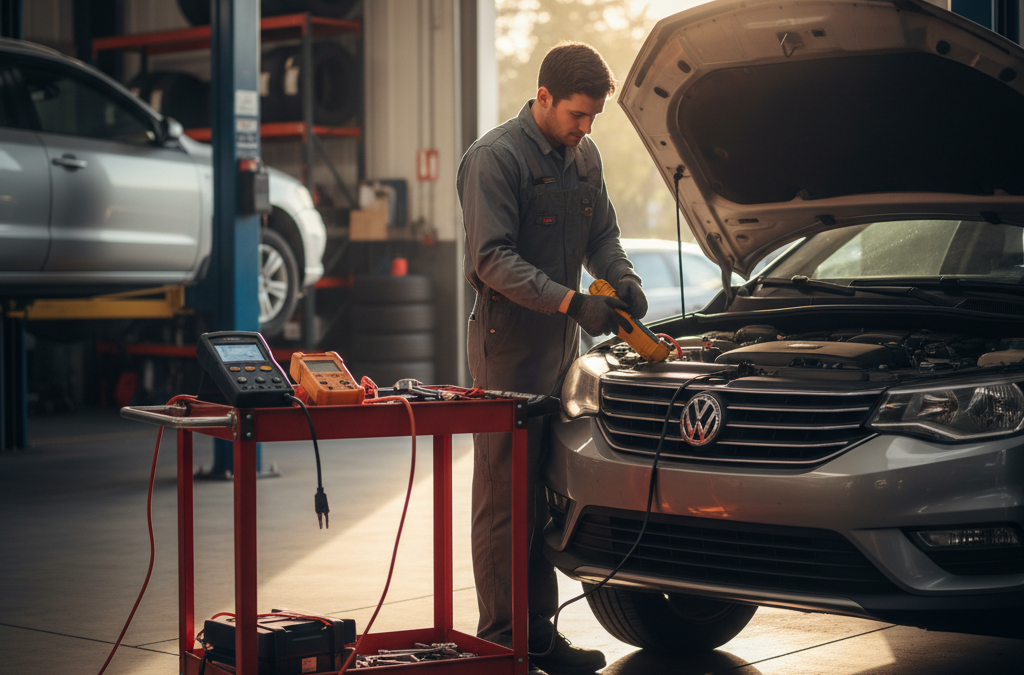
At On Site Auto Repair, a battery test takes just a few minutes and gives you a real picture of where things stand — not just a guess based on whether the car started this morning. We’ll also check the charging system, including the alternator, so you know whether a new battery would actually fix the issue or whether there’s something draining or undercharging it. There’s nothing worse than replacing a battery only to find out the alternator was killing it the whole time.
If you’re already noticing the early warning signs above, don’t wait. You can schedule a diagnostic check and we’ll look at the full electrical picture, not just the battery in isolation.
Can You Jump-Start Your Way Out of a Bad Battery?
Jump-starting a car with a failing battery can get you moving in a pinch, but it’s not a long-term solution — and it can occasionally cause problems with modern vehicles that have sensitive electronics. On newer cars, a sudden voltage spike from jump-starting can trigger error codes or affect modules that have to be recalibrated. If you’re jump-starting your car more than once in the same week, that’s a clear signal the battery needs to be replaced, not just recharged.
Also worth noting: if your battery dies while you’re parked at a winery in the Russian River Valley or out on a backroad near Sebastopol with no cell signal, a jump-start may not be an option. Proactive battery checks are a lot cheaper than a tow.
What to Expect When You Come In for a Battery Service
Battery replacement at a reputable independent shop is typically a straightforward service. The tech will test your current battery first to confirm it actually needs replacing — we don’t suggest parts you don’t need — then install a replacement that matches your vehicle’s specifications. On some newer vehicles, the battery replacement also requires a registration step so the charging system knows the new battery’s capacity, and we handle that as part of the service.
We work on all makes and models, so whether you’re driving a Toyota Camry, a Ford F-150, a Honda CR-V, a Subaru Outback, or anything else, we can source the right battery and get it done right. Preventive maintenance visits are also a good time to ask us to check your battery — especially if it’s been more than three years since the last replacement.
Frequently Asked Questions About Car Batteries in Sonoma County
How do I know if it’s the battery or the alternator?
If your car won’t start but jump-starts easily and then runs fine, the battery is usually the culprit. If it starts but then dies again while driving, or if your battery light comes on while you’re moving, the alternator is more likely involved. A proper electrical system test checks both and takes the guesswork out of it.
Can I replace my own car battery?
On older vehicles, DIY battery replacement is pretty simple. On newer vehicles — especially European makes, some Toyotas, and anything with a battery monitoring system — you may also need to register the new battery with the car’s computer. Skipping that step can cause premature alternator wear. It’s worth having a shop handle it if you’re not sure whether your vehicle requires that step.
How long does a battery replacement take?
Usually 30 to 45 minutes, including testing and any programming steps. It’s one of the faster services we do.
My car sits for days at a time without being driven. Does that hurt the battery?
Yes. Modern vehicles draw a small amount of power even when parked — from the alarm system, the computer modules, the clock, and other systems. If a car sits for more than a week or two without being driven, the battery can discharge enough that the charging system has to work harder to catch up. Frequent short trips also don’t give the alternator enough time to fully recharge the battery. Both situations can shorten battery life.
Do I need a more powerful battery for hot Sonoma County summers?
Not necessarily more powerful, but you want a quality battery with a high CCA rating for your vehicle type and a good heat tolerance rating. Cheap batteries typically use thinner plates that degrade faster in high heat. We’ll recommend a replacement that’s appropriate for how and where you drive.
Don’t Wait Until You’re Stranded — Get Your Battery Tested Now
A battery test is quick, honest, and something we’re happy to do without any pressure to sell you something you don’t need. If your battery is fine, we’ll tell you. If it’s showing signs of reduced capacity, we’ll show you exactly what the numbers mean and let you decide how you want to proceed. That’s how we’ve worked since 2011, and it’s not going to change.
Whether you’re in Santa Rosa, Windsor, Rohnert Park, or anywhere else in Sonoma County, reach out to On Site Auto Repair to schedule your battery test or get a free estimate on battery replacement. We’d rather spend ten minutes catching this now than have you calling for a tow from a parking lot later.