Why Is My Car Shaking When I Drive? Steering and Suspension Warning Signs in Santa Rosa
If your car has been feeling a little rough lately — shaking at highway speed, pulling to one side, or bouncing more than usual over bumps — your steering and suspension system is telling you something. For Santa Rosa drivers, this is one of those issues that’s easy to ignore until it suddenly isn’t. The truth is, worn shocks, bad struts, or an alignment that’s gone off can quietly make your vehicle harder to control, accelerate tire wear, and put extra stress on your brakes. Here’s what the most common symptoms actually mean, why Sonoma County’s terrain makes this especially worth paying attention to, and when it’s time to stop waiting and get it checked out.
What Does It Mean When Your Car Shakes While Driving?
Shaking or vibrating while driving isn’t just annoying — it’s diagnostic. The tricky part is that several different problems can cause a similar feeling, and where and when the shaking happens tells you a lot about what’s going on.
- Shaking at highway speeds (55–70 mph): This is usually a wheel balance issue or a tire that’s worn unevenly. It can also point to a bent wheel or a tie rod end that’s starting to wear out.
- Vibration through the steering wheel when braking: That’s often warped brake rotors — a separate issue, but one worth mentioning because it gets confused with suspension problems all the time.
- Shaking or bouncing over bumps that doesn’t settle quickly: This is a classic sign that your shocks or struts are worn. If your car keeps rocking after you hit a dip in the road, the dampening function is gone.
- Shaking at low speeds or when turning: This can point to CV axle issues, a worn control arm bushing, or a failing ball joint — none of which you want to let go for long.
The takeaway: don’t just describe it as “my car shakes.” Pay attention to when it happens, at what speed, and whether it’s through the wheel, the seat, or the whole car. That detail helps a mechanic zero in on the actual cause faster.
Why Sonoma County Terrain Is Unusually Hard on Suspension
This is something that doesn’t get talked about enough at local shops. Santa Rosa isn’t flat. If you live in Fountaingrove, Bennett Valley, or Oakmont, you’re doing a lot of up-and-down driving every single day. Those elevation changes, combined with off-camber turns and narrower roads, put more stress on your shocks, struts, and ball joints than a typical flat commute would.
Add in the fact that many Wine Country backroads — the kind that wind out toward Healdsburg, Sebastopol, and the Russian River Valley — are rough, patchy, or cambered in ways that gradually knock your alignment out of spec. If you’re making regular runs on Highway 101 between Santa Rosa and the Bay Area, that kind of repetitive highway mileage wears on tires and suspension components at a different rate than local stop-and-go driving.
And don’t forget potholes. After wet winters, the roads around Rohnert Park, Windsor, and parts of south Santa Rosa can get pretty rough. One solid pothole hit at speed can knock your alignment off immediately — or crack a strut mount that was already borderline.
What Are Shocks and Struts, and When Do They Need to Be Replaced?
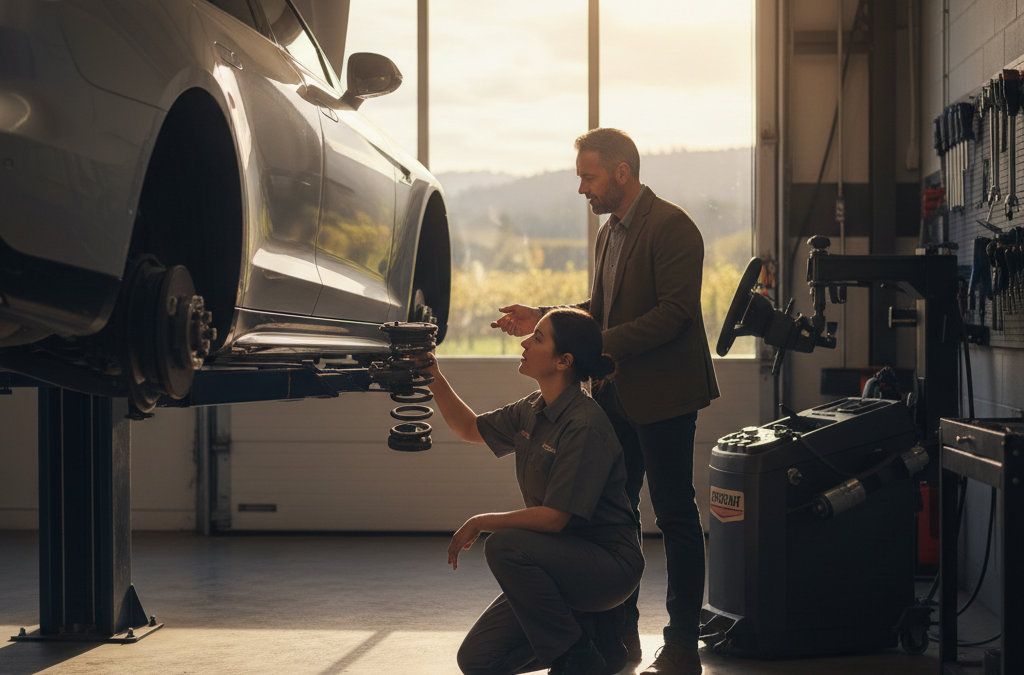
Shocks and struts both control how your vehicle handles bumps and body movement, but they’re not the same thing. Struts are a structural component — they actually support the vehicle’s weight and are part of the steering geometry. Shocks are separate dampers that only control bounce. Replacing struts is a bigger job than replacing shocks, which is part of why people sometimes put it off longer than they should.
As a general rule, most vehicles need shocks or struts inspected around 50,000 miles, and many need replacement between 50,000 and 100,000 miles depending on how the vehicle is driven. That said, driving on hilly terrain or rough roads shortens that window. If your vehicle is visibly nose-diving when you brake, leaning hard in corners, or the rear end feels like it’s floating on the highway, those are signs it’s time to have them looked at — not in six months, now.
For Toyota and Honda owners especially, these vehicles often hold up so well mechanically that suspension wear can sneak up on you. The engine runs great, nothing’s obviously wrong, but the ride and handling have slowly degraded to the point where it’s affecting safety. Our steering and suspension services cover the full picture — shocks, struts, ball joints, tie rods, control arm bushings, and sway bar links — for all makes and models.
Wheel Alignment: The Most Overlooked Part of Suspension Maintenance
Most people only think about wheel alignment when their car is pulling hard to one side. But alignment drifts gradually, and by the time you really notice the pull, your tires have often already started wearing unevenly. That uneven wear means you’ll be replacing tires sooner than you should — which costs significantly more than an alignment would have.
You should consider getting your alignment checked if:
- You’ve hit a significant pothole or curb
- You’re getting new tires (always align with new rubber)
- You’ve had any front-end suspension work done
- Your steering wheel isn’t centered when driving straight
- Your tires are wearing faster on one edge than the other
For most drivers in Sonoma County, an alignment check once a year is a reasonable baseline — more often if you’re covering a lot of miles on rural roads or doing regular Highway 101 commuting to the Bay Area.
Steering Problems: What Pulling and Wandering Actually Tell You
If your car drifts or pulls to one side on a flat, straight road, alignment is the first suspect. But if you’re also noticing looseness in the steering wheel — a kind of vague, wandering feeling where the car doesn’t respond crisply — that’s more likely a worn tie rod end, loose steering rack, or failing power steering component.
A car that wanders or feels “numb” to steer is genuinely less safe to drive, especially at highway speeds. It also tends to get worse gradually, which is why a lot of people get used to it without realizing how far things have drifted from normal.
If you’re in this situation, a proper inspection and diagnostic check is the right first step. The goal isn’t to sell you a list of parts — it’s to figure out exactly what’s causing the problem and quote you honestly on what it takes to fix it.
Brand-Specific Notes Worth Knowing
A few vehicles we see regularly in Santa Rosa that have suspension quirks worth knowing about:
- Subaru: The all-wheel drive system means alignment specs matter more than average. A misaligned Subaru puts extra wear on the AWD components, not just the tires.
- Ford F-150 and similar trucks: Ball joints and tie rod ends wear faster under load. If you’re using your truck for hauling around Windsor or Healdsburg, inspect these components more frequently.
- Honda CR-V and Pilot: Rear suspension bushing wear is a known issue on higher-mileage examples. It often shows up as a clunking noise over bumps before it’s visible during inspection.
- Jeep Wrangler: If you’re doing any off-road driving in Sonoma County, your suspension takes a beating. Expect more frequent inspection intervals than the owner’s manual suggests for purely on-road use.
Frequently Asked Questions
How do I know if it’s my shocks or my tires causing the vibration?
Tire-related vibration usually has a specific speed range where it’s worst — often 60 to 70 mph — and it’s typically felt through the steering wheel. Worn shocks or struts show up more as excessive bouncing, swaying in corners, or a floaty feeling at all speeds. That said, the two can overlap, which is why a hands-on inspection beats guessing.
Can I drive with worn shocks or struts?
Technically yes, but it’s not a good idea for long. Worn shocks reduce your ability to control the vehicle during sudden maneuvers, extend your stopping distance, and accelerate wear on your tires and other suspension parts. If they’re bad enough that you’re noticing it, get them looked at soon.
How often should I get a wheel alignment in Santa Rosa?
Once a year is a reasonable baseline for most drivers here. If you do a lot of driving on rural backroads, hit a significant pothole, or get new tires, those are all good triggers to check it sooner.
Does steering and suspension work cost a lot?
It varies widely depending on what’s actually wrong. An alignment is one of the more affordable services you can do for your car. Replacing a pair of struts is a bigger job, but doing it proactively (before a strut mount cracks or the ride becomes dangerous) is almost always cheaper than waiting. We give you a clear, upfront estimate before any work starts — no surprises.
I live in Oakmont and drive hilly roads every day. How often should I have my suspension inspected?
Given the terrain in Oakmont and similar hillside neighborhoods, we’d suggest having your suspension components inspected at every oil change or at least once a year. Elevation changes, road camber, and frequent braking on downhill grades all accelerate wear beyond what a flat-road commuter would see.
Get a Straight Answer — No Runaround
If your car is shaking, pulling, bouncing, or just doesn’t feel right, don’t wait until something breaks. At On Site Auto Repair in Santa Rosa, we’ve been diagnosing and fixing steering and suspension problems across Sonoma County since 2011 — on everything from daily-driver Hondas and Toyotas to trucks, SUVs, and older vehicles that need a careful eye. We tell you what’s actually wrong, what can wait, and what needs attention now. No upselling, no unnecessary work.
Contact us today to schedule an inspection or get a free estimate. We’ll take a look, give you honest answers, and help you drive with confidence again.