
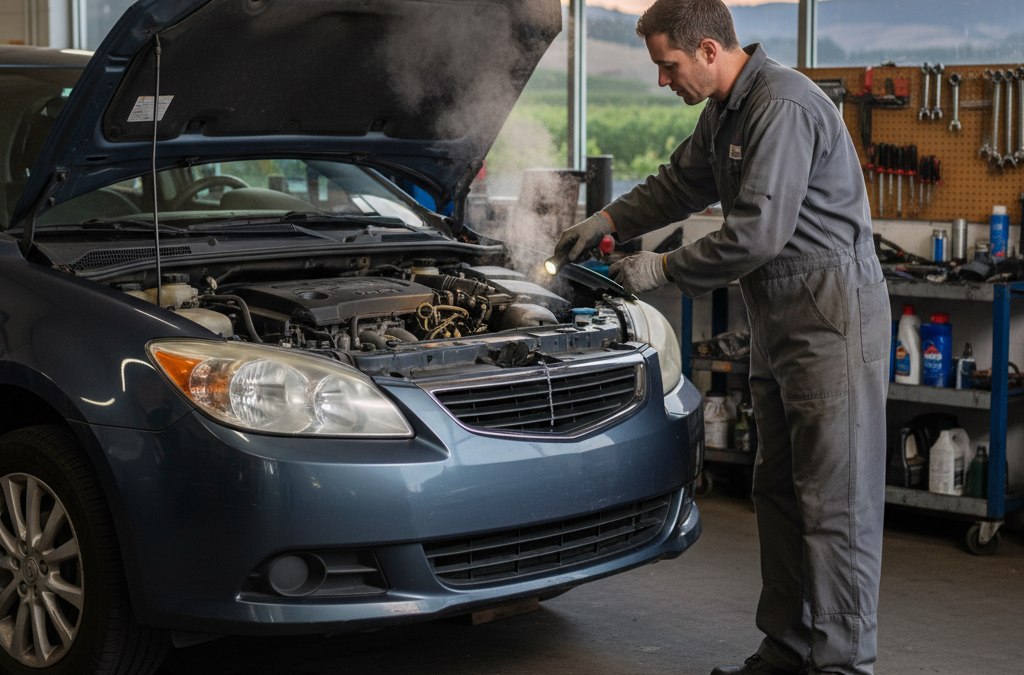
Why Is My Car Overheating in Petaluma? What to Do and When to Get It Checked
If your temperature gauge has been creeping toward the red — or you caught a whiff of something sweet and chemical while sitting in traffic on Highway 101 between Petaluma and Rohnert Park — your cooling system is trying to tell you something. An overheating engine is not a “wait and see” situation. Left unchecked, it can warp your cylinder head, blow a gasket, or cause engine damage that costs several times more than the original cooling system repair. The good news: most overheating problems are caught early enough to fix without drama, as long as you act quickly and get it to someone who knows what they’re looking at.
What Actually Causes a Car to Overheat?
Your engine generates an enormous amount of heat just doing its job. The cooling system — coolant, radiator, water pump, thermostat, hoses, and fans — exists specifically to manage that heat and keep everything running in a safe temperature range. When any one of those parts fails or gets degraded, the whole system starts to struggle.
Here are the most common culprits we see at On Site Auto Repair:
- Low or depleted coolant: This is the most frequent cause. Coolant doesn’t just evaporate — if levels are dropping, there’s usually a leak somewhere. Even a slow leak can sneak up on you during a long summer drive.
- Faulty thermostat: The thermostat regulates how coolant flows through the engine. When it sticks closed, coolant can’t circulate properly and temps spike fast.
- Water pump failure: The water pump is what actually moves coolant through the system. A worn impeller or leaking seal means you’ve lost circulation, even if coolant levels look fine.
- Radiator problems: A clogged or damaged radiator can’t dissipate heat efficiently. Older coolant breaks down over time and leaves behind deposits that restrict flow.
- Blown head gasket: This one is more serious. If combustion gases are leaking into the coolant passages, you’ll see overheating alongside white exhaust smoke or a milky film under the oil cap.
- Cooling fan failure: At low speeds and in stop-and-go traffic, the electric or mechanical cooling fan is what pulls air through the radiator. If it stops working, you’ll overheat at idle but may be fine at highway speed — a reliable clue for diagnosis.
What to Do Right Now If Your Car Starts Overheating
This matters a lot, so let’s be direct about the steps:
- Turn off the AC immediately. Air conditioning puts extra load on the engine. Turning it off reduces heat production right away.
- Turn the heater on full blast. Yes, this sounds backwards — but your heater core acts like a secondary radiator, and running it at full heat pulls heat away from the engine. Roll the windows down if you need to.
- Pull over safely as soon as you can. Don’t push through to your destination hoping it’ll cool down. Once the needle is in the red, you’re risking real damage with every mile.
- Turn the engine off and let it sit. Do not open the radiator cap while the engine is hot. The system is pressurized, and you will get scalded. Wait at least 30 minutes before checking anything.
- Call for help. If you’re stranded on 101 between Petaluma and Cotati, or somewhere along the backroads near Penngrove, it’s worth a call rather than trying to nurse a hot engine further down the road.
Why Sonoma County Summers Are Especially Hard on Cooling Systems
This region doesn’t mess around in July and August. Temperatures in Santa Rosa and inland Sonoma County regularly hit the mid-90s or higher, and that ambient heat is working against your cooling system the entire time you’re driving. Add in stop-and-go traffic near the Petaluma exits on 101, long commutes down to Marin County or San Rafael, and a vehicle that may already have aging coolant or a slow-leaking hose — and you’ve got a recipe for an overheating event that catches people completely off guard.
We also see this more frequently in late summer when wildfire conditions return to the region. Smoke and fine ash can actually clog the front of the radiator, reducing airflow through the fins and limiting the radiator’s ability to shed heat. If you’ve been driving through heavy smoke or parked outside during an ash event, it’s worth having the front of your cooling system inspected.
Vehicles that have been sitting through Sonoma County’s cool, wet winters and then get hit with a hot July are particularly vulnerable. Coolant degrades over time even when the car isn’t overheating — its protective additives break down and it becomes less effective at both heat transfer and corrosion prevention. Most manufacturers recommend a coolant flush every 2–5 years depending on the coolant type, though many drivers go far longer than that. A cooling system inspection and flush before summer is one of the highest-value preventive services you can do for a vehicle you depend on year-round.
What a Proper Cooling System Diagnosis Actually Looks Like
One thing that’s notably missing from a lot of local shop websites is any real explanation of what a cooling system diagnosis involves — beyond “we check your coolant level.” That’s not a diagnosis. That’s a glance under the hood.
A thorough cooling system inspection should include:
- Pressure testing the system to locate slow leaks that aren’t visible at idle
- Checking the condition and concentration of the coolant (not just the level)
- Inspecting the radiator cap — a cap that doesn’t hold pressure causes the system to boil over at lower temperatures
- Checking all hoses and clamps for soft spots, swelling, or cracking
- Testing the thermostat operation
- Verifying that the cooling fan(s) engage at the right temperature
- Looking for signs of a head gasket leak — a combustion leak test using a chemical kit is the right way to do this, not just a visual
If a shop is quoting you a cooling system repair without doing most of that, you’re probably not getting the full picture. At On Site Auto Repair, we’ve been doing this since 2011, and we’d rather spend the time diagnosing it right than replace one part and send you back out onto 101 still running hot.
Brand-Specific Notes Worth Knowing
Some vehicles are more prone to cooling system issues than others, and knowing your vehicle’s history matters:
- Subaru (especially older 2.5L engines): Head gasket failures are a well-documented issue on EJ-series engines. If you have an older Outback or Forester and it’s running warm, take it seriously. Early intervention is much cheaper than a full head gasket repair.
- Toyota and Honda: Generally very reliable, but they’re not immune. Older Camrys, Corollas, and Civics with original coolant and 100K+ miles are prime candidates for a proactive flush and hose inspection.
- Ford and Chevy trucks: Cooling systems on work trucks tend to get neglected because the trucks just keep running. That tends to end dramatically. A coolant flush is cheap compared to a water pump replacement done roadside.
- European vehicles (VW, Mercedes, BMW): These tend to use long-life coolants that people forget about entirely, but the plastic fittings and expansion tanks on these cars age poorly. Cracked coolant reservoirs are a common and easily preventable source of overheating.
Frequently Asked Questions About Overheating in Sonoma County
How do I know if my car overheated badly enough to cause damage?
If you caught it early and pulled over quickly, you may have gotten lucky. Signs of more serious damage include white exhaust smoke after the engine warms up, oil that looks milky or frothy, a sweet smell from the exhaust, or rough running after the repair. A compression test and combustion leak test can confirm whether a head gasket is compromised.
Can I just add water if I’m in a pinch and my coolant is low?
In an emergency, yes — plain water is better than running with no coolant. But water alone doesn’t provide corrosion protection and raises the boiling point less than a proper coolant mix. Get it properly topped off with the right coolant type for your vehicle as soon as possible. Mixing the wrong coolant types can also cause issues, so let someone who knows your vehicle handle it.
How often should I flush my coolant?
It depends on your vehicle and the type of coolant it uses. Older green-formula coolant was typically a 2-year/30K-mile interval. Most modern extended-life coolants (orange, pink, or blue depending on manufacturer) are rated for 5 years or 100K–150K miles. Check your owner’s manual, but when in doubt, have it tested — we can check the condition of your coolant in minutes.
Is it safe to drive to the shop if my car ran hot but seems fine now?
Proceed with caution. If it cooled back down and the temp gauge is normal, you might make it a short distance — but keep a close eye on the gauge and be ready to pull over immediately. We’d recommend having it towed if you’re more than a few miles out, especially in summer heat.
Do you service cooling systems on all vehicle makes?
Yes — everything from Toyotas and Hondas to Ford and GM trucks, Subarus, Volkswagens, Jeeps, and more. We work on all makes and models, and we use the correct coolant type for each vehicle rather than a one-size-fits-all approach.
Don’t Wait Until You’re Stranded — Get It Checked Before Summer Peaks
Whether you’re commuting daily from Petaluma up to Santa Rosa, running errands around Rohnert Park, or heading out on the backroads toward wine country this weekend, an overheating engine can go sideways fast in Sonoma County summer heat. The repairs are almost always more manageable when you catch a cooling system problem early — before it becomes a blown head gasket or a cracked engine block.
If your temperature gauge has been doing anything unusual, you’ve noticed a sweet smell, or you just can’t remember the last time your coolant was serviced, reach out to On Site Auto Repair and let’s take a look. We’ll give you an honest assessment, explain exactly what we find, and never push a repair you don’t actually need. That’s how we’ve been doing it since 2011 — and that’s not changing.