Why Is My Car’s Suspension Making a Clunking Noise Over Bumps in Healdsburg? What Sonoma County Drivers Need to Know About Ball Joints and Control Arms
If you’ve been hearing a hollow thunk or clunk every time you hit a bump on Dry Creek Road, bounce over the train tracks on Healdsburg Avenue, or navigate the winding back roads between Geyserville and Cloverdale, that noise isn’t something to tune out. A clunking suspension is one of the clearest signs your car is trying to get your attention — and in most cases, it’s pointing to worn ball joints or failing control arm bushings. Both of those are steering and suspension components that directly affect how safely your vehicle handles and steers. Left unchecked, they can become genuinely dangerous.
Here’s what those sounds actually mean, which parts are most likely responsible, and what to do before a clunk turns into a real problem on the road.
What Do Ball Joints and Control Arms Actually Do?
Your suspension system connects your wheels to the frame of your car and absorbs the energy from every bump, dip, and pothole you drive over. Ball joints are the pivot points in that system — they work like a hip socket, allowing the wheel to move up and down while still turning left and right when you steer. Control arms are the structural links that hold the wheel assembly in place relative to the frame.
When either of these components wears out, the tight, precise connection they’re supposed to maintain starts to loosen. That looseness creates movement where there shouldn’t be any — and that movement makes noise. Usually a clunk, a knock, or a repetitive thud over rough pavement.
Ball joints in particular wear out gradually. They contain a grease-packed ball and socket that can dry out, develop play, or crack the protective rubber boot that keeps the lubricant in and the dirt out. Once that boot tears — which happens more often on older vehicles or those driven regularly on unpaved Wine Country roads — contamination accelerates the wear dramatically.
What Does a Worn Ball Joint Sound Like?
The sound is usually described as a clunking, knocking, or popping noise that happens when you:
- Drive over speed bumps or railroad crossings
- Hit a pothole or dip in the road
- Turn the wheel sharply while moving slowly (like in a parking lot)
- Accelerate or brake firmly
Sometimes it’s louder on one side than the other. Sometimes it changes with vehicle load — you might notice it more when the car is packed with passengers or cargo. If the noise is happening primarily when you steer, that’s a strong indicator the ball joint is the culprit rather than another suspension component.
Control arm bushings — the rubber or polyurethane sleeves that cushion the metal joints where the control arm connects to the frame — tend to produce a similar sound, but often with more of a rubbing or creaking quality, especially at lower speeds. They also tend to cause the vehicle to wander or feel imprecise during lane changes on Highway 101 near Windsor.
Why Sonoma County Roads Accelerate This Wear
Ball joints and control arm bushings are designed to handle a lot of abuse, but they wear faster on certain types of roads. And Sonoma County has more than its share of those.
If you’re regularly driving rural routes — the kind that wind through vineyards between Healdsburg and Cloverdale, or the rough stretches near Geyserville — the combination of uneven pavement, road edges with soft shoulders, and dirt or gravel driveways puts real stress on suspension components. The same goes for anyone in Windsor who regularly loads up a truck or SUV for weekend projects. Heavy loads amplify the force on ball joints with every bump.
Age matters too. Ball joints on vehicles with 80,000 or more miles don’t have the resilience they once did, and bushings in older vehicles can harden or crack from the repeated cycle of Sonoma County’s hot, dry summers and cool, wet winters. If your vehicle is getting up there in mileage and you haven’t had the suspension inspected in a few years, this is a good time to have it looked at.
When a Clunking Suspension Becomes a Safety Issue
This is where it’s worth being direct: a ball joint that fails completely can allow the wheel to separate from the vehicle. That’s rare, but it happens — and when it does, you lose steering and possibly braking control instantly. Most ball joints give plenty of warning before that point, but the warning is the clunking noise you’re already hearing.
Beyond the catastrophic failure risk, worn ball joints and bushings cause several problems that build quietly:
- Uneven tire wear — If the wheel isn’t being held at the correct angle, your tires wear faster on one edge than the other
- Alignment drift — Loose suspension geometry throws off your wheel alignment, which then accelerates tire wear further
- Steering vagueness — The car starts to feel less precise and responsive, especially at highway speeds
- Vibration through the steering wheel — A severely worn ball joint can cause a shimmy you feel in your hands
If you’re already noticing your car pulling or feeling looser than it used to, the ball joints or control arms may have been worn for a while. A proper steering and suspension inspection will tell you definitively what needs attention.
How Ball Joints Are Inspected and What Repair Typically Involves
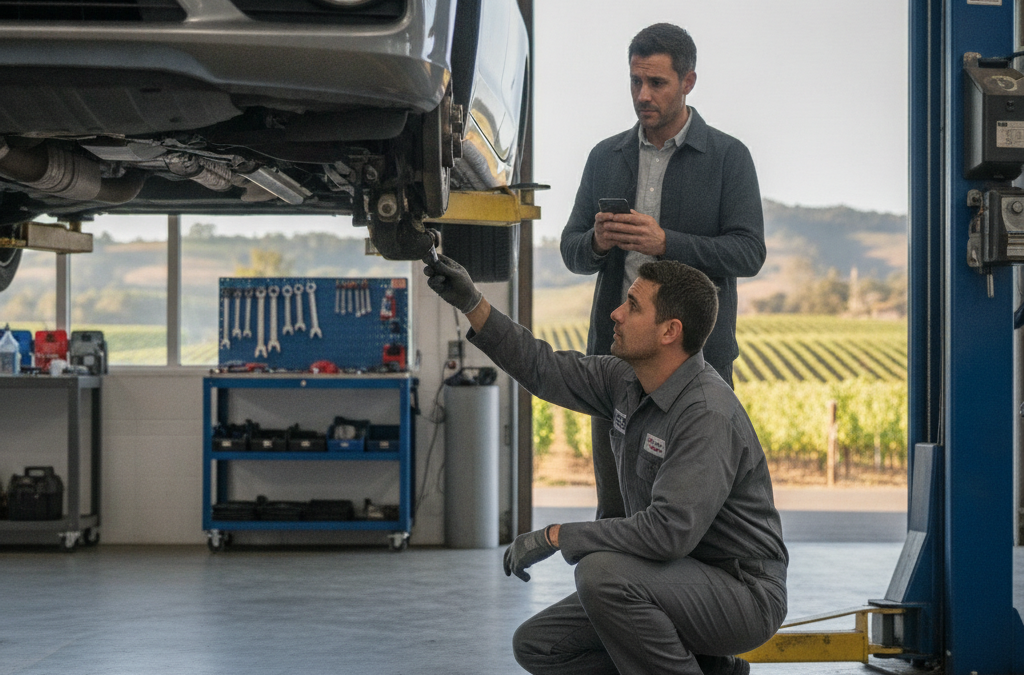
A technician checks ball joints by lifting the vehicle and physically testing for play — either with a pry bar or by rocking the wheel in specific directions. There are measurable tolerances that determine whether a ball joint is within spec or past its service life. This isn’t something an OBD-II scanner will catch, which is why it requires hands-on inspection rather than just a code read.
Replacing a ball joint typically involves removing the wheel assembly, disconnecting the joint from the steering knuckle, and pressing in a new component. On many vehicles, the ball joint is integrated into the control arm itself, meaning you replace the whole arm rather than just the joint. That affects cost, but it also means the new bushing and joint come together as a matched unit — which is usually the right call on higher-mileage vehicles anyway.
After any suspension repair, a wheel alignment is almost always necessary. The geometry has been disturbed, and you want to make sure the wheels are properly set before putting more miles on fresh components.
What Most Local Shops Don’t Tell You About Ball Joint Replacement
Here’s a detail that’s easy to overlook: not all ball joints are equal. Some aftermarket parts are priced aggressively low because they’re built to looser tolerances or use inferior materials. On a Toyota Tacoma or a Ford F-150 that hauls loads or tows regularly, a bargain ball joint may last half as long as an OEM-quality part. It’s worth asking your shop what brand they’re installing and whether the part carries a warranty.
At On-Site Auto Repair, we’ve been doing this work since 2011. We use quality parts, we don’t upsell you on repairs you don’t need, and we’ll show you exactly what we found before we do any work. If only one ball joint is bad, we’ll tell you that — we’re not going to push you into replacing all four at once if the other three are fine.
Brands We See Most Often for Suspension Work in the Healdsburg Area
We work on everything, but around the northern part of Sonoma County — Healdsburg, Windsor, Geyserville, and up toward Cloverdale — we see a lot of Ford F-150s, Chevy Silverados, Toyota Tacomas, and Subaru Outbacks. Trucks that work hard on rural roads tend to need ball joint inspection earlier than the average suburban commuter vehicle. Subarus with higher mileage can develop worn control arm bushings that create that characteristic knock over bumps. If you’re driving a vehicle with 80,000 or more miles and you’ve never had the suspension looked at, it’s worth having it checked — especially before a long drive down Highway 101.
We also service Honda CR-Vs, Jeep Wranglers, Nissan Frontiers, and everything in between. For a full picture of what we cover, take a look at our complete auto repair services.
Frequently Asked Questions
How do I know if it’s a ball joint or something else making that clunking noise?
A ball joint clunk typically happens when driving over bumps or turning slowly, and it’s often isolated to one corner of the vehicle. Sway bar end links produce a similar sound but tend to be more pronounced at lower speeds. A loose heat shield or exhaust hanger can also clunk. The only way to know for sure is to have a technician lift the car and physically check. Don’t guess on suspension components.
Is it safe to drive with a clunking suspension?
It depends on how far gone the ball joint is. A slight play with a mild clunk may give you some time, but a severely worn ball joint — especially one with a torn boot — is a genuine safety risk. If the clunking is new and getting worse, don’t delay getting it inspected. A ball joint that fails at highway speed is not a situation you want to find yourself in.
How long does ball joint replacement take?
A single ball joint on a straightforward vehicle can often be done in a couple of hours. If the control arm needs to be replaced as a unit, or if multiple components are being addressed at once, plan for more time. We’ll give you an honest estimate before we start any work.
Do I need a wheel alignment after replacing ball joints or control arms?
Yes — almost always. Suspension geometry affects your alignment angles directly. After any suspension work, we recommend an alignment check to protect your new parts and prevent premature tire wear.
What does ball joint replacement typically cost?
Costs vary significantly by vehicle make, model, and whether the ball joint is a standalone replacement or part of a control arm assembly. We don’t publish flat rates because the job isn’t the same on a Subaru Outback as it is on a Ford F-250. Contact us for a free estimate specific to your vehicle — we’ll tell you exactly what it involves and what it’ll cost before anything is touched.
Hear a Clunk Over Bumps Near Healdsburg? Let’s Take a Look
A clunking suspension isn’t just annoying — it’s your car telling you something important. Whether you’re in Healdsburg, Windsor, Cloverdale, or making the run down to Santa Rosa regularly, don’t let a fixable problem become an expensive one. We’ve been serving Sonoma County drivers since 2011, and we’re happy to give your suspension a proper inspection with no pressure and no guesswork.
Contact On-Site Auto Repair to schedule your suspension inspection or request a free estimate. We’ll tell you exactly what we find and what it’ll take to fix it — honestly, without the runaround.