Why Is My Car’s Cabin Air Filter Clogged in Sebastopol? What Wildfire Smoke and Dusty Roads Do to Your Interior Air Quality
If you’ve been driving around Sebastopol, Graton, or out toward Occidental lately and noticed that your car’s AC doesn’t feel as strong as it used to — or there’s a musty smell every time you turn the fan on — there’s a good chance your cabin air filter is overdue for a change. It’s one of the most overlooked maintenance items on any vehicle, and in Sonoma County’s West County region especially, it gets dirty a lot faster than the manufacturer’s schedule might suggest.
This isn’t a big, expensive repair. But ignoring it long enough can affect your AC system’s performance, your blower motor, and — more importantly right now — the quality of the air you and your family are breathing every time you get in the car.
What Does a Cabin Air Filter Actually Do?
Your cabin air filter sits inside the ventilation system — usually behind the glove box or under the dashboard — and it filters everything that gets pulled into your car’s interior through the HVAC system. That means pollen, dust, mold spores, exhaust fumes, and yes, wildfire smoke particles.
When the filter gets clogged, a few things happen. Airflow to your vents drops. Your blower motor has to work harder to push air through the blocked filter. In cold weather, your windshield may start fogging up more than usual because moisture can’t circulate properly. And in wildfire smoke conditions — which Sonoma County drivers have unfortunately dealt with year after year — a saturated filter stops protecting you and just recirculates whatever made it through.
Most manufacturers recommend replacing your cabin air filter every 15,000 to 25,000 miles or once a year. But that’s under normal conditions. If you live out along the Bodega Highway corridor, drive gravel roads near Forestville or Occidental, or you were driving during any significant smoke event in the last few years, that interval should be cut in half — or shorter.
Why Wildfire Smoke Is Especially Hard on Cabin Air Filters in Sonoma County
Wildfire smoke isn’t like normal road dust. The fine particulate matter in smoke — referred to as PM2.5 — is tiny enough to penetrate deep into filter media and saturate it in a way that regular dust doesn’t. A filter that looks relatively clean on the outside might be completely compromised in the middle layers where the fine particles have built up.
During and after significant smoke events, cabin air filters can go from perfectly serviceable to functionally useless within days of heavy exposure. If you were driving during AQI red or purple days in the past couple of seasons, your filter absorbed a lot — even if you were running your AC on recirculate mode, which many people don’t know to do.
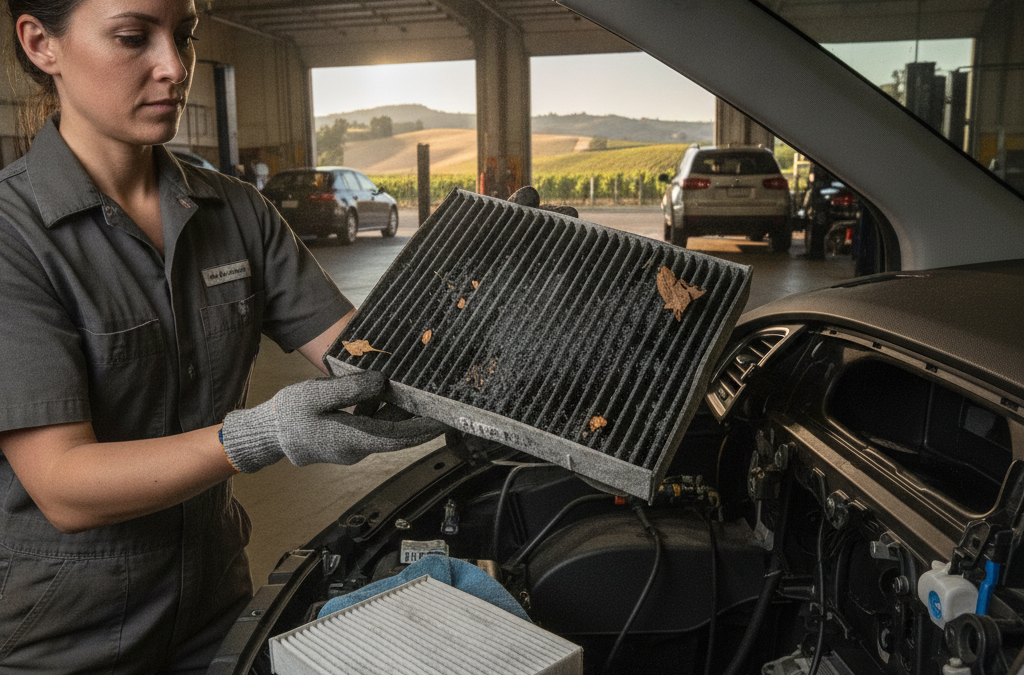
The same goes for ash fallout after a fire. Ash particles are coarser and can clog filter media quickly, especially if you were driving while ash was actively falling. We’ve pulled filters from vehicles in this area that looked like someone had packed them with gray wool — from owners who had no idea how bad it had gotten.
If you drive in or around Santa Rosa, Rohnert Park, or anywhere in the Russian River Valley corridor and you haven’t replaced your cabin air filter since your last significant smoke season, it’s worth having it checked. Your AC and heating system will work better for it, and so will your lungs.
Dusty West County Roads Make It Worse
Even in years with minimal wildfire activity, the roads out toward Graton, Guerneville, and Occidental generate plenty of fine dust — especially in late summer when the ground is bone dry and vineyard traffic kicks up a layer of grit on every back road. If you’re commuting daily on unpaved or chip-seal roads, you’re pulling that dust through your ventilation system constantly.
This is something the generic manufacturer schedule doesn’t account for. A Honda owner in San Jose who commutes on clean freeways might genuinely get two years out of a cabin filter. A Honda owner doing the same mileage on rural Sonoma County backroads is a different story entirely.
Signs Your Cabin Air Filter Needs to Be Replaced
- Weak airflow from vents even at higher fan speeds
- Musty or stale smell when the AC or heat first kicks on
- Increased windshield fogging, especially in cool morning commutes
- Visible debris, mold growth, or heavy discoloration when the filter is pulled
- Allergy or sinus symptoms that seem worse when you’re inside your vehicle
- A dusty or smoky odor that lingers inside the cabin even with windows closed
Some of these symptoms — particularly the musty smell — can be confused with an AC evaporator issue. But a clogged filter is usually the simpler and less expensive fix, and it’s always worth ruling out first. If replacing the filter doesn’t resolve the smell, then it’s time to look at the evaporator or drain lines.
What Type of Cabin Filter Should You Get?
There are two main types: standard particulate filters and activated carbon (charcoal) filters. Standard filters catch dust, pollen, and larger particles. Activated carbon filters do all of that plus absorb odors and gaseous pollutants — including some of the chemical compounds in wildfire smoke.
For Sonoma County drivers who deal with fire season, pollen from Wine Country agriculture, and dust from rural roads, an activated carbon filter is worth the modest extra cost. It’s typically a $10–$20 difference at the part level, and it makes a noticeable difference if you have any sensitivity to smoke or airborne irritants.
We can check which filter fits your specific vehicle and make sure it’s installed correctly — some vehicles have filter housings that are awkward to access, and an improperly seated filter is almost as bad as no filter at all.
This Is One of the Most Skipped Items in Preventive Maintenance
If you look at the competitor shops around Sonoma County, almost none of them have a meaningful, detailed explanation of cabin air filter service on their websites — especially anything that accounts for local conditions like wildfire smoke or rural road dust. Most treat it as a footnote on a checklist, if they mention it at all.
But it matters. Especially here. It’s a low-cost service that protects a much more expensive system (your blower motor, your evaporator, your HVAC system overall) and directly affects what you’re breathing every day in your vehicle. As part of routine preventive maintenance, it should be checked every time your vehicle is in the shop — not just at oil changes, but especially after any significant smoke event or prolonged exposure to dusty conditions.
We’ve been doing this work throughout Sonoma County since 2011, and cabin air filters are one of those things we always check because we know what conditions are like out here. We’ll show you the filter before and after, explain what we found, and let you decide. No pressure, no upselling — just honest information.
Frequently Asked Questions
How much does a cabin air filter replacement cost?
Typically it’s a modest, affordable service — usually under $50–$80 depending on the vehicle and filter type. Some vehicles have more labor-intensive access points, but most are straightforward. We’ll always give you an honest estimate before doing anything.
Can I replace my cabin air filter myself?
On many vehicles, yes — it’s accessible behind the glove box and doesn’t require tools. But it’s worth having a shop check it if you’re not sure where the housing is, or if you want to confirm the right filter type. Incorrect installation (even just inserting it backwards) defeats the purpose.
How do I know if smoke damage to my filter is affecting my health?
If you notice sinus irritation, coughing, or allergy-like symptoms that ease when you step out of your vehicle, a saturated filter is a likely contributor. It’s not a guaranteed cause, but it’s always one of the first things to rule out.
Does running AC on recirculate during a fire protect me?
It helps significantly — recirculate mode pulls air from inside the cabin rather than outside, which limits exposure to outdoor smoke. But your cabin filter still matters, and it will still get loaded over time even on recirculate. After any significant smoke event, get the filter inspected.
How often should Sebastopol or West County drivers replace their cabin filter?
In this area, we recommend every 12 months or 10,000–12,000 miles — whichever comes first — and immediately following any major smoke event where you were driving regularly. Don’t go by the standard schedule alone; local conditions here are harder on filters than the national averages assume.
Ready to Get Your Cabin Air Quality Checked?
If you can’t remember the last time your cabin air filter was replaced — or if you’ve been through any fire season in Sonoma County without replacing it since — it’s time to get it looked at. We serve drivers throughout Sebastopol, Forestville, Graton, Guerneville, Occidental, and the greater Santa Rosa area, and we’re happy to check your filter as part of any service visit.
Reach out to On Site Auto Repair to schedule a time or ask a question. We’ll take a look, tell you what we find, and give you a straight answer — no pressure, no upsell. Just honest local service from people who actually know what driving out here is like.