
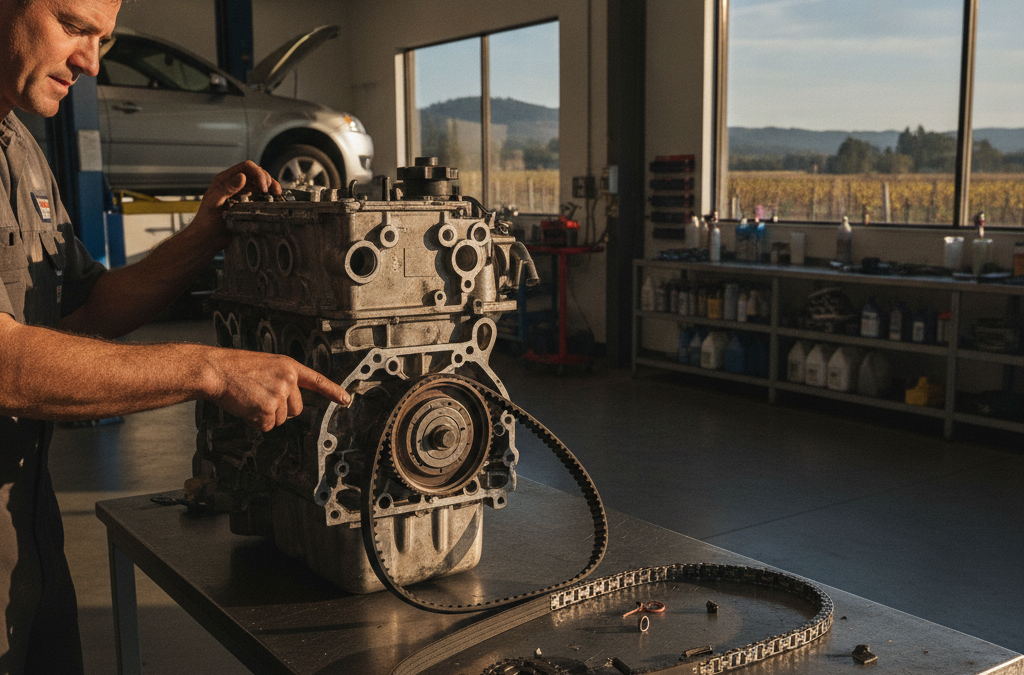
Why Is My Car’s Timing Belt or Chain Failing in Healdsburg? What Sonoma County Drivers Need to Know
If your car suddenly sounds different — a faint ticking at idle, a rattling on startup, or a rough stumble when you accelerate — there’s a chance your timing belt or timing chain is trying to get your attention. For drivers in Healdsburg, Windsor, and throughout Sonoma County, this is one repair you don’t want to ignore. A timing belt or chain failure doesn’t usually give you a second chance. On many engines, when it goes, the engine goes with it.
At On Site Auto Repair in Santa Rosa, we’ve seen firsthand what happens when this service gets skipped — bent valves, damaged pistons, engine replacements that could have been avoided entirely. The good news is that with the right information, you can catch this problem before it turns catastrophic.
What Does a Timing Belt or Timing Chain Actually Do?
Your engine runs on precise timing. The crankshaft (which drives the pistons up and down) has to stay perfectly synchronized with the camshaft (which opens and closes the valves). The timing belt or chain is what keeps those two in sync. If it slips, stretches, or snaps, that synchronization breaks down — and on what’s called an interference engine, the pistons and valves will physically collide. That collision causes serious, often irreparable internal damage.
Non-interference engines are more forgiving — if the belt breaks, the engine simply stops. But interference engines — which include most modern Honda, Toyota, Subaru, Volkswagen, and Ford models — don’t give you that grace. The damage happens instantly.
Timing Belt vs. Timing Chain: What’s the Difference?
These two components do the same job, but they’re built differently and wear differently.
- Timing belts are made of reinforced rubber. They’re quieter and cheaper to manufacture, but they degrade over time regardless of mileage. Most manufacturers recommend replacing them between 60,000 and 105,000 miles — or every 7 to 10 years, whichever comes first. The rubber breaks down from heat and age even if the belt looks fine from the outside.
- Timing chains are metal and are generally designed to last the life of the engine. But they stretch over time, especially if oil changes are skipped. A stretched chain rattles — often most noticeably on cold startup — and can jump timing before it snaps entirely.
If you’re not sure which one your vehicle has, your owner’s manual will tell you — or just ask us. It’s one of the first things we check during a preventive maintenance inspection.
Warning Signs Your Timing Belt or Chain Is in Trouble
This is the section most competitor shops don’t go into enough detail on — and it’s exactly where drivers get left in the dark. Here’s what to watch and listen for:
- Ticking or rattling noise on startup: If you hear a metallic ticking or chain-slap sound when you first start the car — especially in cold weather — that’s a classic timing chain stretch symptom. It may go away after the engine warms up and oil pressure builds, which tricks a lot of drivers into thinking it’s fine. It’s not.
- Rough idle or misfires: If the timing is even slightly off, the engine’s combustion cycle gets out of order. You might feel the engine stumbling at idle or hesitating under load, especially on the on-ramps heading out of Healdsburg toward Windsor on Highway 101.
- Engine won’t start: A snapped timing belt often causes the engine to crank but not fire. If your engine cranks normally but refuses to start and you haven’t had the belt replaced recently, this is worth investigating immediately.
- Check engine light with timing-related codes: Codes like P0016 or P0017 (camshaft and crankshaft correlation errors) point directly at timing issues. These are not codes to clear and ignore.
- Visible belt wear (if accessible): On some vehicles, you can see the timing belt through an inspection port or cover. Cracking, fraying, or glazing are clear signs it needs to go.
- Oil leaks near the front of the engine: If you have a timing belt, it’s housed in a sealed cover. Leaking oil from the crankshaft or camshaft seals near the cover can contaminate and quickly destroy a timing belt.
Why Sonoma County Driving Conditions Matter Here
You might wonder why we’re singling out Healdsburg and the surrounding area specifically. It comes down to how people drive around here.
Commuters running down Highway 101 from Healdsburg or Windsor to jobs in Santa Rosa, Rohnert Park, or even Petaluma put consistent highway miles on their vehicles. That kind of steady-state driving is actually fine for most components — but it also means those cars rack up mileage quickly. A vehicle that does 20,000 miles a year can hit a 90,000-mile timing belt replacement interval in under five years. If you bought a used car and don’t know its service history, you may already be past due.
Our hot, dry Sonoma County summers also accelerate rubber degradation. Timing belts sitting in an engine bay that regularly hits triple digits in August don’t age the same as belts in a milder climate. This is especially true if the vehicle sits outside — which is most vehicles in Wine Country. If you’re adding the age-based interval to your calculation (and you should be), the heat here makes that factor even more important.
Which Vehicles Have the Highest Timing Belt Risk?
Certain makes and models come up in our shop consistently when it comes to timing belt and chain services:
- Honda and Acura: Many older Accord, Odyssey, and Pilot models use timing belts. The 4-cylinder engines switched to chains, but the V6s used belts into the mid-2010s.
- Toyota and Lexus: Most modern Toyotas use timing chains, but older 4Runners, Tacomas, and Camrys (pre-2007 V6) used belts. The 1MZ-FE V6 is a common one we see past due.
- Subaru: The EJ-series engines (Outback, Forester, Legacy, Impreza up through the mid-2010s) use timing belts. These are interference engines. Skipping this service on a Subaru is a serious gamble.
- Volkswagen and Audi: Some VW TDI and TSI engines use timing belts and have relatively short replacement intervals — some as low as 40,000 miles. German vehicles are less forgiving when this gets deferred.
- Ford Powerstrokes and older V8s: Timing chains, but stretch-related issues are common when oil changes are skipped.
If you drive any of these vehicles and aren’t sure when the timing belt was last replaced, that’s worth finding out sooner rather than later. Our auto diagnostic service includes a thorough inspection that covers exactly this kind of service history gap.
What Does a Timing Belt Replacement Actually Involve?
This is a labor-intensive job on most vehicles. The front of the engine has to come apart — accessories, covers, sometimes the water pump and tensioners. Because the water pump and belt tensioner are right there and typically due for replacement on the same schedule, most shops (including us) recommend doing all of it at once. That way you’re not paying for the same labor a second time two years later when a tensioner pulley fails.
The job typically takes several hours. It’s not a quick oil-change kind of visit, and any shop quoting you a suspiciously low price may be cutting corners on the tensioners, idler pulleys, or water pump — components that will take down a brand-new belt if they fail first.
We’ll always give you a clear, honest estimate before we start. No surprise charges, no pressure to add things you don’t need.
Frequently Asked Questions
How do I know if my car has a timing belt or timing chain?
The quickest way is to check your owner’s manual under the maintenance schedule. If there’s a listed replacement interval for a “timing belt,” you have one. If there’s no interval listed, you likely have a chain. You can also call us — we can look it up by your year, make, and model in about 30 seconds.
Can I drive with a failing timing chain or belt?
For a short while, maybe — but this is genuinely one of those repairs where waiting is a very bad gamble. If the belt or chain snaps while you’re driving, you could be looking at a tow, a complete engine teardown, and potentially an engine replacement. That’s a $4,000–$10,000+ outcome that a timely belt replacement could have prevented for a fraction of the cost.
My car has 85,000 miles and I bought it used. Should I assume the belt was done?
Never assume. We see cars every week at 90,000+ miles where there’s no record of the timing belt being replaced. If you can’t produce a receipt, treat it as overdue and budget accordingly. The peace of mind is worth it.
Does On Site Auto Repair handle timing belt service on all makes and models?
Yes. We work on domestic and foreign vehicles including Honda, Toyota, Subaru, Volkswagen, Ford, Chevrolet, Nissan, Hyundai, Kia, Mazda, and many others. If you’re not sure whether your vehicle is due, bring it in and we’ll take a look — no charge for the conversation.
Is a timing chain really maintenance-free?
Mostly — but not entirely. Timing chains depend on clean, properly pressurized oil to stay lubricated. If you run low on oil or go too long between changes, the chain stretches faster and the guide rails wear. Staying current on oil changes is genuinely the best thing you can do for a timing chain engine.
Don’t Wait Until You’re Stranded
Whether you’re commuting from Windsor into Santa Rosa, running errands around Healdsburg, or heading down to Rohnert Park for the week, a timing belt or chain failure doesn’t pick a convenient moment. It happens at speed on the freeway, or in a parking lot, or — worst case — on a remote Sonoma County backroad on your way to a winery.
The best move is a simple one: know your vehicle’s interval, check your service records, and if there’s any doubt, let a trusted local shop take a look. We’ve been helping Sonoma County drivers with exactly this kind of preventive work since 2011. We’ll tell you honestly what we find and what we recommend — nothing more, nothing less.
Contact On Site Auto Repair today to schedule an inspection or get a free estimate on timing belt or chain service. We’re based in Santa Rosa and serve drivers throughout Healdsburg, Windsor, and all of Sonoma County.