Why Is My Car Pulling to One Side on Highway 101 Near Cotati? What Uneven Tire Wear and Alignment Problems Actually Mean
If you’re driving the Highway 101 corridor between Cotati and Santa Rosa and you feel your car quietly drifting toward one lane — or you have to keep nudging the steering wheel to hold a straight line — that’s your car telling you something is off. Most of the time, what you’re feeling is a wheel alignment problem, uneven tire wear, or both working against each other at once. Neither one fixes itself, and both get worse the longer you let them go. Here’s what’s actually happening and what you should do about it.
What Does It Mean When a Car Pulls to One Side?
A vehicle that tracks straight on its own — hands barely on the wheel — is properly aligned. When something is pulling you left or right, one or more of your wheels isn’t pointed the same direction as the others. That misalignment creates drag. Your tires are fighting each other, and you’re fighting your car. It’s tiring to drive, it chews through your tires faster than they should wear, and it can actually put more stress on your steering components over time.
The most common causes of a pull include:
- Wheel alignment that’s out of spec — usually after hitting a pothole, curb, or road debris
- Uneven tire pressure — a tire that’s lower on one side creates drag in that direction
- Uneven or cupped tire wear — tires that have worn unevenly will pull even if alignment is corrected
- A sticking brake caliper — this causes a harder pull, especially under braking
- Worn suspension components — ball joints, control arm bushings, or tie rod ends that have worn down can throw alignment off and hold it there
Some of these are quick fixes. Others mean something more substantial is going on underneath your vehicle. That’s why it’s worth having a proper inspection rather than just checking the tire pressure and hoping for the best.
Why Sonoma County Roads Are Especially Hard on Alignment
Highway 101 between Petaluma, Cotati, Rohnert Park, and Santa Rosa gets a lot of traffic — daily commuters heading to the Bay Area, delivery trucks, wine country visitors, and everyone in between. The heavy use takes a toll on road surfaces, and if you’ve driven those stretches regularly, you know the lanes aren’t always smooth. Expansion joints, patched asphalt, and occasional debris from the shoulder are all alignment enemies.
Off the freeway, it gets even rougher. Drivers coming from Sebastopol, Forestville, or up toward Windsor deal with rural road surfaces that can be inconsistent, especially after a wet winter where freeze-thaw cycles crack the pavement. Even around Santa Rosa’s neighborhoods — Rincon Valley, Fountaingrove, Bennett Valley — there are enough hills and dips to stress your suspension regularly. If you’ve gone off a speed bump a little too fast or dropped a wheel into a pothole you didn’t see, there’s a good chance something moved that shouldn’t have.
What Uneven Tire Wear Is Actually Telling You
Here’s the part most drivers miss: your tires are a record of everything that’s happened to your alignment and suspension over time. If you crouch down and look at your tires from the front of the vehicle, you should see relatively even wear across the full width of each tire. If one edge is significantly more worn than the other, something is out of alignment — or was, for a long time before you noticed.
Common wear patterns and what they signal:
- Feathering or scalloping — the tire tread looks rounded on one side and sharp on the other, usually caused by a toe alignment problem
- Inner or outer edge wear — one edge of the tire is worn much faster than the center, often a sign of camber (tilt angle) being off
- Cupping or dipping — patches worn unevenly around the tire’s circumference, usually a sign of worn shocks or struts allowing the tire to bounce rather than stay firmly on the road
- Center wear — the center tread is more worn than the edges, almost always caused by consistently over-inflated tires
The tricky thing is that once tires have worn unevenly, replacing the alignment alone doesn’t undo the damage. The tires themselves may need to be rotated — or in worse cases, replaced — before the car tracks straight again. That’s why catching this early matters. Regular tire rotations help even out wear patterns before they become a problem you can’t reverse.
The Alignment-Suspension Connection Most Shops Don’t Explain Well
This is the part we see a lot of competitor shops gloss over: alignment and suspension are not separate conversations. They’re the same conversation.
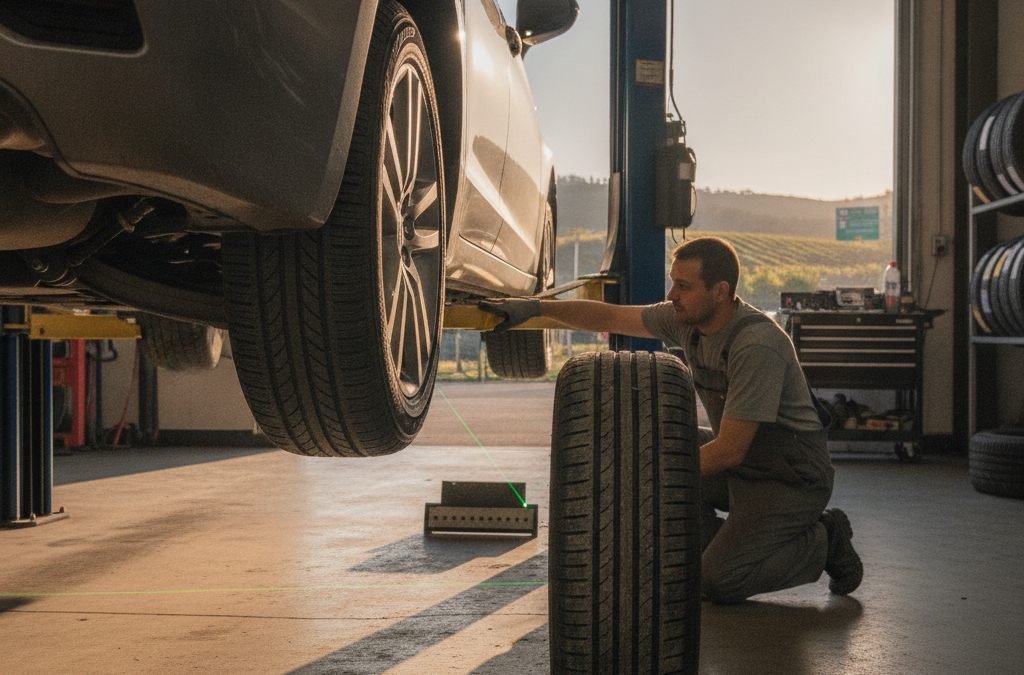
When we check alignment here at On Site Auto Repair, we’re not just plugging your car into a machine and printing numbers. We’re also looking at the components that hold the alignment in place — tie rod ends, control arm bushings, ball joints, sway bar links. If any of those are worn, we can adjust the alignment all we want and it won’t stay. The car will drift back out of spec within a few hundred miles because the worn part isn’t holding its position consistently.
This is especially relevant if you drive a vehicle with some age on it. A lot of Sonoma County drivers are putting real miles on their vehicles — Subarus, Hondas, Toyotas, older Ford trucks, higher-mileage Nissans — and the suspension components that were new at 60,000 miles aren’t the same at 120,000. If your car has been pulling for a while and you’ve had the alignment “fixed” before without improvement, worn suspension parts are the likely reason it didn’t stick.
Our steering and suspension service includes a full inspection of these components before we ever touch the alignment specs — because doing it any other way is just spinning your wheels.
When a Sticking Brake Caliper Is the Real Culprit
There’s one cause of pulling that gets confused with alignment fairly often, and it’s worth calling out separately: a sticking brake caliper. If the pull is happening specifically when you apply the brakes — the car lurches or pulls hard in one direction as you slow down — that’s not alignment. That’s a brake problem. A caliper that isn’t releasing properly stays partially engaged on one side, which creates drag and uneven braking force.
You might also notice that one corner of the car smells hot after driving, or that the vehicle pulls during braking but not when cruising. Those are strong signals to get the brakes inspected before assuming the tires are the problem. Ignoring a sticking caliper isn’t just an alignment issue — it’s a safety issue.
How to Check If Your Alignment Is Off Right Now
You don’t need any tools for this. Find a flat, empty stretch of road — a quiet parking lot works well. Drive straight at a low speed and briefly take your hands off the wheel. If the car tracks straight, alignment is probably close. If it drifts noticeably left or right within a few seconds, something is pulling.
Also check your tires visually. Run your hand across the tread of each front tire. Does it feel the same from one side to the other? Does the outer edge feel sharper than the inner, or vice versa? Any obvious difference in texture from one side to the other is worth investigating.
Frequently Asked Questions
How often should I get a wheel alignment in Sonoma County?
Most mechanics recommend checking alignment every 12,000–15,000 miles, or once a year. If you drive a lot of rural roads around Sebastopol, Windsor, or along the 101 corridor, more frequently is smarter. Also check it any time you hit something hard enough to rattle the car — a pothole, a curb, a speed bump too fast.
Can I drive with a car that’s pulling to one side?
Technically yes, but it accelerates tire wear significantly, puts strain on your steering components, and makes the car less stable in an emergency situation. It’s not a fix-it-tomorrow kind of thing — especially if you’re doing regular highway miles between Cotati, Rohnert Park, and Santa Rosa.
Does a wheel alignment fix uneven tire wear?
Alignment corrects the cause going forward, but it doesn’t reverse wear that’s already happened. Depending on how badly worn the tires are, you may need a rotation — or new tires — in addition to the alignment to get the car tracking straight again.
What’s the difference between a two-wheel and four-wheel alignment?
A two-wheel (front-end) alignment only adjusts the front axle. A four-wheel alignment sets all four wheels to the correct angles relative to each other and to the vehicle’s centerline. Most modern vehicles benefit from a four-wheel alignment — especially all-wheel-drive vehicles like Subarus and Audis where all four wheels affect handling.
My car just started pulling after I hit a pothole near Petaluma. Is that an emergency?
Not an emergency in the pull-over-right-now sense, but don’t wait weeks either. A hard impact can knock alignment out immediately and sometimes bend or crack a control arm or tie rod. Have it inspected soon — both for alignment and to make sure nothing structural was damaged.
Get It Checked Before It Gets Expensive
Alignment and tire wear problems are the kind of thing that snowballs. A $100 alignment check ignored for six months can turn into $600 worth of tires worn unevenly and suspension parts that needed replacement because the alignment was never corrected. We’ve seen it plenty of times since we opened in 2011.
At On Site Auto Repair in Santa Rosa, we check your alignment and inspect your suspension components honestly — no upselling, no invented problems. If your car is pulling and you want a straight answer about why, reach out to us and we’ll get you in for an inspection. We serve drivers from Cotati, Rohnert Park, Petaluma, Windsor, Sebastopol, and all across Sonoma County, and we’re happy to talk through what you’re experiencing before you even book an appointment.