Why Are My Brakes Squealing in Santa Rosa? What It Means and When to Get It Fixed
That sharp, high-pitched squeal every time you tap the brakes is hard to ignore — and it shouldn’t be. In Santa Rosa and the surrounding hills of Sonoma County, your brakes work harder than most drivers realize. Neighborhoods like Fountaingrove, Bennett Valley, and Oakmont put constant downhill pressure on your braking system, and if you’re doing a daily Highway 101 run down to Marin County or the Bay Area, you’re adding even more miles of stop-and-go wear on top of that. So when your brakes start screaming at you, there’s usually a real reason.
The good news: most brake noise has a clear explanation, and catching it early almost always saves you money compared to waiting until something grinds or fails. Here’s what the squeal likely means, what other warning signs to watch for, and what you should expect from a straightforward brake inspection.
What’s Actually Causing That Squealing Sound?
The most common cause of brake squeal is a wear indicator — a small metal tab built into your brake pad specifically designed to make noise when your pads are getting thin. Manufacturers put it there on purpose. It’s not a malfunction; it’s a warning system. When you hear that high-pitched squeal and it goes away after the first few stops in the morning but comes back later, that’s usually the indicator doing its job.
Other common causes include:
- Glazed rotors or pads — When brakes get overheated (hello, Fountaingrove downhills), the rotor surface can harden and become smooth, causing a squealing or light grinding sound even with decent pad thickness remaining.
- Dust and debris — After sitting overnight, a thin layer of surface rust can form on rotors. This usually makes a brief scraping noise for the first stop or two and then clears up. If it clears quickly, it’s normal. If it sticks around, keep paying attention.
- Cheap or mismatched brake pads — Some aftermarket pads are formulated in ways that cause noise, especially semi-metallic pads on rotors they weren’t matched to. This is worth asking about if your brakes were recently replaced elsewhere.
- Missing or worn hardware — Brake caliper hardware (shims, clips, and slides) keeps everything seated properly. When that hardware wears or goes missing, you get vibration and noise.
- Low brake fluid — This won’t directly cause squealing, but it’s often found alongside other brake wear issues and can affect pedal feel.
Squealing vs. Grinding: Why the Difference Matters
Squealing means you’re probably still in the warning zone — your pads may be low but there’s likely still time to handle it before damage spreads. Grinding is a different story. If you’re hearing a deep metallic grinding or growling when you brake, that usually means the pad material is gone and you’re now making metal-to-metal contact between the caliper and rotor. At that point, the rotor itself may need replacement, which adds to the repair cost significantly.
The simple version: squealing = get it checked soon. Grinding = get it looked at now.
Why Santa Rosa Drivers Wear Through Brakes Faster Than Average
Brake wear isn’t just about miles. Driving style and terrain play a huge role. If you live in Bennett Valley or Oakmont and you’re doing a hilly commute every day, your brakes are under load even when you’re not technically “stopping hard.” Gentle, sustained braking on long descents actually generates more heat over time than a few firm stops on flat ground.
Add in the Highway 101 commuter traffic between Santa Rosa and Petaluma or Rohnert Park, where you’re braking constantly in stop-and-go conditions, and it’s not unusual to see brake pads wear out noticeably faster than the mileage estimates on the box suggest. We’ve seen pads on vehicles driven primarily in Sonoma County hill communities wear down to the indicator in under 20,000 miles on the front axle.
Heavier vehicles — SUVs, trucks, and crossovers — also burn through front brake pads faster because more weight transfers to the front under braking. If you’re driving a Ford F-150 or a Chevy Tahoe and doing any amount of hilly driving, checking your brakes at every oil change interval is smart practice.
What a Brake Inspection Should Actually Include
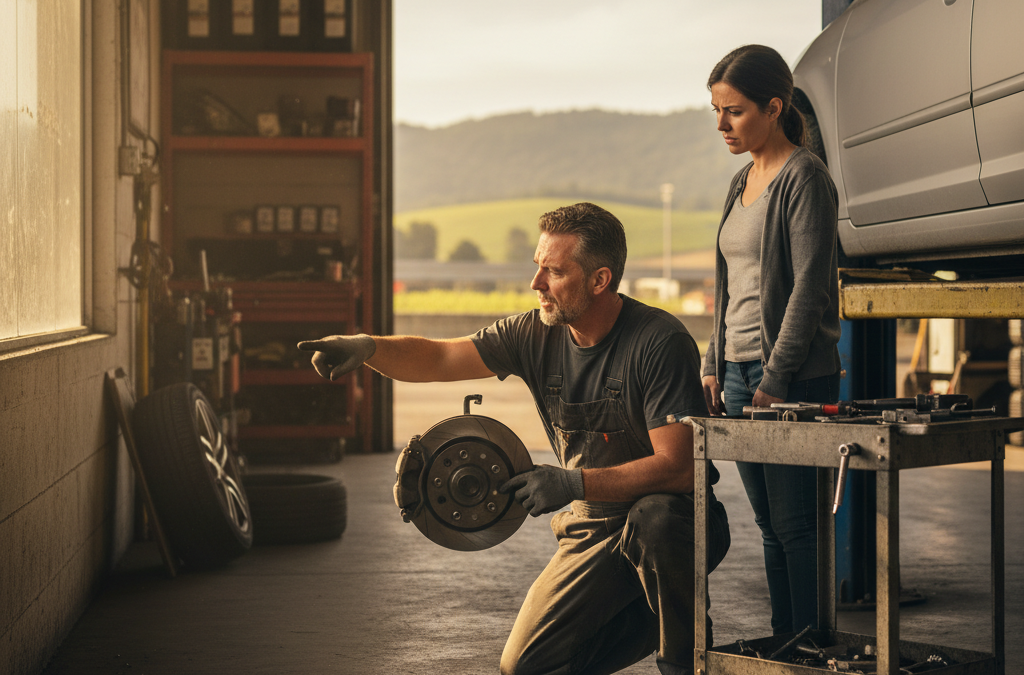
One thing that frustrates us about how brake service gets sold around Sonoma County is the vagueness. You bring your car in for squealing brakes and you get a quote for “pads and rotors” with no real explanation of what was found or why. That’s not good enough.
A proper brake inspection should tell you:
- Remaining pad thickness (in millimeters, front and rear separately)
- Rotor thickness compared to the manufacturer’s minimum spec
- Whether the rotors show heat damage, scoring, or warping
- Caliper condition — are the slides moving freely? Is anything seized?
- Brake fluid condition — old, moisture-contaminated fluid lowers the boiling point and affects braking performance
- Hardware condition — shims, clips, and anti-squeal components
At On Site Auto Repair, we give you the actual numbers and explain what they mean. If your pads have 4mm left and the rotors are still above spec, we’ll tell you that — and let you decide whether to do the work now or wait a few months. We’re not going to push you into replacing parts that don’t need replacing. Learn more about our brake repair and inspection services here.
Pad Type Matters — Especially for Hilly Driving
Not all brake pads are the same, and the type that’s right for your car depends on how you drive. There are three main categories:
- Ceramic pads are quieter, produce less dust, and handle heat well — a solid choice for most daily drivers in Santa Rosa, especially if noise is a concern or you’re driving a luxury vehicle like a Lexus or Acura.
- Semi-metallic pads offer stronger stopping power and are better suited for heavier loads — good for trucks, SUVs, or anyone who does regular hilly driving. They can run noisier than ceramic, but they handle heat better under sustained load.
- Low-metallic organic pads are softer and quieter, but they wear faster and aren’t the best fit for Sonoma County’s hilly terrain or high-mileage commuters.
If a shop just hands you “pads” without discussing the compound, it’s worth asking which type they’re installing and why.
Don’t Forget Brake Fluid
This is one of the most overlooked parts of brake maintenance. Brake fluid is hygroscopic — meaning it absorbs moisture from the air over time. As water content increases, the boiling point of the fluid drops. Under hard braking on a long downhill stretch (think the grade coming down from Fountaingrove toward downtown Santa Rosa), this can contribute to a spongy pedal or, in extreme cases, brake fade.
Most manufacturers recommend replacing brake fluid every 2–3 years or around 30,000 miles, whichever comes first. A quick test strip during your inspection can tell you whether the fluid is still within spec. It’s inexpensive to replace and makes a real difference in braking consistency.
Brakes on Specific Makes: A Few Things Worth Knowing
Different vehicles have different brake system quirks that are worth knowing:
- Subaru models (very common in Sebastopol and West County) tend to wear rear pads faster than front pads due to their brake bias settings — opposite of most vehicles. It’s worth checking rear pad thickness specifically.
- Toyota Prius and hybrid vehicles use regenerative braking, which means the friction brakes get used less — but the pads and rotors can actually develop corrosion from sitting unused. Occasional inspection is still important.
- Jeep Wranglers and 4WD trucks used on rural roads out toward Windsor or Healdsburg often pick up debris in the braking components. A thorough clean and inspection after off-road use is worth it.
- European vehicles (VW, Mercedes, BMW) often use softer pad compounds from the factory that perform well but wear faster and create more brake dust. If your rims are always coated in black dust, that’s likely what’s going on.
If you’re not sure what applies to your specific vehicle, bring it in and we’ll walk you through it. We work on all makes and models — foreign and domestic — and have since 2011. Our preventive maintenance services include brake checks as part of regular vehicle health assessments.
Frequently Asked Questions About Squealing Brakes in Santa Rosa
Is it safe to drive with squealing brakes?
Squealing alone — without grinding, pulling to one side, or a soft pedal — usually means you have a little time, but don’t push it. Driving more than a week or two on pads that are hitting the wear indicator risks scoring your rotors, which turns a pad replacement into a rotor replacement too. Get it checked within the next few days.
Why do my brakes squeal only in the morning?
That’s usually surface rust forming on the rotors overnight — especially common in Santa Rosa’s cool, damp winters or after a rainy stretch. If the noise clears up after the first stop or two and doesn’t come back, it’s generally not a concern. If it keeps happening throughout your drive, have the pads and rotors inspected.
How much does a brake job cost in Santa Rosa?
It varies based on your vehicle, what’s actually worn, and what parts are needed. A front axle pad replacement on a typical sedan or crossover is considerably less expensive than a full four-wheel pad and rotor replacement on a larger SUV or truck. We give honest, upfront estimates with no pressure — contact us and we’ll tell you what your vehicle actually needs.
Can I just replace the pads and skip the rotors?
Sometimes, yes. If your rotors are still above minimum thickness and don’t show warping, scoring, or heat damage, new pads on clean rotors can work fine. We’ll measure and tell you honestly. Resurfacing (also called turning) rotors used to be standard practice, but many modern rotors come from the factory thin enough that replacement makes more sense than resurfacing. We’ll give you the actual rotor thickness measurement so you can make an informed call.
Do you service brakes on electric vehicles and hybrids?
Yes. Hybrids and EVs use regenerative braking differently, but they still have conventional friction brakes that wear and need service. The inspection process is the same — we check pad thickness, rotor condition, hardware, and fluid just like any other vehicle.
Ready to Get Your Brakes Checked?
If your brakes are squealing — or if you just can’t remember the last time they were inspected — don’t wait until the grinding starts. On Site Auto Repair is based in Santa Rosa and serves drivers throughout Sonoma County, from Rohnert Park and Petaluma up through Windsor and Sebastopol. We give you a straight answer, real measurements, and an honest estimate with no pressure.
Contact us today to schedule a brake inspection or request a free estimate. We treat your car like it’s our own — because that’s the only way we know how to do this job.