Why Is My Car’s Starter or Ignition System Failing in Windsor? What Sonoma County Drivers Need to Know About No-Start Problems
You walk out to your car in Windsor on a Tuesday morning, turn the key — or press the start button — and get nothing. Maybe a click. Maybe a grinding sound. Maybe just silence. It’s one of the most frustrating things that can happen to a driver, especially if you’ve got a commute down Highway 101 to get to, or kids to drop off at school. The good news is that a no-start problem usually comes down to one of a handful of causes — and a starter motor or ignition system issue is near the top of that list.
At On-Site Auto Repair in Santa Rosa, we’ve been diagnosing and fixing no-start problems for drivers across Sonoma County since 2011. Here’s what you need to know so you’re not left guessing at the side of the road.
What Does the Starter Motor Actually Do?
Your starter is an electric motor — usually bolted to the side of the engine — that physically cranks the engine to get it going. When you turn the ignition key or push the start button, an electrical signal flows from the ignition switch to a component called the starter solenoid, which then engages the starter motor. The motor turns a gear (called the pinion gear) that meshes with your engine’s flywheel or flexplate and spins the engine until it fires on its own.
It all happens in about half a second. When it works, you don’t think twice about it. When it doesn’t, you’re stuck.
Warning Signs Your Starter Is Going Bad
Starters rarely fail without warning — they usually give you some hints first. The problem is that most drivers don’t recognize those hints for what they are. Here’s what to watch and listen for:
- A single loud click or series of rapid clicks when you turn the key — One click often points to the starter solenoid. Rapid clicking usually suggests a weak battery, but a failing starter can produce the same symptom.
- Slow or sluggish cranking — The engine turns over, but it sounds labored and slow, like it’s struggling to get going. That’s a classic sign of a starter that’s drawing more current than it should because internal components are worn.
- Grinding noise when starting — A grinding sound usually means the starter’s pinion gear isn’t engaging the flywheel cleanly. If you ignore this, it can damage the flywheel — an expensive fix.
- Intermittent starting problems — Sometimes it starts fine, other times nothing happens. You might have to try two or three times before it catches. This on-again, off-again behavior is a common sign of a failing starter solenoid or worn brushes inside the motor.
- Smoke or burning smell near the engine — Rare, but it happens when a starter motor overheats or sticks in the engaged position. If you smell burning and your engine is running, turn it off and call for help.
Is It the Starter — or Something Else?
This is where proper diagnosis really matters. A lot of no-start problems get misdiagnosed, and drivers end up replacing parts that weren’t the real cause. Before assuming it’s your starter, a few other culprits need to be ruled out:
- Dead or weak battery — This is the most common no-start cause we see. A battery with low charge won’t give the starter enough power to work. We always test the battery first.
- Corroded or loose battery terminals — Even a fully charged battery can fail to deliver power properly if the connections are corroded or loose. It takes about two minutes to check.
- Faulty ignition switch — The ignition switch is what tells the starter to engage when you turn the key. If the switch fails internally, your starter never gets the signal. This is more common in older vehicles and in certain makes known for ignition switch wear.
- Bad neutral safety switch or brake switch — On automatic transmissions, the car won’t start unless it’s in Park or Neutral. If the neutral safety switch fails, the car thinks it’s in gear even when it isn’t. Same idea with the brake pedal switch on push-button start vehicles.
- Blown fuses or relay failures — A burned-out fuse or starter relay can interrupt the circuit entirely, leaving you with zero response when you try to start.
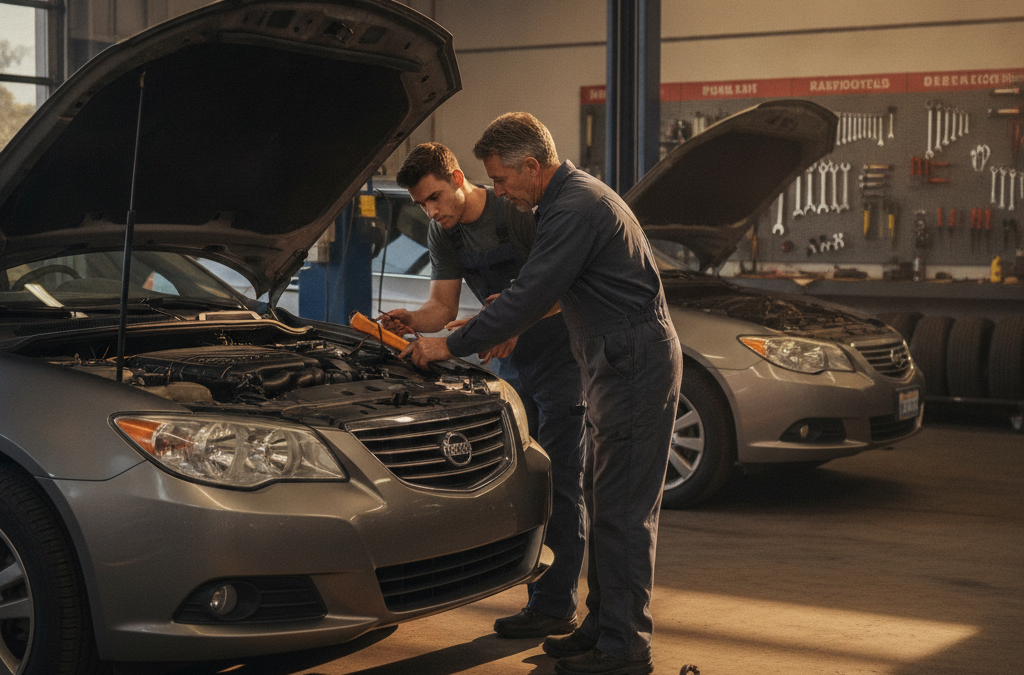
That’s why we never just replace parts at random. When you bring your vehicle into our diagnostic service, we test the full starting circuit — battery, cables, solenoid, starter draw, and ignition inputs — before recommending any repair. That approach saves you money and gets it fixed right the first time.
Why This Problem Is Common in Sonoma County
Windsor drivers, and really anyone in Sonoma County, deal with conditions that can accelerate starter and ignition wear in ways that aren’t always obvious.
Our winters are cool and damp, and our summers are hot and dry. Those temperature swings are hard on electrical components. Heat is especially tough on starter motors — the heat soak after shutting off a hot engine is one of the most common times a marginal starter will finally give up. If your car starts fine in the morning but doesn’t restart after a short stop at the grocery store on a hot afternoon, heat soak is a likely suspect.
Drivers who make long commutes down Highway 101 toward Rohnert Park, Petaluma, or even into Marin County are also starting their engines more frequently with longer warm-up cycles, which puts more total cycles on the starter over time. If your vehicle is getting up there in mileage — say, 100,000 miles or more — it’s worth having the starting system inspected as part of your routine maintenance, especially before the heat of summer arrives.
We also see a fair number of vehicles come in from Healdsburg, Cloverdale, and the rural areas north of Windsor where drivers are farther from help if they break down. Getting ahead of a starter problem before it leaves you stranded on a remote road is always the smarter play.
Push-Button Start Vehicles: What’s Different?
More and more vehicles these days use a push-button start and a key fob instead of a traditional ignition key. The starting system still uses a starter motor, but the ignition system is more complex — involving a transponder, a body control module, and sometimes multiple layers of communication before the starter ever engages.
If your push-button start vehicle won’t respond, don’t panic. First, make sure your key fob battery isn’t dead. Most push-button vehicles have a backup way to start using the fob itself held near the start button. Check your owner’s manual for that procedure. If the fob is fine and the car still won’t start, it’s time to get it diagnosed. Issues with the RFID transponder, smart key module, or the ignition control circuit all require proper diagnostic tools — not a guess.
What Does Starter Replacement Usually Involve?
On most vehicles, starter replacement is a straightforward job — typically a few hours of labor depending on how accessible the starter is on your particular engine. Some vehicles, like certain V6 or V8 trucks and SUVs common in Sonoma County, have starters tucked in tight spots that require more disassembly to reach. We’ll always give you an honest estimate upfront so you know what to expect before work begins.
We service starters and ignition systems on all makes and models — from Toyotas and Hondas to Ford trucks, Chevy SUVs, Subarus, Nissans, and everything in between. If your vehicle is older or harder to find parts for, we’ll tell you that too.
Frequently Asked Questions: Starter and Ignition Problems in Sonoma County
How do I know if it’s my starter or my battery?
The quickest way is to have both tested. A battery test takes about two minutes and tells us the state of charge and health of the battery. If the battery is good but the starter is drawing too much current or not responding correctly, that points to the starter. Don’t assume one or the other — test both.
Can I jump-start a car with a bad starter?
No. Jumping a car adds power to a weak battery, which can help if the battery is the problem. But if the starter motor itself is failed or seized, more power won’t help it spin. If jump-starting does nothing, the starter is likely the problem.
How long does a starter motor last?
Most starters are designed to last 100,000 to 150,000 miles or more, but heat, moisture, and driving habits all affect longevity. Vehicles that do a lot of short-trip driving — many starts per day — may wear starters out faster than highway-driven vehicles.
Is it safe to keep driving with ignition switch problems?
It depends. If the ignition switch is failing intermittently, you risk being stranded without warning. Some ignition switch failures can also affect other electrical systems — including the ability to cut power in an emergency. We’d recommend getting it looked at promptly rather than waiting.
Do you service both older vehicles and newer push-button start vehicles?
Yes. We work on vehicles from the 1990s through current model years, including modern vehicles with smart key systems, push-button start, and advanced ignition controls. If it’s not starting, we can figure out why.
Don’t Get Stranded — Get It Checked First
A starter or ignition problem rarely announces itself at a convenient time. The good news is that if you’re catching the warning signs early — slow cranking, intermittent starts, that grinding noise — you have time to get it diagnosed and fixed before you’re stuck somewhere inconvenient.
Whether you’re in Windsor, Healdsburg, Rohnert Park, or anywhere else in Sonoma County, the team at On-Site Auto Repair is ready to help. We’ll test your starting and ignition system honestly, explain exactly what we find, and give you a straight answer about what it needs — no upselling, no guessing. We treat your vehicle the same way we’d want ours treated.
Reach out today to schedule a diagnosis or ask a question. You can find us at our contact page — or just give us a call at (707) 326-8655. We’re here to help you stay on the road.