
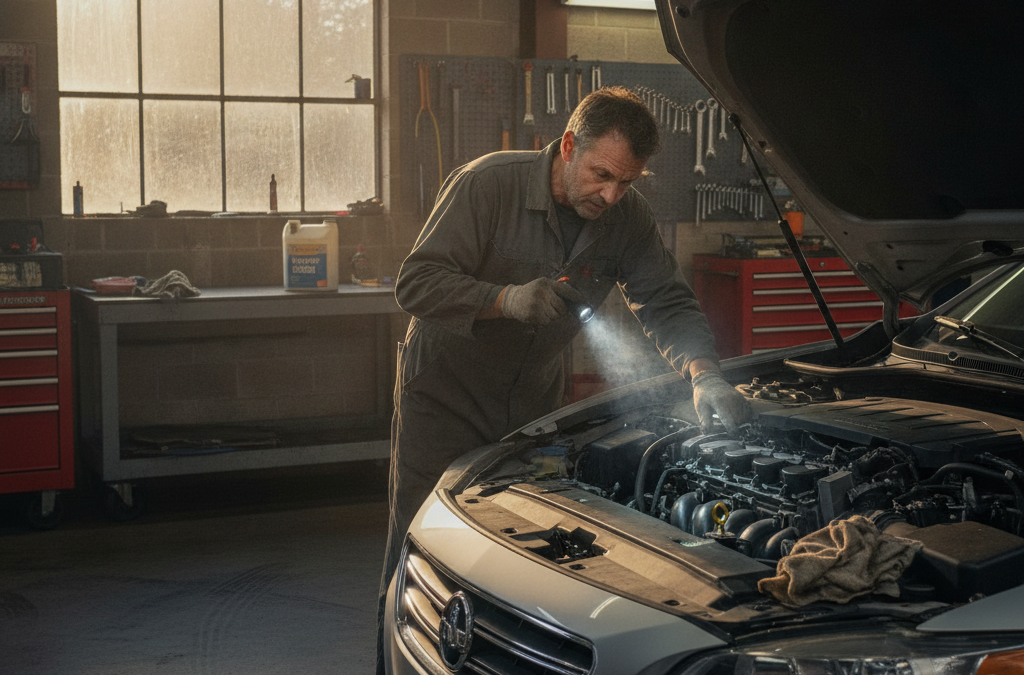
Why Is My Car’s Head Gasket Failing in Petaluma? What Sonoma County Drivers Need to Know About Head Gasket Problems
If your temperature gauge has been creeping up, you’re noticing a sweet smell from under the hood, or your oil looks more like a chocolate milkshake than a dark fluid — your head gasket might be trying to tell you something. For drivers in Petaluma and throughout Sonoma County, a failing head gasket is one of those problems you really don’t want to ignore. Catch it early and you’re looking at a repair. Ignore it long enough and you could be shopping for a new engine — or a new car.
At On-Site Auto Repair, we’ve been diagnosing and repairing head gasket problems on all makes and models since 2011. Here’s what you need to know, without the runaround.
What Does a Head Gasket Actually Do?
Your engine has two main sections: the engine block on the bottom, which houses the pistons and cylinders, and the cylinder head on top, which manages the valves, combustion chambers, and coolant passages. The head gasket sits between these two pieces and seals everything together — keeping combustion gases in, oil in, and coolant in, all in their proper channels.
When that seal fails, things start mixing that shouldn’t mix. Coolant can enter the combustion chamber. Exhaust gases can enter the cooling system. Oil and coolant can contaminate each other. Any one of these scenarios puts your engine under serious stress.
Warning Signs of a Failing Head Gasket
The tricky part about head gasket problems is that the early symptoms can look like other, less severe issues. Here’s what to watch for:
- White or sweet-smelling exhaust smoke: If you’re seeing thick white smoke coming from your tailpipe — especially after the engine warms up — that’s often a sign that coolant is burning in the combustion chamber. It has a distinct sweet smell that’s hard to miss.
- Mysterious coolant loss: If you keep having to top off your coolant but you don’t see any puddles under the car, the coolant may be burning off internally through a head gasket leak.
- Milky or foamy oil: Pull your oil dipstick. If the oil looks creamy, tan, or frothy instead of dark brown or black, coolant has gotten into the oil. This is a serious red flag and you should not drive the vehicle until it’s inspected.
- Engine overheating: A head gasket leak can cause the cooling system to lose pressure and efficiency, leading to overheating — sometimes rapidly, sometimes gradually.
- Bubbling in the coolant reservoir: This can indicate exhaust gases pushing into the cooling system, which is a classic sign of a blown head gasket.
- Loss of power or rough running: A leak between cylinders can drop compression and cause misfires or sluggish acceleration.
None of these symptoms should be ignored, and a few of them — particularly milky oil or severe overheating — mean you should stop driving the vehicle immediately and get it inspected. A proper diagnostic can confirm whether you’re dealing with a head gasket failure or something else entirely before any work is done.
Why Sonoma County Drivers Are Particularly at Risk
Head gaskets fail for a reason, and the conditions here in Sonoma County create a few that are worth knowing about.
Our summers get hot and dry — consistently pushing into the 90s and beyond inland. If your cooling system isn’t in top shape, the extra heat load can push an engine closer to overheating, which is one of the fastest ways to damage a head gasket. Heat cycles — repeated warming up and cooling down — also stress the gasket material over time, especially in older vehicles.
Drivers who make the daily Highway 101 commute from Petaluma or Rohnert Park into Marin County or the Bay Area put a lot of heat and load on their engines. Stop-and-go traffic on a hot afternoon is tough on any cooling system. And if you’ve got a slow coolant leak you haven’t noticed yet, those commutes can accelerate the damage significantly.
Subaru Owners in Sonoma County: Pay Attention to This Section
If you drive a Subaru — especially a 2000s-era Outback, Legacy, Forester, or Impreza with the 2.5L naturally aspirated engine — head gasket problems are something you need to know about specifically. These engines have a well-documented history of head gasket failure, often presenting as an external coolant leak rather than the classic internal failure. It can be subtle: a slight seep around the gasket, a slow drop in coolant level, maybe a faint smell near the engine.
The good news is that if caught early — before overheating occurs — the repair on these Subarus is much more manageable than if you wait until the engine takes serious heat damage. We’ve worked on plenty of them here in Sonoma County, and an early catch makes all the difference. Subaru owners can learn more about our specific experience with these vehicles here.
Subaru isn’t alone — older Toyota V6 engines, some Honda four-cylinders, and certain GM vehicles have their own head gasket tendencies. The age of the vehicle, prior overheating history, and maintenance record all play into the risk level.
What the Repair Actually Involves (And What It Costs)
We won’t sugarcoat it: a head gasket repair is labor-intensive. The cylinder head has to come off, which means removing a significant amount of the engine’s top end first. Once the head is off, it needs to be inspected for warping or cracks — if it’s warped, it has to be resurfaced or replaced before a new gasket goes on. Then everything gets reassembled with new seals, gaskets, and fluids.
The total cost depends heavily on the vehicle. A Subaru 2.5L job is different from a Honda Accord four-cylinder or a Ford truck V8. Labor hours are the biggest driver of cost. Without knowing your specific vehicle, we’re not going to throw out a number — but we will give you a straight, honest estimate before any work begins. No upselling, no surprise charges.
What we will say is this: a head gasket repair done correctly, early, almost always costs significantly less than the alternative — which is engine replacement after overheating damage sets in. If you’re seeing any of the warning signs above, the sooner you get it looked at, the better your options.
Can You Drive a Car With a Blown Head Gasket?
Technically, some vehicles with minor head gasket leaks will run for a while before things get catastrophic. But we’d strongly advise against pushing it. Here’s why: a head gasket leak can go from “manageable” to “engine destroyed” faster than most people expect, especially if the cooling system loses enough pressure to cause a sudden overheat. The risk isn’t worth it, particularly if you’re making long commutes between Sebastopol, Santa Rosa, or Petaluma and the Bay Area.
If you’re seeing any of the warning signs listed above, the safest move is to stop driving and get a diagnosis. If the vehicle is still running and you need to get it somewhere, keep a close eye on the temperature gauge and do not let it overheat.
How Head Gasket Failure Gets Diagnosed
A good shop doesn’t just assume it’s the head gasket because you’ve got white smoke. There are other causes of some of these symptoms, and a proper diagnosis rules those out first. The most reliable tests include a combustion gas test on the cooling system (using a chemical block tester that changes color if exhaust gases are present), a cooling system pressure test to check for leaks, compression testing across all cylinders, and inspection of the oil and coolant for cross-contamination.
These tests together give a clear picture of what’s actually going on before any disassembly happens. Our complete repair services always start with an honest diagnosis — we tell you what we found and what your options are, and you decide how to proceed.
Frequently Asked Questions: Head Gaskets in Sonoma County
How do I know if it’s the head gasket or just a regular coolant leak?
External coolant leaks — from a hose, the radiator, or a water pump — usually leave a puddle under the car. Head gasket failures often don’t. If your coolant is disappearing without visible leakage, or you’re seeing white exhaust smoke and milky oil, the head gasket is high on the suspect list. A pressure test and block test can confirm it.
Is a head gasket repair worth it on a high-mileage vehicle?
It depends on the overall condition of the vehicle. If the car is otherwise solid — good transmission, no major rust, brakes and suspension in decent shape — repairing the head gasket often makes financial sense compared to a car payment. We’re happy to give you an honest assessment of whether the repair makes sense for your specific vehicle.
Can a head gasket sealer fix the problem?
Bottled head gasket sealers are sold at every auto parts store. For very minor seeps in some specific situations, they can buy a little time — but they are not a permanent repair and can sometimes cause additional problems by clogging coolant passages or heater cores. We don’t recommend them as a solution.
How long does a head gasket repair take?
Most head gasket jobs take between one and three days depending on the vehicle, whether the cylinder head needs to be resurfaced or replaced, and parts availability. We’ll give you a realistic timeline upfront.
Do you work on all makes and models for head gasket repairs?
Yes — Toyota, Honda, Subaru, Ford, Chevrolet, Nissan, Kia, Hyundai, Volkswagen, Mazda, and more. If you’re not sure whether we service your vehicle, just call or reach out through our contact page and we’ll let you know.
Get a Straight Answer Before It Gets Worse
Head gasket problems don’t fix themselves, and waiting usually just raises the repair bill. If you’re in Petaluma, Rohnert Park, Sebastopol, or anywhere in Sonoma County and you’re seeing the warning signs — white smoke, coolant loss, milky oil, an engine that keeps running warm — bring it in or give us a call. We’ll diagnose it honestly, explain exactly what we found, and give you a clear estimate with no pressure.
Reach out to On-Site Auto Repair through our contact page to schedule an inspection or ask us any questions. We’ve been taking care of Sonoma County drivers since 2011, and we’ll give you the same straight talk we’d want if it were our own car.